 A modern Digital Twin architecture typically combines IoT sensors, telemetry pipelines, edge gateways, cloud platforms, real-time analytics engines, AI/ML models, and visualization layers. The core challenge is not just collecting operational data, but building a scalable and resilient system capable of processing, synchronizing, and analyzing data across distributed industrial environments in real time.
In practice, successful Digital Twin adoption depends on more than advanced analytics alone. It requires reliable telemetry pipelines, accurate sensor calibration, integration readiness, and strong operational alignment across engineering and business teams. As enabling technologies continue to mature, Digital Twins are evolving from static monitoring tools into intelligent operational systems capable of predicting failures, optimizing performance, and supporting automated real-time decision-making.
As Digital Twin ecosystems mature, organizations adopting these technologies early are expected to gain operational advantages through improved predictive maintenance, better asset utilization, reduced energy waste, and more data-driven operational planning.
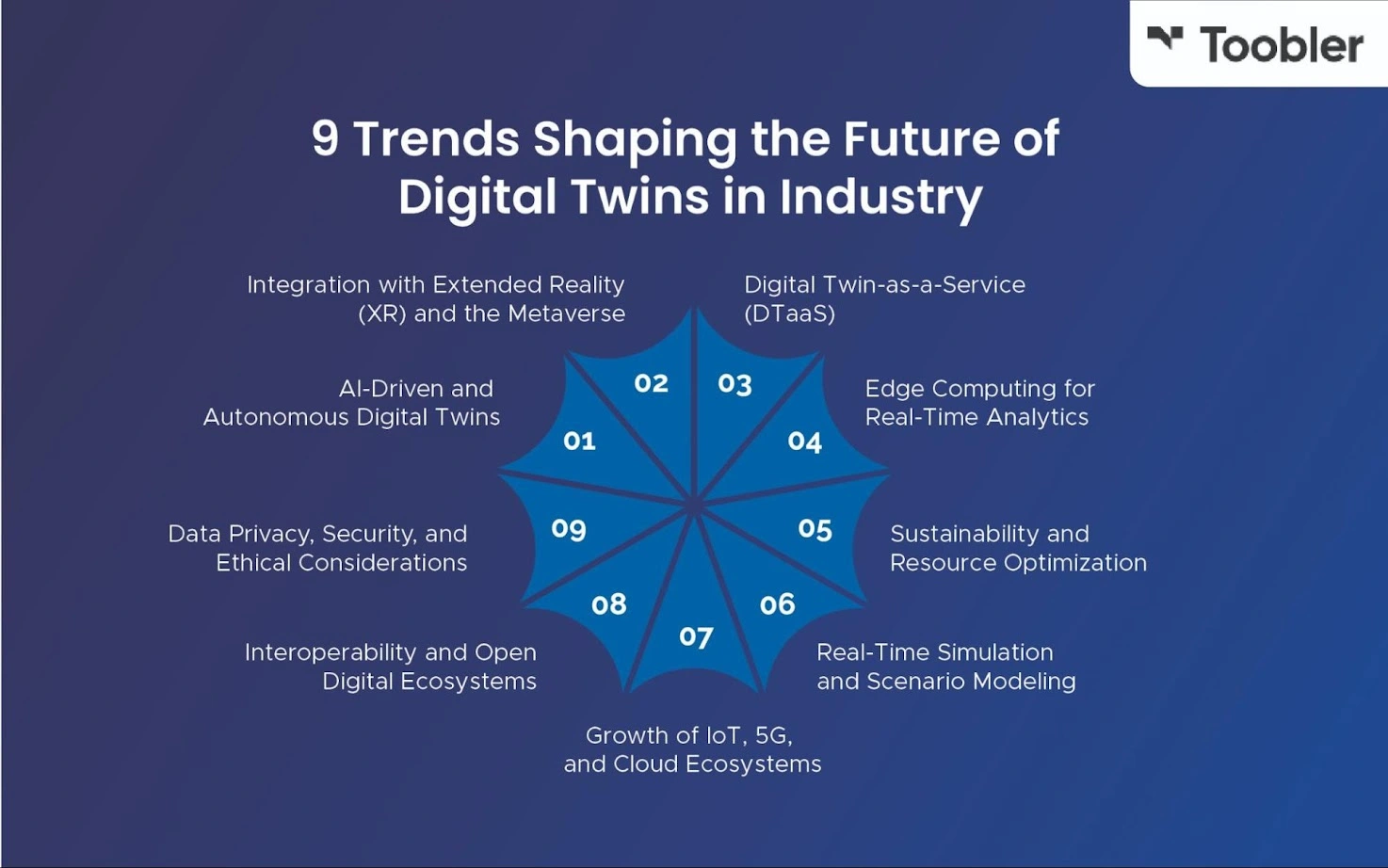
1. AI-Driven and Autonomous Digital Twins
Digital Twins are evolving from basic monitoring systems into intelligent operational platforms powered by AI and Generative AI. Rather than simply displaying equipment status, modern businesses leverage Digital Twins to provide real-time telemetry analysis that enables teams to:
This shift is helping organizations move beyond reactive maintenance toward more predictive and data-driven operations. AI-powered Digital Twins can simulate operational scenarios before deployment, recommend corrective actions based on live system behavior, and deliver faster insights for engineering and maintenance teams.
These capabilities are becoming increasingly valuable across industries such as manufacturing, energy, logistics, infrastructure, and smart facilities where operational efficiency and rapid decision-making are critical.
At the same time, Digital Twins are becoming more autonomous and self-updating. Modern systems are increasingly designed to stay synchronized with connected assets automatically, detect anomalies independently, and continuously improve their models using live operational data.
As AI, simulation engines, and real-time telemetry platforms continue to advance, organizations are exploring Digital Twin systems capable of automatically simulating process adjustments, improving operational reliability, and reducing manual intervention across complex industrial environments.
2. Integration with Extended Reality (XR) and the Metaverse
Digital Twins are increasingly being integrated with technologies such as Augmented Reality (AR), Virtual Reality (VR), Mixed Reality (MR), and spatial computing platforms to create more immersive and interactive industrial environments. Instead of viewing operational data only through traditional dashboards, teams can interact with systems in real time using 3D visual and spatial experiences.
For example, a maintenance engineer using AR glasses can view live operational data such as thermal gradients, vibration patterns, pressure levels, and flow conditions directly overlaid onto a multi-stage centrifugal pump during peak load conditions. This provides faster troubleshooting, improved situational awareness, and more effective remote expert support without relying entirely on manual inspection.
In industrial environments, these technologies are making complex systems easier to visualize, monitor, and manage. They also support virtual testing environments, remote maintenance operations, workforce training, and real-time collaboration between distributed teams. By improving contextual awareness and operational visibility, these capabilities are becoming increasingly relevant across manufacturing, smart infrastructure, energy systems, and remote industrial operations where faster decision-making is critical.
As XR technologies continue to mature, Digital Twins are expected to support more immersive engineering workflows, enabling teams to visualize live operational data, perform remote diagnostics, and improve collaboration across distributed industrial environments.
3. Digital Twin-as-a-Service (DTaaS)
Cloud-based Digital Twin-as-a-Service (DTaaS) models are making Digital Twin technology more accessible for organizations that may not have the resources or infrastructure to build large-scale systems from scratch. Instead of investing heavily in on-premise infrastructure, businesses can adopt subscription-based cloud platforms that provide Digital Twin capabilities with faster deployment and lower upfront costs.
This approach allows organizations to manage and monitor assets more centrally while benefiting from automatic software updates, scalable cloud infrastructure, and easier expansion across multiple operational sites.
For many businesses, especially small and medium-sized enterprises, DTaaS reduces the complexity traditionally associated with Digital Twin adoption and provides a more practical way to launch pilot programs, validate operational value, and scale implementations incrementally as operational requirements evolve.
4. Edge Computing for Real-Time Analytics
In industrial environments such as robotics, autonomous systems, energy infrastructure, and high-speed manufacturing lines, even small delays in data processing can affect operational performance. Relying entirely on cloud processing is not always practical because transmitting large volumes of telemetry data can introduce latency during critical operations.
This is why the role of IoT in industrial automation and edge-layer processing is becoming increasingly central to modern Digital Twin deployments.
Edge Computing addresses this challenge by processing sensor and operational data closer to the physical equipment before selectively synchronizing with centralized cloud platforms. This allows Digital Twin systems to respond more quickly to changing conditions and maintain operational continuity, even during network interruptions.
For example, in a high-speed manufacturing environment, edge devices can analyze vibration, temperature, or machine behavior locally and trigger alerts immediately without waiting for cloud communication. When combined with Digital Twins, edge-enabled architectures improve response speed, reduce cloud dependency, and support more resilient industrial operations across distributed environments.
5. Sustainability and Resource Optimization
Sustainability is becoming an increasingly important part of industrial operations, and Digital Twins are helping organizations approach it in a more practical and data-driven way. Instead of relying only on periodic reports or manual analysis, businesses can continuously monitor how equipment, energy, and resources are being used across day-to-day operations.
In many industrial environments, even small inefficiencies can lead to significant energy waste over time. Digital Twins help teams identify issues such as machines consuming excessive power during idle periods, inefficient fuel usage, or operational patterns that increase overall energy consumption. With better real-time visibility, organizations can make targeted improvements that reduce both operational costs and environmental impact.
As industries continue to focus on sustainability goals and regulatory compliance, Digital Twins are expected to play a larger role in helping organizations improve efficiency, reduce emissions, and build more resource-conscious operations without compromising performance.
This makes Digital Twins valuable for organizations pursuing long-term environmental and operational goals.
6. Real-Time Simulation and Scenario Modeling
One of the most valuable capabilities of Digital Twins is the ability to simulate operational scenarios before applying changes in the real environment. Instead of relying solely on assumptions or trial-and-error approaches, organizations can evaluate system behavior, test operational strategies, and identify risks in advance.
Leading Digital Twin solutions for manufacturing are increasingly built around this simulation-first approach to reduce operational risk.
For example, a manufacturing facility can simulate production line adjustments and analyze how those changes may affect throughput, equipment utilization, maintenance requirements, or energy consumption before implementation. This helps teams make more informed decisions while reducing operational risks, implementation costs, and unplanned downtime.
As Digital Twin platforms continue to evolve, simulation-driven planning is becoming an increasingly important tool for operational optimization, process validation, and long-term engineering decision-making.
7. Growth of IoT, 5G, and Cloud Ecosystems
The rapid growth of IoT, 5G, cloud computing, and AI technologies is accelerating Digital Twin adoption across industrial environments. Modern Digital Twins depend on continuous telemetry streams from sensors, machines, and connected systems, making real-time data integration and scalable data infrastructure increasingly important.
Low-latency 5G connectivity helps synchronize physical assets with their digital counterparts more efficiently, particularly in environments such as smart manufacturing, robotics, autonomous systems, and remote operations where fast system response is critical.
Cloud platforms complement this ecosystem by enabling centralized telemetry management, large-scale data processing, historical analysis, and AI/ML model training across distributed facilities.
Together, IoT connectivity, cloud infrastructure, and intelligent analytics are enabling Digital Twins to become more scalable, more connected, and better equipped to support predictive, data-driven industrial operations.
8. Interoperability and Open Digital Ecosystems
As Digital Twin adoption grows, organizations are prioritizing interoperable and vendor-neutral architectures that integrate smoothly with existing industrial systems. Most industrial environments already rely on a mix of legacy equipment, PLCs, SCADA systems, IoT devices, ERP platforms, and cloud services from multiple vendors. A scalable Digital Twin ecosystem therefore depends on reliable data exchange without requiring major infrastructure replacement.
Technologies and standards such as OPC UA, MQTT, Asset Administration Shell (AAS), and NGSI-LD are becoming increasingly important because they standardize communication across operational and software environments. These frameworks improve telemetry exchange, system integration, and operational visibility across distributed industrial operations.
In practice, interoperability remains one of the biggest challenges in Digital Twin implementation. Organizations often need to synchronize telemetry across industrial controllers, edge gateways, cloud analytics platforms, and enterprise systems while maintaining data consistency and reliability.
Strong interoperability also reduces vendor lock-in and simplifies long-term scaling. As industrial operations become more connected, open and standards-based architectures will play a critical role in building flexible, scalable, and future-ready Digital Twin ecosystems.
9. Data Privacy, Security, and Ethical Considerations
As Digital Twins process increasing volumes of real-time industrial and operational data, concerns about cybersecurity, privacy, and ethical AI use are becoming increasingly important. Modern Digital Twin platforms often connect IoT devices, industrial systems, edge infrastructure, and cloud platforms, making secure data management essential.
In industrial environments, a compromised Digital Twin system could expose sensitive operational data, disrupt workflows, or impact connected infrastructure. Industries such as healthcare, manufacturing, and smart infrastructure must also comply with growing data privacy and governance requirements.
To reduce security risks, organizations are increasingly adopting encryption, secure telemetry pipelines, role-based access control, data anonymization, and zero-trust security architectures. At the same time, businesses are placing greater focus on transparency around AI-driven insights and automated operational decisions.
As Digital Twin adoption grows, strong security, privacy, and ethical governance will become critical for building scalable and trusted industrial systems.

 Industrial organizations generate more operational data than ever before. Sensors, machines, control systems, and connected assets continuously produce information that can reveal how equipment is performing and when failures are likely to occur. Yet many businesses still struggle to turn that data into actionable insights.