TL;DR: Warehouse operations face issues such as inventory inaccuracies, inefficient workflows, labor shortages, inventory mismatches, delayed picking, poor space utilization, equipment downtime, and congestion in busy zones, which can be addressed with digital twin technology to improve insights and optimize operations. Digital twin technology offers a revolutionary solution, providing real-time insights, predictive analytics, and enhanced automation to optimize performance. In this blog, we explore how digital twins are transforming warehouse management and improving operational efficiency in 2026.
Digital Twin
How Digital Twins Are Revolutionizing Warehouse Operations in 2026
Bobin GeorgeMay 19, 2026
On This Page
The warehouse industry faces many global challenges, including labor shortages and inefficient use of inventory. The other biggest challenge in warehouse operations is visibility. Managers often receive data from different systems, but that data is not always connected in a way that gives a full picture of what is happening on the floor.
For example, stock may appear available in the system while the real shelf location is incorrect, or a packing delay may actually be caused by a problem that started earlier in picking or replenishment.
During peak seasons, these problems become even more serious because warehouses must process more orders with less room for error. This is exactly why warehouse digital twin technology is gaining attention. It helps warehouse teams understand problems more clearly and respond with better planning and faster decisions.
Additionally, the continually increasing need for faster delivery times makes it imperative for warehouses to change how they operate. Warehouse digital twins are the solution that will take the warehouse industry to the next level.
In this blog post, let’s examine the tremendous power of digital twins for warehouses and see what this emerging trend has to offer in 2026.
What is a Warehouse Digital Twin?
A warehouse digital twin is a virtual representation of a physical warehouse that uses real-time data to monitor and optimize operations. By integrating IoT sensors, AI, and predictive analytics, digital twins simulate warehouse activities and workflows, enabling managers to visualize, test, and refine their operations without disrupting the physical space.
Key Components of a Warehouse Digital Twin
IoT Sensors: Collect real-time data on inventory levels, equipment status, and environmental conditions.
Artificial Intelligence (AI): Analyzes data to predict potential disruptions, optimize workflows, and make smarter decisions.
Predictive Analytics: Forecasts demand fluctuations, maintenance needs, and performance bottlenecks to ensure smooth operations.
Why Warehouse Digital Twins Are a Game-Changer
Warehouse digital twins are often described as game-changers because they enable businesses to shift from reactive management to proactive decision-making. In a traditional setup, many decisions are made only after problems arise, such as delayed shipments, stock discrepancies, or equipment breakdowns.
A digital twin changes that by giving teams a near-real-time view of the warehouse and allowing them to test decisions before making physical changes on the floor.
This creates value in several ways. It helps improve picking speed, reduce congestion, lower downtime, and use space more efficiently. It also supports better planning by allowing managers to simulate different scenarios without disrupting actual operations.
For instance, they can check whether moving fast-selling items closer to the packing area will reduce travel time, or whether a layout change will improve flow during peak demand. In simple terms, a digital twin makes warehouse operations more visible, more predictable, and easier to optimize.
Digital twins application enable warehouses to go beyond traditional monitoring. By creating a virtual environment that mimics physical operations, managers can make data-driven decisions, simulate various scenarios, and automate processes, leading to more efficient and cost-effective operations.
Types of Digital Twins in the Warehouse Industry
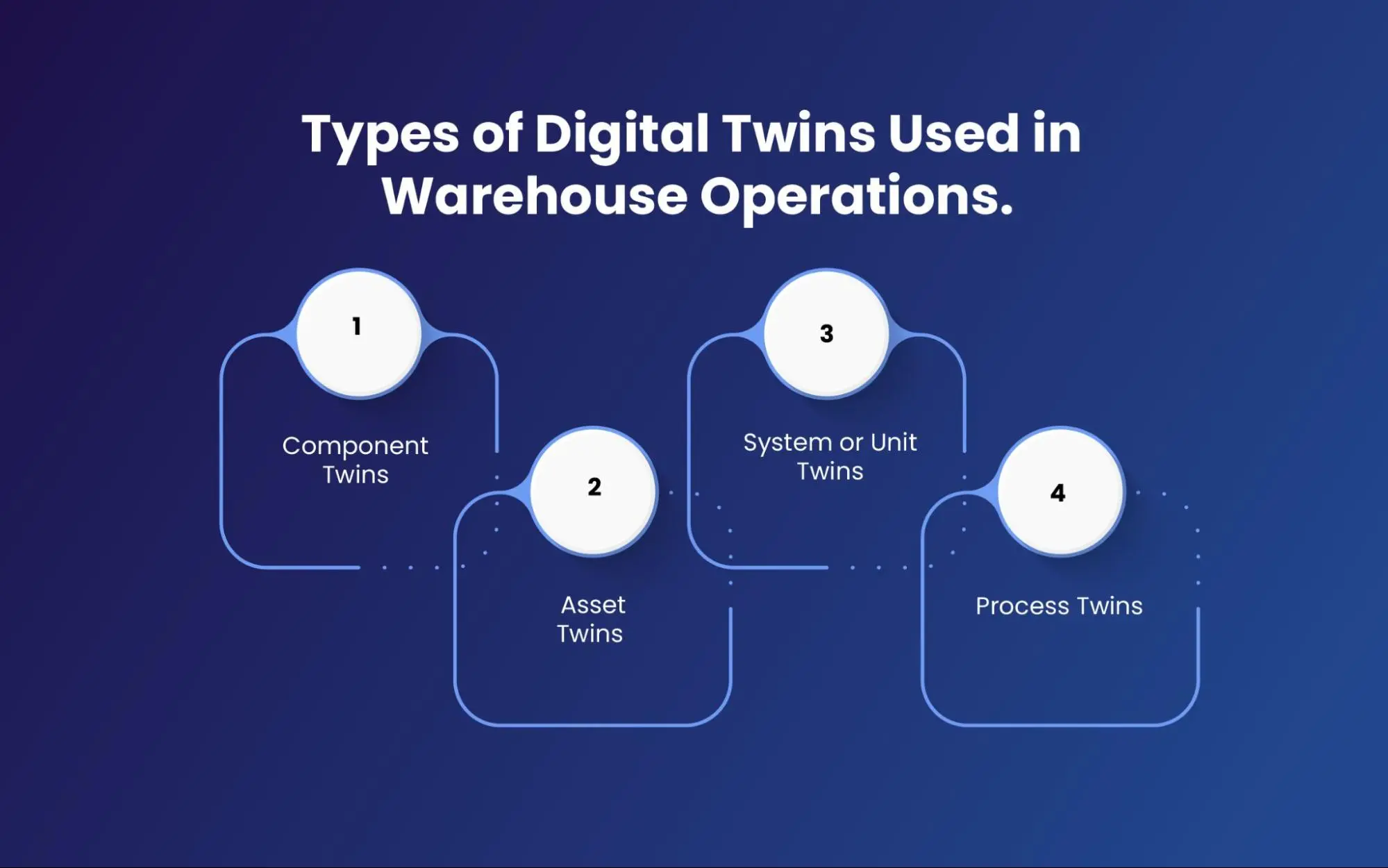 Warehouse digital twin technology can be implemented in various ways depending on the needs of the warehouse under consideration. Each type of digital twin targets a different function within warehouse operations, thereby providing solutions ranging from equipment monitoring to process simulation. Below are the primary types of digital twins that are applied in a warehousing context:
Component Twins
Component Twins: These replicate individual parts or machines in a system. Digital Twins are used to monitor the performance of specific components to ensure they operate at their best.
Component twins are very helpful for keeping tabs on essential equipment in the warehouse, for example:
Conveyors: Monitor belt speed, tension, motor load, vibration, bearing temperature, and wear signs (such as roller alignment or belt stretch). The twin detects when a section is losing efficiency or when energy use increases due to misalignment or material buildup.
Forklift Trucks: Monitor battery health (SoH), charge cycles, motor temperature, hydraulic pressure, load weight, travel patterns, and operator usage. This helps balance workload across the fleet and prevents early battery failure.
Automated Guided Vehicles (AGVs) / Autonomous Mobile Robots (AMRs): Replicate route efficiency, battery drain rates, payload balancing, obstacle detection performance, wheel wear, and navigation accuracy. The twin supports dynamic rerouting simulations and identifies when an AGV is consistently taking suboptimal paths due to sensor drift or floor conditions.
Asset Twins
Asset twins are virtual replicas of all assets in a facility that allow you to simulate and visualize how your machines and equipment operate within a warehouse. An asset twin emphasizes the interconnectivity among all the assets that make up the facility's infrastructure, rather than treating each individual machine's operations as a separate entity.
The following examples will make clear what an asset twin looks like:
Automated Picking Systems (APS): Observe how robots, conveyor belts, and picking systems are used to accomplish a task.
Sorting Machines: Understand how sorting machines, conveyor belts, and storage areas work together to categorize products.
Storage Systems: Model how different shelving units interact with Automated Picking Systems to facilitate efficient product pick up.
Benefits:
Workflow Optimization: Helps improve the overall flow of goods by identifying slow areas and smoothing operations across the entire system.
Predicting Bottlenecks: Spots potential bottlenecks before they happen so you can take action early and keep operations running smoothly.
Better Resource Allocation: Shows exactly where to assign robots, forklifts, or workers for maximum efficiency.
Scalability: Makes it easier to test and plan for future growth, such as adding more machines or expanding the warehouse layout.
Real-World Example: In a large distribution center, asset twins could simulate the flow of products from automated picking systems to sorting machines and ultimately to packaging stations, ensuring that the digital twins in the mining process work efficiently without overloading any part of the system.
System or Unit Twins
A system twin is a digital replica of an entire system or unit, created by integrating its parts and enabling them to function as a whole. A system twin's purpose is to develop a picture of how many assets and components work within a larger warehouse network. System twins allow you to simulate the different steps of the overall workflow from start to finish.
Receiving and Storage: A system twin allows you to simulate all aspects of the incoming goods process, from the distribution centres to the shelf or bin level, including factors such as product usage rate, available space, and warehouse layouts.
Order Fulfillment: Modeling: simulating the entire picking, packing, and shipping process. This includes optimizing picking routes to ensure orders arrive at their destination as quickly as possible.
Shipping and Distribution: A system twin simulates the flow of products from finished packaging through outbound shipping, integrating packaging machines, sorting stations, and national freight (transport) logistics & into the simulation.
Benefits:
Holistic Optimization: Improves the performance of the entire warehouse system, not just individual machines.
Layout Improvements: Helps test and redesign warehouse layouts for better flow and space utilization.
Real-Time Adaptation: Allows quick adjustments when conditions change, such as sudden order spikes or equipment issues.
Scenario Testing: Lets you safely test “what-if” situations (like adding new machines or changing shifts) before making changes in the real warehouse.
Let's you safely test “what-if” situations (like adding new machines or changing shifts) before making changes in the real warehouse.
Real-World Example: A system twin might be used by a fulfillment center to model how products move from receiving to storage, then through the picking and packing processes, and finally to shipping, optimizing every step along the way. This helps improve overall throughput and ensures smooth operations.
Process Twins
Using process twins, organizations can leverage a unified digital twin of all asset types (component, asset, system) to create an end-to-end simulation of their entire warehouse operation(s). Process twins create the most extensive simulation of warehouse operations by representing all warehouse functions.
As the definition states above, process twins are ideal for simulating all elements of a warehouse's operations, allowing users to model complex workflows that span multiple processes, assets, and departments. Below are some examples of what a process twin can simulate:
Complete Fulfillment Cycle: Simulate the entire order fulfillment process, from receiving inventory to picking, packing, and shipping, integrating all warehouse systems and components.
Supply Chain Integration: Model the interactions between the warehouse and external systems, including suppliers, transport logistics, and customer-facing platforms.
Maintenance and Downtime Scenarios: Simulate how warehouse operations would continue if a key component fails, helping managers plan for possible downtime or disruptions.
Benefits:
End-to-End Optimization
Scenario Testing
Proactive Decision Making
Improved Risk Management
Real-World Example: A process twin could simulate the full order fulfillment process in an e-commerce warehouse. It would include everything from receiving inventory, product storage, picking and packing, shipping, and even forecasting the impact of sudden demand spikes or shipping delays.
Choosing the Right Type of Digital Twin for Your Warehouse
When selecting the right type of digital twin for your warehouse, consider factors such as the complexity of your operations, the scale of your warehouse, and the specific challenges you are facing.
For example:
Smaller warehouses may be enough with component or asset twins that help optimize individual machines or resources.
Larger, more complex warehouses may benefit from system or process twins that provide a complete view of warehouse operations.
It’s also worth exploring vendor options to ensure that you choose the best digital twin solution for your particular needs. Whether you're looking to improve the performance of individual machinery or simulate an entire process, the right type of digital twin can significantly impact your warehouse's efficiency and bottom line.
Before jumping to the digital twin example, take a look at the role of digital twins in supply chain management.
Real-World Examples of Digital Twins in Action
Here are some real-world examples of how digital twins are being used across industries today.
E-commerce and Distribution Centers
Big companies, such as Amazon and Walmart, are using twin technology to improve warehouse efficiency. They use this technology to simulate the amount of stock they have, the machines that do the work, and the routes delivery trucks take.
This helps them make customers happy, get things to people, and handle all the stuff they have in stock. Digital twins and sustainability technology are really helping Amazon and Walmart with their warehouse operations.
Manufacturing and Production Facilities
Companies like General Electric use twins to improve their supply chain. General Electric makes a copy of its production lines on the computer. This way, General Electric can predict when equipment will fail, making it easier to procure materials and minimize downtime. So General Electric can make products and get them to people faster.
Logistics Providers
Logistics companies, including DHL and FedEx, use digital twin warehouses to manage inventory across multiple locations. By having a digital view of their entire logistics network, they can improve stock management, optimize delivery routes, and reduce operational costs.
Suggested Read: Smart Homes (IoT): How Internet of Things helps our lives?
Common Warehouse Challenges Addressed by Digital Twin Technology
Inventory Management
Digital twins in smart cities provide the information we need now, so managers can keep a closer eye on inventory and prevent issues such as running out of stock or overstocking. Digital twins and predictive models help managers adjust inventory levels based on what they expect people to want, enabling them to use their resources more effectively. Digital twins are really helpful for this kind of thing.
Adapting to Demand Fluctuations
By simulating various demand scenarios, digital twins help warehouses adjust to market fluctuations, enabling better decision-making during supply chain disruptions or seasonal demand changes.
Integration with Existing Warehouse Systems
One reason digital twins are practical for warehouses is that they work alongside many of the systems already used in daily operations. Businesses do not need to replace their existing infrastructure to adopt a digital twin. Instead, the digital twin becomes more valuable when it connects with current warehouse technologies and operational platforms.
A warehouse digital twin can integrate with:
Warehouse Management Systems (WMS)
Enterprise Resource Planning (ERP) systems
Transportation Management Systems (TMS)
Barcode scanners
RFID tracking networks
Conveyors and sorting systems
Automated Guided Vehicles (AGVs)
Robotics platforms
Machine controllers and industrial equipment
This integration is important because warehouse operations are usually spread across multiple disconnected systems. The WMS may track inventory locations, the ERP may manage orders and demand forecasts, while automation systems monitor equipment activity and machine performance. A digital twin brings all of this information together into one connected operational view.
For example:
If the WMS confirms that an item has been picked, the digital twin can instantly update the virtual warehouse model.
If incoming orders increase suddenly in the ERP, managers can quickly evaluate whether current labor, storage, and picking capacity are enough to handle demand.
If a conveyor system starts slowing down, the digital twin can visualize how the delay may impact packing operations and outbound shipments.
Future Possibilities of Digital Twins in Warehouse Operations
The future of digital twin warehouse operations goes far beyond basic monitoring and simulation. As warehouses become more connected through automation, IoT devices, and real-time data systems, digital twins are expected to play a much larger role in operational planning and coordination.
Warehouses are unlikely to become fully autonomous overnight, but digital twins may gradually become central to how businesses manage, optimize, and adapt warehouse operations in real time.
In the coming years, digital twins may support:
Better coordination between robots, conveyors, forklifts, and sorting systems
Faster operational decision-making during delays or disruptions
Real-time workload balancing across warehouse zones
Improved supply chain responsiveness during demand spikes
Smarter labor allocation and resource planning
Layout planning is another major future use case. Instead of physically testing warehouse changes, teams can use digital models to evaluate:
Rack and shelving designs
Storage strategies
Picking routes
Material movement flows
Space utilization improvements
The long-term value of digital twins lies beyond operational visibility and digital transformation practices. Their real strength lies in adaptability. A well-connected digital twin can help warehouses become more intelligent, more responsive, and better prepared for both day-to-day operational pressure and large-scale business changes.
How Toobler Enhances Warehouse Operations with Digital Twin Technology
 Toobler is a leader in providing innovative digital twin technology to revolutionize warehouse operations.
With expertise in IoT integration, AI, and predictive analytics, Toobler offers scalable solutions that optimize performance, improve decision-making, and streamline warehouse processes.
By creating digital replicas of physical systems, Toobler enables warehouses to monitor, simulate, and optimize operations in real time, leading to greater efficiency and cost savings.
Toobler's Digital Twin Services
Comprehensive Digital Twin Solutions Toobler enables a warehouse digital twin solution that replicates physical assets and systems, allowing for continuous monitoring and optimization. This enhances the ability to track performance, identify inefficiencies, and predict potential disruptions.
Engineering-Grade Performance & Optimization Toobler seamlessly integrates IoT sensors and AI-driven analytics to monitor warehouse assets in real-time, providing the predictive insights needed to optimize workflows and reduce equipment downtime by up to 40%. These insights are visualized through flexible interfaces, from immersive 3D Unity dashboards to 2D GIS mapping, all supported by a secure, cloud-native architecture with agnostic identity integration across providers.
Scenario Simulation & Forecasting Toobler’s digital twins allow warehouses to simulate different operational scenarios (e.g., demand spikes, layout changes) to test their impact before implementing them physically, minimizing risks and improving decision-making.
Operational Process Improvement Toobler’s predictive analytics help warehouses enhance their workflows, from inventory management to shipping, by forecasting demand and maintenance needs, ensuring smooth operations.
Core Expertise and Services
Strategy & Consultation: Toobler works closely with clients to create tailored digital twin strategies based on specific warehouse needs.
Data Integration: Seamless integration of IoT devices ensures real-time data collection, providing accurate insights for decision-making.
Simulation & Analytics: Advanced AI and predictive analytics help optimize workflows and forecast potential issues.
Scalability: Toobler’s solutions grow with your business, adapting to new technologies and evolving operational requirements.
End-to-End Digital Twin Implementation
From initial design and integration to ongoing support, Toobler offers end-to-end digital twin services, ensuring a smooth transition and long-term optimization of warehouse operations. Their solutions help warehouses achieve greater efficiency, reduce operational costs, and enhance overall performance.

Conclusion
Warehouse operations are being challenged every day by labor shortages, demand fluctuation, and inefficiencies, among other factors. However, digital twin technologies can be used to improve warehouse operations. Many digital twin use cases are proof.
Warehouse digital twin technology provides real-time visibility, predictive analytics, and automated workflows to increase warehouse efficiency, scalability, and cost-efficiency. The advancement of digital twin solutions from companies such as Toobler is revolutionizing warehouse management, enabling intelligent, optimized operations.
Are you interested in changing your warehouse operations using digital twin technology? Learn how Toobler can help you achieve your business goals today!
FAQ
1. Is a digital twin only useful for large warehouses?
No. Large warehouses often see big benefits because their operations are more complex, but digital twins are not limited to large facilities. Even a smaller warehouse can use a digital twin to improve inventory visibility, monitor equipment, reduce delays, and test workflow changes before applying them in the real environment.
2. Can small or mid-sized warehouses also use digital twins?
Yes. Small and mid-sized warehouses can adopt digital twins in a focused way by starting with one area, such as inventory tracking, picking efficiency, or equipment monitoring. They do not need to model the entire warehouse at once. A smaller pilot can still deliver useful insights and measurable improvements.
3. What kind of data is required to build a warehouse digital twin?
A warehouse digital twin usually needs operational data such as inventory levels, stock movement, order flow, equipment status, location data, and workflow performance. This data may come from WMS, ERP, barcode scanners, RFID systems, IoT sensors, conveyors, forklifts, or robotics platforms. The exact data required depends on the business goal and the type of digital twin being built.
4. Can a digital twin work with an existing WMS or ERP system?
Yes. In fact, a digital twin becomes more useful when it connects with existing systems such as WMS and ERP. These systems provide important data about stock, orders, replenishment, and planning. When integrated properly, the digital twin can turn that data into a more complete and real-time operational view.
5. Can digital twins help reduce return handling and reverse logistics issues?
Yes. Digital twins can help warehouses understand where delays, errors, or inefficiencies happen in return handling. They can be used to model inspection, sorting, restocking, repair, and disposal processes so teams can improve flow and reduce turnaround time. This is especially useful in e-commerce environments with high return volumes.
6. How do digital twins help during seasonal demand spikes?
Digital twins help warehouses prepare for demand spikes by simulating different load conditions before peak periods arrive. Teams can test labor plans, inventory placement, picking routes, and shipping workflows to see where pressure points may appear. This makes it easier to handle busy seasons with fewer delays and better resource allocation.
7. How long does it take to implement a digital twin in a warehouse? A basic pilot can be ready in 4–8 weeks. A full-scale digital twin covering multiple processes usually takes 3–6 months, depending on the size of your warehouse, data quality, and integration needs. Starting small helps you see results faster.
8. Do I need advanced automation or robots to use a digital twin? No. You can start with your current equipment by adding affordable sensors and connecting existing systems. Digital twins work with both manual and automated warehouses and become even more powerful when combined with automation later.
9. What is the ROI of using Warehouse Digital Twin Technology?
ROI from digital twin technology is derived from operational efficiency, reduced downtime, and resource optimization. A digital twin in a warehouse reduces operational expenditure and increases profitability for the facility.