Engineering Construction Cost Intelligence and AI Expense Forecasting
A construction cost-management and AI expense-forecasting platform, engineered on the group's own project data

- Client
- Nael
- Planning cycle
- ~30 days shorter
- Material-estimate errors
- ~80% lower
On a construction project, the gap between the budget and the actual cost is where margin is won or lost — and it usually only becomes visible after the money has been spent. Toobler engineered a cost-intelligence platform for Nael that closes that gap: it reconciles cost against value as work proceeds, and forecasts where project expenses are heading using the economic signals that actually move construction costs.
Customer and context
The client is Nael, a construction and contracting group. Like most contractors, Nael ran projects, costs and workforce across systems that didn’t talk to each other, and cost control lagged reality — the numbers that mattered arrived too late to act on. Toobler engineered a web and mobile platform, delivered over several phases, with cost intelligence at its core.
The challenge
Construction cost control is a data and forecasting problem before it is a reporting one:
- Budget versus actual, in arrears. Committed and actual costs are scattered across projects and months, so variance surfaces after it has already happened.
- Cost–value reconciliation (CVR). Reconciling the cost of work done against its certified value — the discipline that tells a contractor whether a project is really making money — is laborious and inconsistent when the data isn’t structured.
- Forecasting under volatile inputs. Construction costs move with interest rates and material prices. A forecast built only on a project’s own history ignores the macro-economic forces that actually drive it.
- No single source of truth. Design, procurement and site-management each kept their own records — spreadsheets and disconnected systems — so costing a project meant reconciling fragmented, duplicated data before anyone could act on it.
The solution
Toobler engineered three connected layers on the group’s own project data.
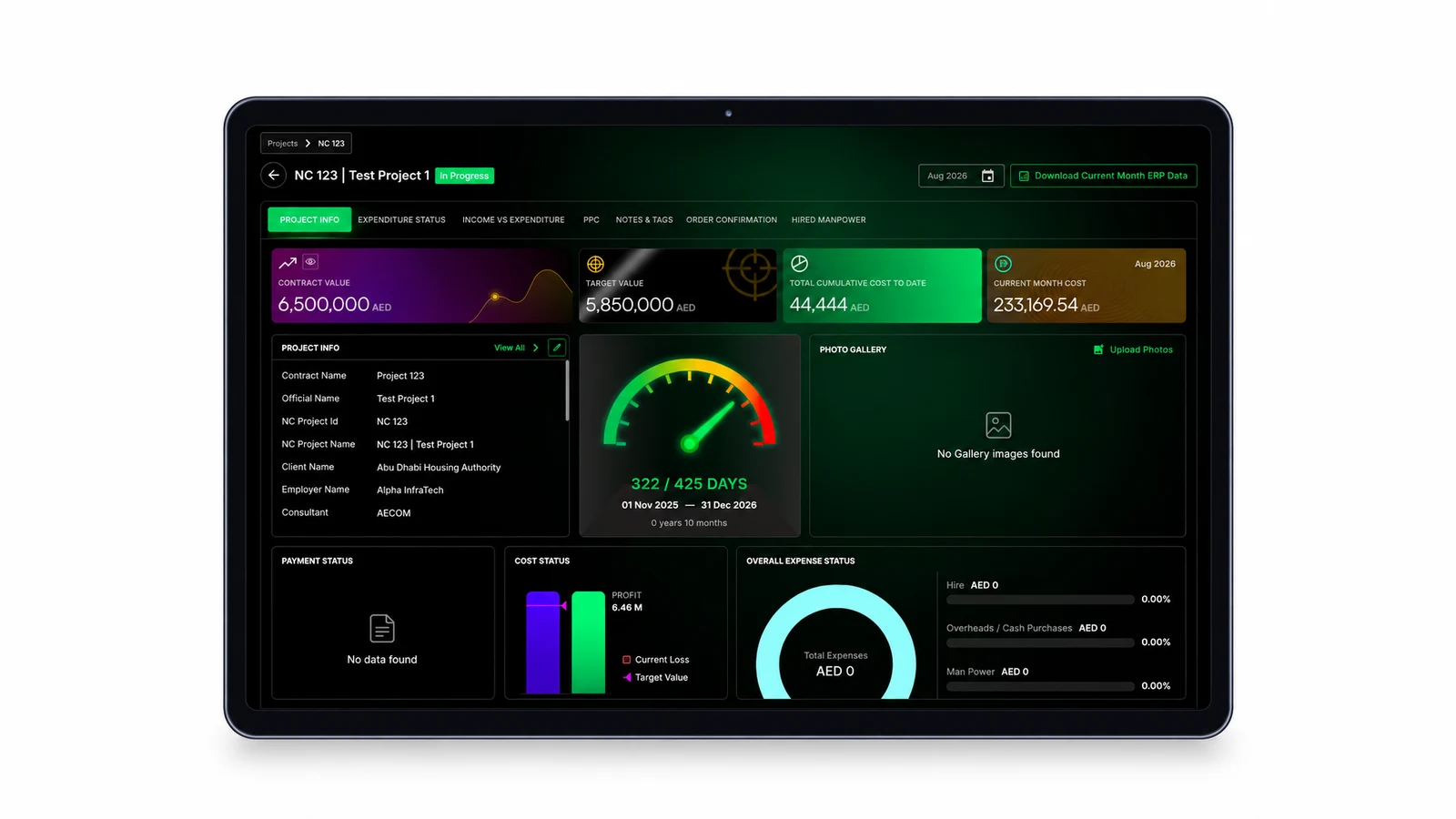
Structured cost management. Monthly project cost and actuals, income versus expenditure, contract values and their variations, payment tracking, and configurable expenditure categories — so cost data is captured consistently across projects rather than rebuilt in spreadsheets each month.
Cost–value reconciliation (CVR). CVR engineered into the platform per project type and its attributes, turning a manual month-end exercise into a repeatable, data-backed one.
AI expense forecasting. A machine-learning layer forecasts project expenses, trained not only on project data but on the macro-economic signals that move construction costs — interbank rates (EIBOR), cement, steel and petroleum prices, and mobilization data — with time-series models surfaced in a project-manager view. Preprocessing, model training and a retrain path were engineered so the forecasts keep improving as data accrues.
Around this core, the platform also covers workforce operations (attendance, leave, appraisal) and a mobile app with site-relevant features such as weather alerts — because cost, schedule and workforce are the same operational picture.
Engineering challenges worth naming
- A consistent cost model across projects — capturing committed, actual and reconciled cost the same way for every project type, so forecasts and CVR are comparable rather than bespoke per site.
- Forecasting from external signals — engineering a data pipeline that brings macro-economic time-series alongside project data, and models that use them without over-fitting to any single project’s history.
- Operational reliability — a production platform with server migration and monitored data flows, engineered to be depended on for month-end commercial decisions.
- One platform, one source of truth — a micro-service architecture that consolidated fragmented departmental data into a single database, with real-time updates across modules and a containerized deployment built to scale.
Results
Consolidating fragmented, in-arrears cost data into a single, current source of truth produced measurable gains: project-planning cycles shortened by roughly 30 days per project, and material-estimate errors cut by around 80%. That is sharper procurement and planning on a production platform that pairs structured cost management and engineered CVR with machine-learning expense forecasting grounded in macro-economic signals.
What this means for construction platforms today
Off-the-shelf construction software rarely fits how a contractor actually operates, and generic project-management tools stop at recording cost rather than forecasting it. Toobler engineers the cost-intelligence layer on a contractor’s own data — reconciliation, forecasting and the integrations that keep them current — as a custom platform, not a product to be bought into. If your organization is trying to see cost variance before it happens or bring forecasting discipline to a construction portfolio, talk to Toobler’s engineering team.
Toobler has been a reliable technology partner for us at Nael Group, consistently delivering solutions which meet our operational and strategic needs. Their team demonstrates strong technical capability, clear communication, and a commitment to quality that aligns with our expectations. We value the professionalism they bring to each engagement, and appreciate the support extended via the strategic partnership shared between our organizations.

Baisil Varughese Oommen
Deputy Managing Director, Nael Group
Related work and capabilities
- Industry
Construction & Facilities
Construction data sits in separate systems — projects, cost, workforce, site — and no product template joins them the way your teams actually work. Toobler engineers platforms that do.
Proof, engineered
Case studies from Toobler — real platforms engineered across event technology, construction and digital twins. The work behind the claims.