Inventory monitoring, engineered from the sensor up

- Client
- Hurst Green Plastics
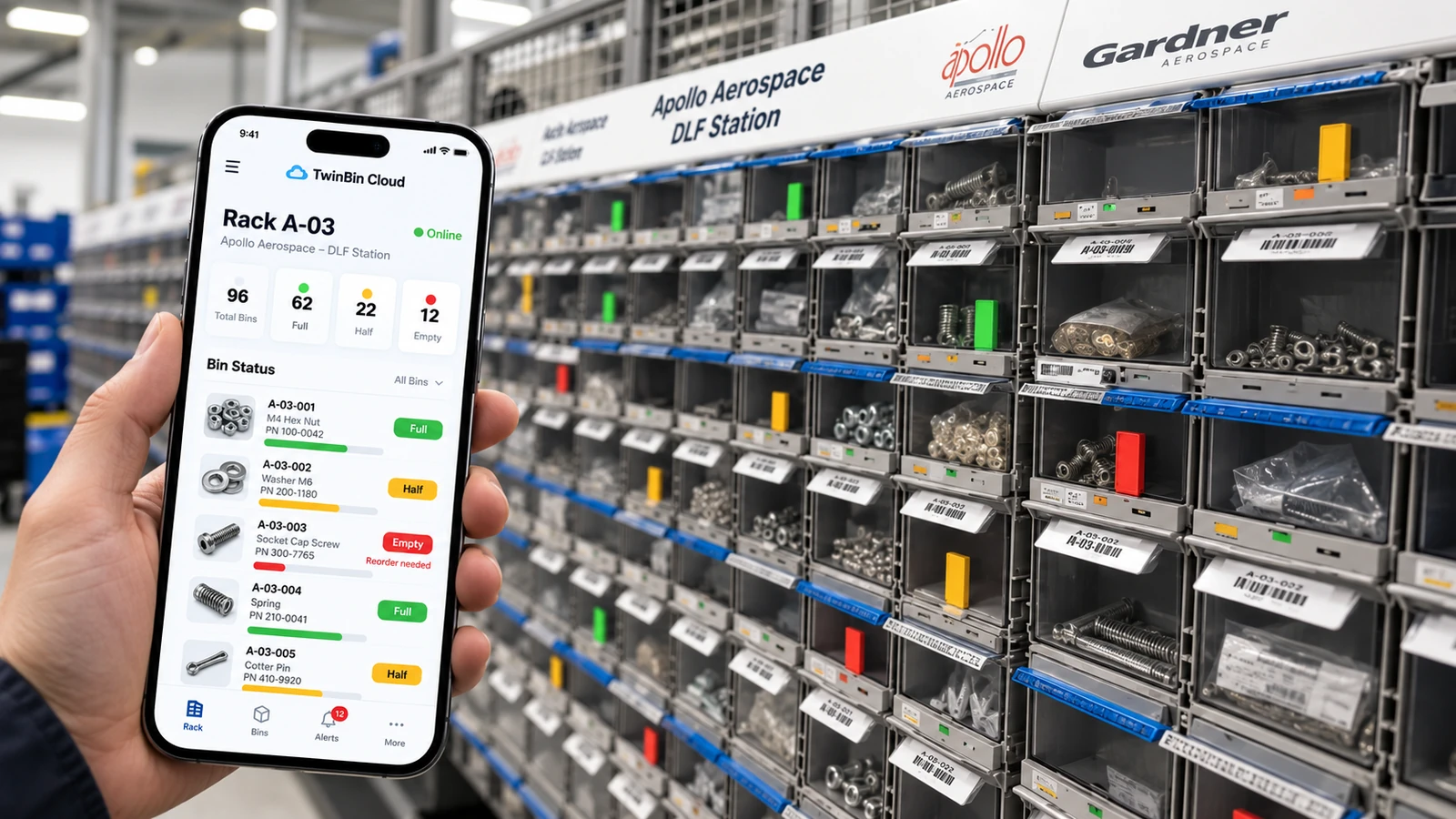
Counting stock by hand doesn’t scale. On a production floor, someone has to walk the bins, spot what’s running low, and reorder before it stops the line — and that check is only ever as current as the last time someone did it. TwinBin Cloud replaces the walk with a sensor in every bin. Toobler engineered it end to end for Hurst Green Plastics — the sensor device, the wireless mesh that carries its readings, the cloud behind it, and the web and mobile apps teams use.
Customer and context
Hurst Green Plastics makes TwinBin — a two-bin inventory system for industrial parts: the fasteners, components and consumables a production line runs on. The principle is simple: stock sits in two bins, and when one empties, it’s time to reorder. TwinBin Cloud is the connected version of that idea — bins that report their own stock level, so a team can see what’s running low across a whole site without walking the floor to count it. Toobler was the engineering partner that built it: the sensor device, the network, the cloud and the apps.
The challenge
A connected-inventory product is only as strong as its weakest layer — and this one had to be engineered at every layer:
- The reading has to come from the bin itself. That means a purpose-built sensor device — reliable and low-power enough to sit with the stock and just work — not an app bolted onto a generic tag.
- Signals have to cross a whole facility. A single radio hop won’t reach across a floor of steel racking, so the devices had to form a network that relays readings reliably from anywhere on site.
- Everything has to reach the cloud, in sync. Readings from many nodes, through many gateways, aggregated centrally without gaps.
- People need it where they work. Web for the office, mobile for the floor — one live picture of stock in both.
The solution
A custom IoT sensor device. Toobler developed the sensor node itself — the hardware and the firmware that sit with the stock and report its level — rather than depending on a third-party tag.
A wireless mesh network. The nodes form a mesh: each relays data through its neighbors to a gateway, so coverage extends across a facility and the network routes around obstacles instead of every device needing to reach a single base station. Gateways bridge the mesh to the cloud.
A cloud platform. The gateways feed a cloud application that collects readings from across the site, holds the current state of every bin, and serves it to the apps.
Web and mobile applications. A web application to manage and monitor stock from the office, and a mobile application for the same live view on the floor — so whoever needs to act on a low bin can see it there.
Engineering worth naming
The hard part of TwinBin Cloud was breadth: it is a genuine full-stack IoT build. Most “IoT” products are software layered on someone else’s hardware. Here Toobler engineered the whole stack — the sensor device, the embedded firmware, the mesh networking between nodes and gateways, the cloud that ingests it, and the web and mobile apps on top. One team, from the silicon to the screen.
That end-to-end range — a sensor on a shelf through to an app in someone’s hand — is exactly what a connected-hardware product needs from an engineering partner, and what this project proves.
Related work and capabilities
Industrial IoT
Industrial assets produce data long before anyone can act on it. Toobler builds the software layer that connects, monitors and controls them at scale.
- Industry
Manufacturing & Industrial
Production, inventory and maintenance data sits across MES, ERP modules and shop-floor devices that were never designed to talk to each other. Toobler connects them into one operational picture.
Proof, engineered
Case studies from Toobler — real platforms engineered across event technology, construction and digital twins. The work behind the claims.