One shared place for everyone caring for someone
More than a decade engineering Jointly, Carers UK's care-coordination app — a platform migration, a full rebuild, security hardening and monthly releases
- Client
- Carers UK
Caring for someone usually means several people sharing the load — family, friends, neighbors — each holding a piece of the picture: when the next appointment is, which medication changed, who is doing the shopping this week. Jointly, from the charity Carers UK, gives them one shared place to keep it. Toobler has been its engineering team for more than a decade, through a forced platform migration, a complete rebuild, and years of steady releases since.
Customer and context
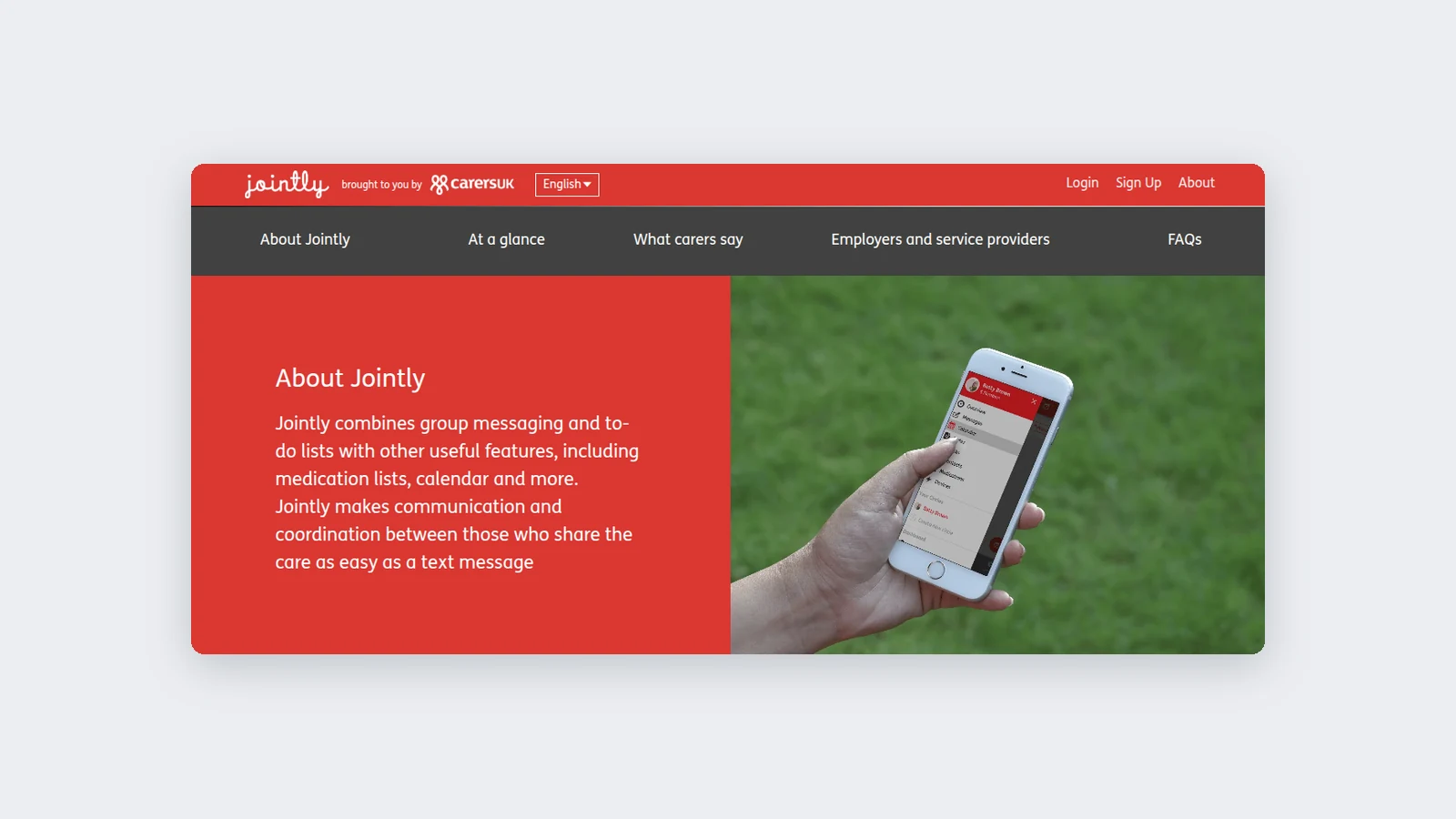
Jointly is Carers UK’s app for organizing care: a person sets up a care circle for someone they look after and invites the others involved. Inside the circle they share messages, notes, tasks, a calendar, medications, contacts and the details of the person being cared for, on the web and on iOS and Android.
Toobler first worked on Jointly in 2014, on sprints for the app as it then existed. From 2015 Toobler took on the engineering: the partner APIs, the move off its original backend, the rebuild that relaunched it in 2020, and the security, infrastructure and monthly releases since. The engagement is still running.
The challenge
- The data is personal and sensitive. A circle holds medication lists, health notes, contacts and care plans for one person, shared among people with different roles. Who can see and change what has to be right everywhere.
- The platform underneath had to change, twice. Jointly’s original backend service was shut down by its provider in 2017. Later the product needed a full rebuild — while every existing circle, with years of history, kept working and came across intact.
- Caring does not keep office hours. Carers use the app on the move, often with patchy signal, and set reminders for medication at specific times of day. Offline behavior, notifications and time zones all matter.
- It is an ecosystem, not just an app. Partner organizations create circles for the people they support, connected devices post updates into circles, and corporate partners offer Jointly under co-branding.
The solution
A careful move off a disappearing backend. When Jointly’s hosted backend was announced for shutdown, Toobler moved it to a self-hosted equivalent on Node.js and AWS, imported the data, and repointed the partner services and apps.
A full rebuild, with every circle carried across. From 2018 Toobler redesigned and rebuilt Jointly: a new Node.js API with token-based authentication and role-based permissions, the data moved to a managed MySQL database on AWS, a React web app, and React Native apps for iOS and Android with a PIN lock. Relaunching meant migrating every circle from the old system, and the team tracked migration issues item by item — task lists, event comments, note formatting, past medications, images — until the new app matched what users already had.
Permissions that follow the data. Each member’s permissions are set in the circle’s settings, and private categories hide notes and records from members without rights to see them.
Built for real security scrutiny. Jointly has been through independent penetration testing. Toobler worked through the findings — access control on uploaded files including medical information, exposure of sensitive account fields, security headers, API rate limiting, protection on the data-export page — and added multi-factor authentication. Security work continues, most recently a review against the OWASP API Security Top 10.
The detail of caring. Medications support “as required” doses and current and past records. The calendar handles recurring appointments and the dates members are unavailable. A contingency-plan export pulls together what someone stepping in would need. Notifications and daily or weekly digests keep members up to date. The app is available in Welsh.
An ecosystem around the circle. Partner organizations can create circles through an API for the people they support; connected devices can post messages straight into a circle; corporate partners can offer Jointly with their own branding; and Carers UK has usage reporting across the service.
Infrastructure that is maintained, not just deployed. Jointly runs on AWS, deployed as code through a CI pipeline, with weekly monitoring of the database, logs and servers, and a steady program of platform upgrades — runtimes, mobile frameworks, push notification services and app-store requirements — so nothing ages out underneath the people relying on it.
A key workflow: a medication change, shared
- A family member updates the dose of a medication in the circle.
- The change is saved against the person being cared for, visible only to members with access to medications.
- Other members are notified, in the app and by email, according to their own notification settings.
- The updated schedule shows in everyone’s medication view, on web and mobile.
- If someone else needs to step in, the contingency-plan export includes the current medication list.
Results
Carers UK has a care-coordination app that has kept running and kept improving for more than a decade: moved off a backend that was shut down, rebuilt on a modern stack with every circle carried across, hardened through independent security testing, extended to Welsh and to partner organizations, and released month after month.
For Toobler, Jointly is what long-term product engineering looks like for a charity: the visible features carers use every day, and the less visible work — migrations, permissions, security fixes and upgrades — that keeps something this personal trustworthy.
Related work and capabilities
- Case study SaaS Product Engineering · Mobile · Healthcare
One app for the patient side of the practice
How Toobler built RXNT's Flutter patient app: health records, appointment requests, billing and secure messaging with providers, over three years.
Proof, engineered
Case studies from Toobler — real platforms engineered across event technology, construction and digital twins. The work behind the claims.
SaaS Product Engineering
SaaS products outgrow the architecture that launched them. Toobler designs, builds, scales and re-platforms software products for SaaS companies, ISVs and funded startups.