A decade engineering the in-room guest experience
A multi-tenant, offline-first guest-engagement platform on in-room tablets — engineered and evolved for Tapendium over more than a decade, across hotels, hospitals and retirement communities.

- Client
- Tapendium
- Guest satisfaction
- 90%
- Concierge calls replaced
- 10,260+
- Partnership
- 10+ years
A printed hotel compendium is out of date the day it’s printed. Toobler has spent over a decade engineering the platform that replaced it: Tapendium, a digital guest-experience system that turns an in-room tablet into a concierge — and lets a hotel, hospital or retirement community update every device in real time, without touching a line of code.
Customer and context
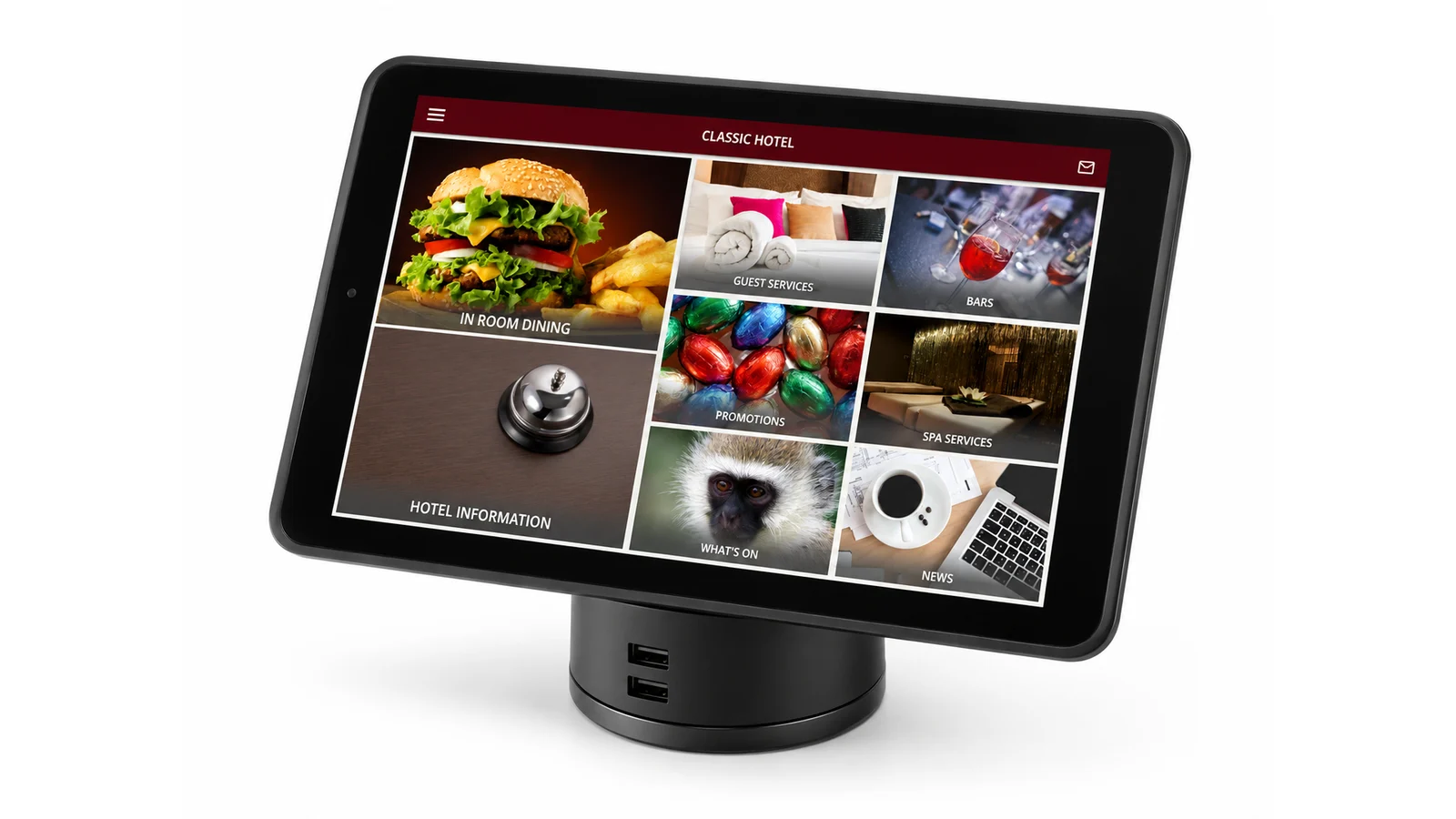
Tapendium is a digital guest-engagement platform for premium hotels, hospitals and retirement communities. It replaces the printed in-room compendium with an interactive experience on Samsung tablets, customized to each operator’s brand — room service, guest services, information, offers and real-time messaging — and gives staff a secure, controlled way to run a fleet of guest devices. A web-based content management system lets managers with no technical experience update every tablet and tailor offers to guests in real time.
Toobler is the product-engineering partner behind Tapendium, and has been for more than a decade. Development began in 2012 as a hotel menu and guest-service tool; across the years it grew into a full guest-engagement platform, adding segments — hospitals, retirement villages — and rebuilding for new devices and expectations along the way.
The challenge
A guest tablet looks simple. Making it dependable in a hotel room, across many properties, is not.
- It has to be instant — even on bad Wi-Fi. A guest browsing a menu won’t wait for a server round-trip, and hotel networks are unpredictable. The experience has to feel immediate whatever the connection is doing.
- One platform, many brands. A single system has to serve many properties, each with its own branding, content, offers and languages — without forking the product per hotel.
- A fleet of devices to run. Hundreds of guest tablets across properties need to be configured, locked down, kept secure and updated centrally — not touched one room at a time.
- It has to connect to the hotel. The guest experience only matters if it ties into how the property runs — its property-management system, point of sale, room controls and media.
- It had to keep evolving. Over a decade — through changing guest expectations, the shift to contactless after COVID, and new customer types — the platform had to keep growing without disruptive rebuilds.
The solution
A multi-tenant platform with an on-device database. Tapendium runs as a multi-tenant SaaS — one shared schema and database serving many hotels — with a copy of each property’s data held as a local database on the tablet itself. Most of what a guest does — opening a menu, browsing services, reading information — is served straight from the device, with no server call. That is what makes the in-room experience instant and keeps it working when the network doesn’t.
A sync that doesn’t waste calls. Before serving from the local copy, the app has to know it still matches the server — normally another request. Instead, a cached flag records whether the server’s content has actually changed since the last sync; only then does the tablet fetch. When nothing has changed, it serves locally. Precise, and cheap.
A real-time CMS anyone can run. The web-based content management system (built in PHP/CodeIgniter) lets non-technical hotel staff manage content, menus, offers and messaging per property, in multiple languages, and push updates to every tablet instantly.
The guest experience. The native tablet app — on Samsung hardware, rebuilt on Material Design — covers room service, guest services, a gift shop, amenities, internet plans, hotel information and what’s-on, an order queue across services, home-screen guest messaging, and embedded media such as Netflix.
A managed device fleet. Tapendium runs as a secure enterprise-mobility platform: the guest tablets are centrally managed through Samsung Knox — locked to kiosk mode, configured and updated across the fleet without visiting rooms.
Integrations and cloud. A REST/JSON API layer connects the platform into the hotel stack — property-management systems, point of sale, room controls and media. It runs on AWS behind a load balancer, using RDS, Redshift, DynamoDB and S3 — elastic on the web tier, with analytics on the warehouse side.
A no-device option. Tapendium Go delivers the same experience as an install-free progressive web app, reached by a QR code on the guest’s own phone.
Engineering worth naming
- Offline-first in the room. The local database plus the change-detection cache is the core idea — it’s why the experience is instant and survives a flaky hotel network, rather than stalling on a server call.
- Many hotels, one platform. Multi-tenant, brand-customized and multilingual, so a new property is a configuration, not a fork.
- Running the hardware, not just the software. Fleet device management through Knox is its own discipline — securing and updating guest tablets across properties.
- A decade of evolution. From a hotel menu tool to a guest-engagement platform spanning hotels, hospitals and retirement communities — grown in place, not rebuilt.
Results
- Guest self-service that takes load off the front desk. Tapendium reports 90% guest satisfaction across hotel deployments, and at one property the tablet replaced over 10,260 calls that would otherwise have gone to the concierge — guests serving themselves instead of picking up the phone.
- Real-time control for the operator. Staff update content, offers and messaging across every tablet themselves, without IT.
- A platform that grew with the business — from a single hotel’s menu tool into a guest-engagement ecosystem across three hospitality and care segments.
- A partnership of more than a decade — Toobler builds, evolves and operates the platform, so Tapendium’s team can focus on hotels and guests rather than infrastructure.
What this means for hospitality and guest-experience software
Guest-experience software lives or dies on two things off-the-shelf tools rarely get right: it has to be instant in the room — even on bad Wi-Fi — and it has to be manageable by non-technical staff across many properties. Tapendium is the pattern in practice: a custom, multi-tenant guest-engagement platform engineered on the operator’s own workflow, with the offline reliability and fleet device management that in-room hardware demands, evolved over a decade by a long-term engineering partner. If you run a hospitality or senior-living operation and want a guest-experience platform built and owned with you — not bought off a shelf — talk to Toobler’s engineering team.
We have several projects running with Toobler and they have been great to work with. We will be continuing development with them.

Mark Ilott
Founder, Tapendium
Related work and capabilities
- Industry
Hospitality & Hotels
A property runs on one system, and every gap in it becomes somebody's manual workaround. Toobler engineers the platforms hospitality operations depend on.
Proof, engineered
Case studies from Toobler — real platforms engineered across event technology, construction and digital twins. The work behind the claims.
SaaS Product Engineering
SaaS products outgrow the architecture that launched them. Toobler designs, builds, scales and re-platforms software products for SaaS companies, ISVs and funded startups.