A price comparison engine, and what it became
A price engine over a thousand sources, a voucher business, and price data syndicated into third-party sites
- Client
- MeltBrands
A price comparison site is a data product wearing a shopfront. ShopBoxUK compared prices across more than a thousand online sources for UK shoppers — and over three years it stopped being only a website, becoming a voucher business and a price-data supplier to sites it did not own. Toobler engineered all three.
Customer and context
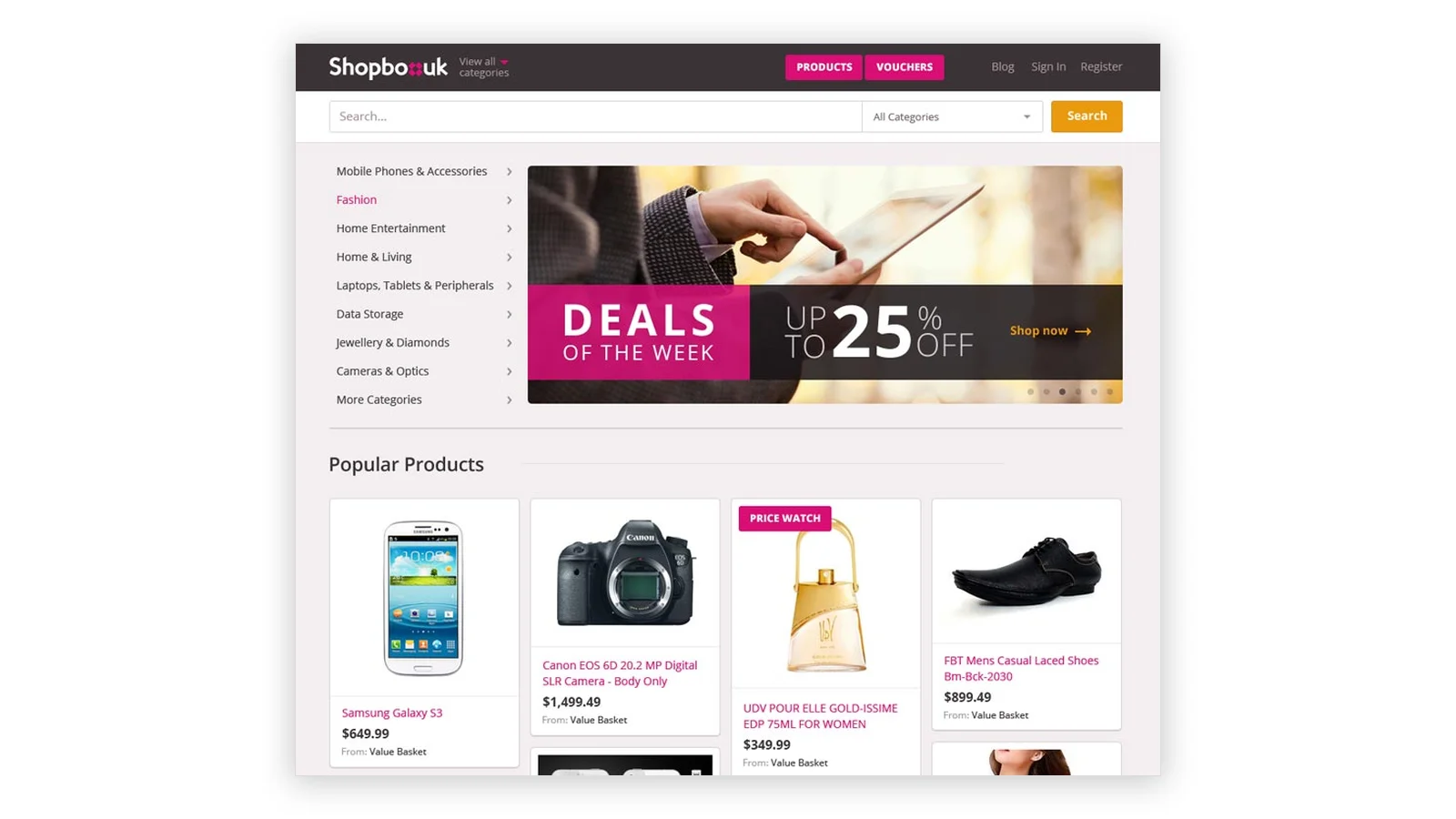
MeltBrands UK came to Toobler to build its price search engine, ShopBoxUK. The premise was simple to say and hard to do: collect current prices from over a thousand online sources across consumer products, and put the best one in front of a shopper. The alternative, as the original brief put it, was a person visiting a thousand websites and comparing by hand.
Toobler engineered it from 2012 to 2015 — the site, the admin behind it, the voucher product that grew out of it, and the plugins that pushed its price data into other people’s websites.
The challenge
- A catalog assembled from a thousand strangers. Every source has its own feed, its own categories and its own idea of what a product is. None of that is the shopper’s problem, so all of it has to be reconciled before a page renders.
- Browsing is the hard screen. Thousands of products with photos, at different sizes, that have to be scannable at a glance and still let someone get quickly to the one thing they came for — without the grid rearranging itself every time the window moves.
- A price site lives on category pages. If search engines cannot see the catalog’s structure, the catalog does not get found.
- The product kept changing shape. A price engine became a price engine plus vouchers plus an API plus WordPress plugins. Each addition reached back into the data model rather than sitting beside it.
- Money attracts attention. Anything handling user accounts around retail traffic has to assume someone will try the obvious attacks.
The solution
Feed ingestion, normalized into one catalog. XML parsing with its own test pass, data pulled from the API into category and brand tables, and a site menu generated by parsing the API rather than maintained by hand — so a change in the source data changed the navigation.
A browsing grid built for the problem. The team used the Isotope jQuery plugin and wrote a custom layout mode for it, plus an isoRepeat directive and a price filter in AngularJS. Lazy loading had to be implemented without image dimensions, because the Shopbox API did not supply them. The explicit goal was to minimize how much the content rearranged itself on resize — the difference between a grid you can shop and one that moves under your hand.
A voucher business, built as its own product. Voucher administration with its own categories, icons and types, multi-level category mapping, retailer listing pages carrying special offers, and in-stock or out-of-stock state rendered live from the API. Nearly forty tasks across three work streams — a second product line, not a feature.
Price data syndicated into other sites. Two WordPress plugins — a dynamic price plugin and a lowest-price plugin — took ShopBoxUK’s data into third-party sites, including installation onto a live one. This is where “multi-platform price comparison service and third-party API provider” stopped being a description and became something that shipped.
Search-engine surface treated as infrastructure. Category pages, a sitemap carrying third-level categories, and work explicitly aimed at making the site indexable. A comparison site that cannot be crawled cannot be found.
Security as a work stream, not an afterthought. XSRF protection in AngularJS, with a token in a JavaScript-readable cookie echoed back as a header and verified server-side — the token itself a digest of the authentication cookie, so it could not be forged by script. Alongside it: a content security policy, random token generation, and regression testing across the application.
The codebase was taken forward, not left. One task reads “converting simple php code into CodeIgniter format” — three years in, the team moved the application onto a framework rather than building on top of what it started as.
Results
ShopBoxUK ran as a price comparison service, a voucher and offers business, and a price-data supplier to third-party sites, built and evolved by one team across more than three years.
The useful part is the shape of the engagement rather than any single feature. A product that begins as “compare prices” and ends as “compare prices, run offers, and supply other people’s sites” is not a project with a finish line — it is a product that needed an engineering team willing to rebuild its own foundations partway through, and to add a second business to it without breaking the first.
This is a build of its time — AngularJS 1.x, jQuery, a WordPress plugin as a distribution channel. The pattern is not: a data product that has to be ingested, made browsable, made findable, and then made available to others.
The guys at Toobler were very involved from the very first minute they started working on my project. Their commitment, knowledge and dedication helped me wrap it up in a spectacular fashion and needless to say, the result was a huge success.

Lee Barrett
MeltBrands
Related work and capabilities
- Case study E-commerce · Marketplace
A two-sided marketplace, built for sneakers
How Toobler built ShoeperMarket — a dedicated two-sided marketplace for buying and selling shoes: Solr-powered catalog search, offers, a demand-capturing Hunt List with smart matching, and full seller and buyer flows.
- Industry
E-commerce & Marketplaces
How you sell is specific to you, and a template store makes you sell the way it was configured. Toobler builds the stores, marketplaces, catalog search, checkout and integrations commerce businesses run on.
Proof, engineered
Case studies from Toobler — real platforms engineered across event technology, construction and digital twins. The work behind the claims.