A Construction Progress Digital Twin, Integrated with BIM
A BIM-integrated construction progress digital twin — simulation, live monitoring and AI forecasting of cost, timeline and resources

- Client
- Nael
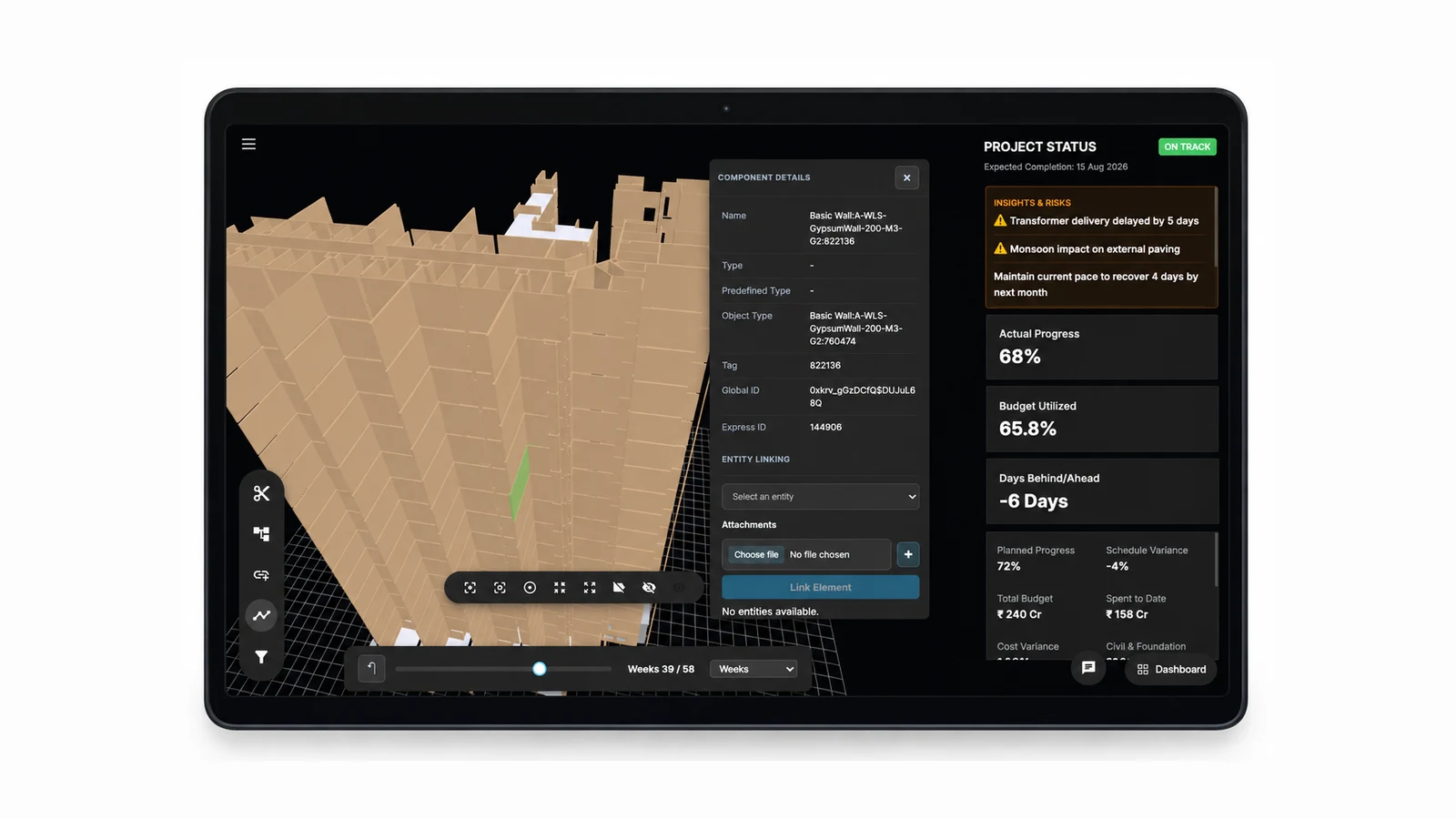
A construction progress digital twin is a live virtual model of a project — its site, its schedule, its costs — kept in step with what is actually being built. For Nael, Toobler engineered one on top of the company’s BIM models and its existing data, so progress could be seen, simulated and forecast rather than reconstructed after the fact.
Customer and context
Nael is a leading construction company in the UAE with 25 years of experience. Its projects generated a great deal of data every day — from execution on site to expenses — but that data was doing little for strategic decisions. Nael wanted to improve how projects were executed, bring costs down, and make better use of its resources.
The challenge
Nael was data-rich but insight-poor. Daily project-execution and expense data sat in operational systems and was underused when it came to planning and decisions. The company needed a way to turn that data into foresight — to plan, monitor and assure quality against a model of the project, rather than against spreadsheets and status meetings after the fact.
The solution
Toobler worked through the pain points across the phases of a project and proposed a construction progress digital twin, built with AI and integrated with Nael’s BIM models.
The twin is a virtual representation of each construction project, tied to the BIM model of the asset and fed by Nael’s data — including IoT sources and the company’s existing software systems. Because it stays connected to live data, the twin reflects the state of the project as work proceeds, not a snapshot taken at the start.
On top of that model, AI predictive models forecast project costs, timelines and resource requirements, and the twin lets teams simulate scenarios before committing to them.
How BIM and the digital twin work together
BIM describes what a project should be; the digital twin tracks what it actually is. Integrating the two makes the BIM model a live baseline: progress, IoT signals and operational data update against it, so a deviation in schedule, cost or resource shows up against the plan rather than surfacing late. Simulation runs on that same model, so a “what if” is tested against the real project, not a detached copy of it.
What it enables
- Planning and development — scenarios simulated on the twin before work starts.
- Monitoring — progress seen against the BIM baseline as it happens.
- Quality assurance — deviations surfaced early, against the model.
- Decisions — AI insight on cost, timeline and resources, drawn from the project’s own data.
Results
The engagement created a working construction progress digital twin for Nael, integrating virtual representations of the physical sites with the company’s data sources, and core AI models that turned that data into decision-ready insight. Specific performance figures are being prepared for publication with the client and are not estimated here. What can be stated is the capability delivered: a BIM-integrated construction progress twin, fed by IoT and existing systems, supporting simulation, monitoring and AI-based forecasting of cost, timeline and resources.
What this means for construction today
Most construction data is only useful in hindsight. A construction progress digital twin, integrated with BIM, turns it into foresight — a live model of the project that can be watched, tested and forecast. Toobler engineers these twins on a contractor’s own BIM models and data, as a custom build. If you are trying to close the gap between the model of a project and its reality, talk to Toobler’s engineering team.
Toobler has been a reliable technology partner for us at Nael Group, consistently delivering solutions which meet our operational and strategic needs. Their team demonstrates strong technical capability, clear communication, and a commitment to quality that aligns with our expectations. We value the professionalism they bring to each engagement, and appreciate the support extended via the strategic partnership shared between our organizations.

Baisil Varughese Oommen
Deputy Managing Director, Nael Group
Related work and capabilities
- Industry
Construction & Facilities
Construction data sits in separate systems — projects, cost, workforce, site — and no product template joins them the way your teams actually work. Toobler engineers platforms that do.
- Capability
Digital Twin Solutions & Engineering Services
Twin initiatives stall at the plumbing, not the modeling. The integration, modeling and operational layer that makes a twin work — on your real data and systems.
Proof, engineered
Case studies from Toobler — real platforms engineered across event technology, construction and digital twins. The work behind the claims.