A two-sided marketplace, built for sneakers
A dedicated two-sided marketplace for buying and selling shoes — Solr-powered catalog search, offers, a demand-capturing Hunt List with smart matching, and full seller and buyer flows — engineered end to end.
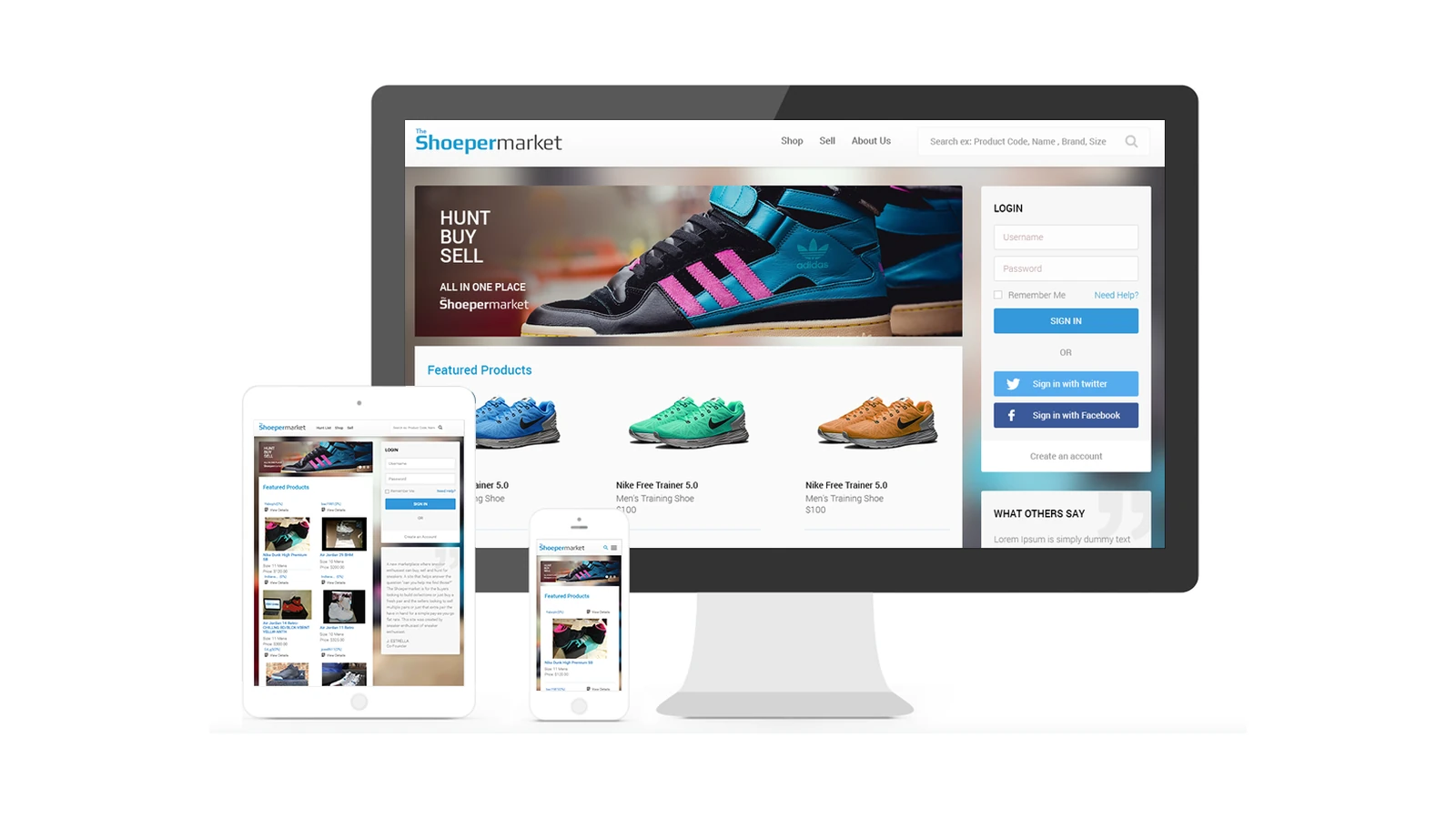
- Client
- ShoeperMarket
- Model
- Two-sided marketplace
- Search
- Apache Solr, catalog-modeled
- Signature feature
- Hunt List demand-matching
Sneaker resale is a marketplace before it is a store: buyers hunting for one specific pair, sellers sitting on stock nobody has found yet. ShoeperMarket is the platform built for exactly that — shoes, and only shoes — and Toobler engineered it end to end: listings, search, offers, a want-list that goes looking on the buyer’s behalf, and the seller and buyer flows around them.
Customer and context
ShoeperMarket is a dedicated online marketplace for buying and selling footwear — sneakers and shoes, exclusively. Sellers list their stock; buyers browse thousands of pairs, make offers, and buy. It was commissioned by the founder of Shoepermarket.com, and Toobler designed and built the platform end to end — the seller side, the buyer side, and the matching engine between them.
The challenge
A niche marketplace is a two-sided product with a matching problem at its heart:
- Two sides, one platform. Sellers need listings, inventory, offers and reputation; buyers need search, offers, a cart and checkout. Both experiences had to live in one product without getting in each other’s way.
- Search that finds the exact pair. Footwear shoppers search on very specific attributes — model, size, variation. Generic keyword search does not cut it.
- Demand that is not in the catalog yet. The pair a buyer wants is frequently out of stock, or never listed at all. The platform had to capture that unmet demand rather than lose the sale.
- Messy human input. Buyers describe what they want inconsistently. To act on their demand, the system had to make sense of loose, imperfect wording.
- Trust between strangers. A consumer-to-consumer market puts buyers and sellers together who have never met, so reputation had to be built into the product.
The solution
A genuine two-sided marketplace. Toobler built the seller flow — accounts, listings, product management with variations, and seller plans — alongside the buyer flow of browse, search, cart and checkout, as one platform. Order management gives each side its own view: my orders for buyers, sold orders for sellers.
Offers, not just buy-now. A buyer can make an offer on a listing and the seller can accept or decline, so negotiation is part of the product — with promo codes and standard checkout (PayPal) alongside it.
Search modeled to the catalog. Product and category search is powered by Apache Solr with a schema built for how people actually shop for shoes, so a buyer can find a specific model and variation rather than a fuzzy keyword match.
A Hunt List that goes looking. The Hunt List lets a buyer register demand for a pair that is out of stock or not listed at all. When a matching product later comes up for sale, the platform emails them automatically. And because buyers rarely describe what they want in catalog terms, Toobler built an offline step that reads a Hunt List entry and resolves it to the right product — so the match fires even when the wording does not line up. Unmet demand becomes a future sale instead of a dead end.
Reputation on both sides. Buyer-and-seller feedback, an in-platform mailbox for messaging, and an admin backed by a permission matrix to run and moderate the marketplace.
The plumbing that makes it work. An email queue and scheduled jobs drive the notifications and the background matching behind the Hunt List; image upload, product variations and category management complete the catalog.
Engineering worth naming
- The Hunt List is the clever part. A want-list that captures unmet demand, normalizes loose human input into something matchable, and notifies the moment supply appears — turning “we do not have that” into a sale that has not happened yet.
- Search built for the domain. A Solr schema modeled to how footwear is actually browsed — model, size, variation — not generic full-text search.
- A real marketplace, not a storefront. Sellers, buyers, offers, reputation, seller plans and moderation — the whole ecosystem.
- Offers as a first-class flow. Make, accept and decline built directly into the buying journey.
Results
- A working niche marketplace — sellers list, buyers hunt, offer and buy, in a space dedicated to footwear alone.
- Demand captured rather than lost — the Hunt List converts out-of-stock and unlisted searches into notifications and future sales.
- Search that finds the exact pair — Solr-backed and modeled to the catalog.
- Trust built in from the start — two-sided feedback and reputation for a consumer-to-consumer market.
What this means for e-commerce and marketplace software
A marketplace lives or dies on matching supply to demand — and the demand that matters most is often for the things you do not stock yet. ShoeperMarket puts that idea into the product itself: a two-sided footwear marketplace with search modeled to how buyers really shop, a want-list that captures and chases unmet demand, and the seller, buyer and trust flows around it. If you are building a marketplace or a vertical e-commerce platform and want it engineered around your market’s actual behavior — not a generic storefront — talk to Toobler’s engineering team.
Related work and capabilities
- Industry
E-commerce & Marketplaces
How you sell is specific to you, and a template store makes you sell the way it was configured. Toobler builds the stores, marketplaces, catalog search, checkout and integrations commerce businesses run on.
Proof, engineered
Case studies from Toobler — real platforms engineered across event technology, construction and digital twins. The work behind the claims.