Five years of answering one question: who is coming?
Five years of continuous enhancement on a live team-management platform — invitations, reminders, statistics, team finances and season handovers
- Client
- teamplayr
Every amateur team runs on the same question, asked again before every session: who is coming? teamplayr answers it for German-speaking sports teams, and for more than five years Toobler was the engineering team that kept extending the platform — invitations and replies, reminders, statistics, team finances — one change request at a time, on a platform teams were using throughout.
Customer and context
teamplayr is a web platform that teams use to organize themselves: a shared calendar of trainings and matches, invitations that players accept or decline, a team pinboard, votes, photos and documents, and the team’s own cash book. Its users are players, coaches and team managers, and the product speaks their language — German.
When Toobler started in 2015, the platform was already live and at its second major version. The work was product engineering on a running system: the client specified each change, Toobler designed, built and tested it, regression-tested the rest of the platform, and deployed it. That rhythm ran from early 2015 into 2020.
The challenge
- Attendance is the whole job. A coach needs to know, early and reliably, who will turn up. That means invitations people actually answer, reminders that arrive at the right time, and a clear count of who has said yes, no or nothing.
- Teams are not static. Players come and go, take a season off, change roles. Each new season risks rebuilding the team from scratch.
- Every team measures something different. Attendance is universal; the figures a team cares about beyond that are not.
- Change has to land safely. The platform was live throughout. Every enhancement had to arrive without breaking what teams already relied on.
The solution
Invitations people answer. Each training or match carries separate lists of invited and not-invited players, with live counts of who has accepted, declined or not yet replied. Players can accept or decline straight from the reminder email. Team managers can respond on a player’s behalf and adjust the invite list. Automatic reminders go to invited players, optional information emails go to everyone else, and replies to past sessions are locked so the attendance record stays true.
A team that carries over between seasons. Players can be marked inactive — kept on the team’s records but left out of new invitations. At the end of a season a manager can copy the whole team, with its settings, as the starting point for the next one, and retire the old team when it is no longer needed.
Statistics each team defines. Beyond attendance, teams set their own key figures per activity, with defaults for the team. Values are recorded per session and charted on the statistics page, filtered to training sessions, other activities or both, and the player list can be sorted by any figure.
The rest of team life, in one place. A team pinboard with notifications and a daily digest; votes with closing dates, comments and a personal view; birthdays in the calendar and birthday reminders; shared photos and documents within per-team limits; calendar export to Outlook and Apple; appointment search; and a team balance sheet that shows open payments across the whole team and filters by payment status.
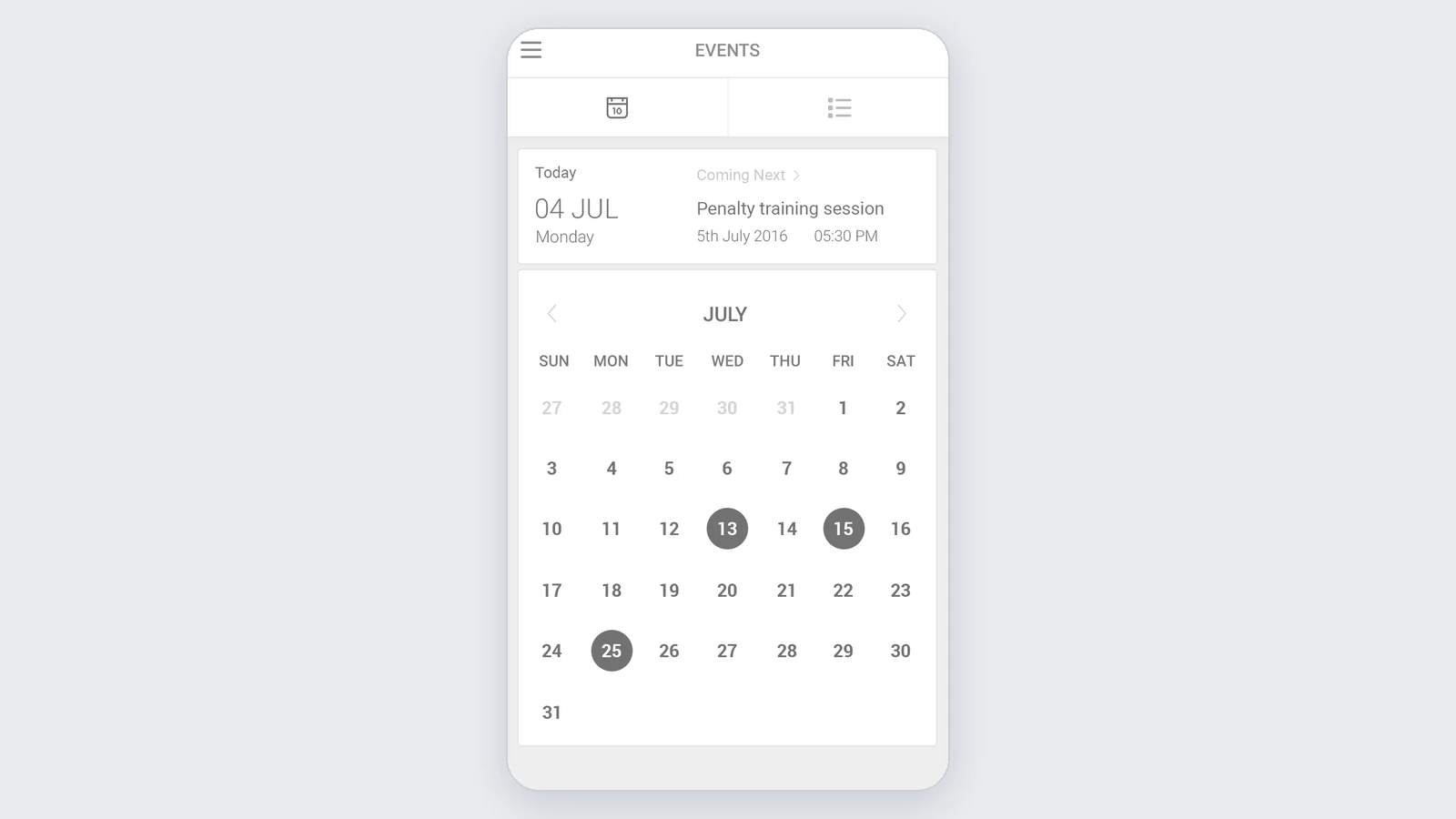
A mobile direction. In 2016 Toobler produced wireframes for a mobile app — team switching, events in calendar and list views, players, photos, profile and sign-in — to set out how the platform’s core flows would work on a phone.
A key workflow: from invitation to attendance record
- A manager creates a training session and invites players; inactive players are left off by default.
- Invited players get an email with accept and decline buttons; anyone who has not answered gets an automatic reminder.
- The session page shows invited, accepted, declined and open counts as replies come in.
- After the session, replies are locked and the session’s key figures are recorded.
- Attendance and key figures feed the team’s statistics charts.
When the rules changed
In 2020, COVID-19 rules required teams to keep a list of everyone who attended each session. The client asked for it as a feature, and Toobler added a printable attendance list for every appointment, with a configuration window to choose what goes on the print-out. Because attendance had been the center of the product for years, the data was already there; the work was making it usable for a requirement nobody had planned for.
Results
teamplayr’s teams got a platform that kept growing with them for more than five years: from invitations and reminders in 2015, through team finances, statistics and season handovers, to attendance records for public-health rules in 2020.
What the engagement shows is the less visible side of product engineering — taking a live platform, understanding it well enough to extend it safely, and turning a steady stream of client requests into releases that teams could rely on.
Related work and capabilities
Proof, engineered
Case studies from Toobler — real platforms engineered across event technology, construction and digital twins. The work behind the claims.
- Industry
Sports & Recreation
A sports organization runs on membership, competition, results and the engagement that keeps participants coming back. Toobler engineers the mobile apps and platforms behind them.
- Case study Sports · Mobile
The app that runs dragon-boat racing
How Toobler engineered Dragon King — a native iOS and Android app for dragon-boat racing clubs: membership, teams and seat-by-seat race-crew line-ups, built and evolved over three-plus years.