Taking ownership of a live aviation platform
An air-cargo ULD data platform, customer and admin portals, and a global ULD-tracking mobile app — engineered and owned through a live vendor transition.

- Client
- Unilode
- ULDs under management
- 200,000+
- Airports served
- 550+
- Global app stores
- 4
Unilode runs the world’s largest outsourced fleet of air-cargo Unit Load Devices — the containers and pallets that move freight in an aircraft’s belly. Toobler is the engineering partner that took ownership of its customer-facing digital ecosystem — the data warehouse, the customer and admin portals, and a mobile field app for tracking ULDs — through a live vendor transition, without disrupting an operation that airlines depend on every day.
Customer and context
Unilode (Unilode Aviation Solutions) is the global leader in outsourced ULD management. It operates the world’s largest outsourced ULD fleet and the largest global network for maintaining and repairing containers, pallets and inflight galley equipment — 200,000+ ULDs under management, 450,000+ ULDs and galley carts serviced a year, across 550+ airports, on more than 25 years in the industry.
In 2023 Unilode set out to own its technology. It was moving from externally built MVP applications toward a sustainable, internally owned digital ecosystem, and standing up its own IT organization around its critical data and customer-facing platforms. Toobler joined that journey as a technology partner — starting with the Customer Portal’s frontend and progressively expanding across frontend, backend and mobile.
The challenge
This was not a greenfield build. It was a transition — the harder problem.
The applications already ran business-critical processes, but the knowledge of how they worked — the systems, the business rules, the delivery practices, the technical decisions — sat with an outgoing external vendor, while Unilode was still building the internal team meant to own them. The task wasn’t just to ship features. It was to absorb a complex domain, preserve continuity, and establish sustainable delivery — without disrupting a platform customers and internal teams rely on.
That meant learning two things at once: the business (ULDs, fleet operations, contracts, customers, reporting) and the existing application landscape (architecture, code, delivery standards), while collaborating with both the departing vendor and Unilode’s emerging IT organization.
The solution
Toobler became an embedded engineering partner across Unilode’s Customer Portal ecosystem, and the scope grew as trust did.
An Enterprise Data Warehouse at the core. The EDW consolidates data from Unilode’s business systems into one trusted foundation — for reporting, analytics, forecasting, inventory visibility, contract management and operational decisions. Everything customer-facing is built on top of it.
The Customer Portal (React). The main touchpoint between Unilode and its customers: business reports and operational insights, fleet information, inventory visibility, contracts and services — giving airlines and freight customers real transparency and control over their ULD operations, with complex operational data presented so people can actually act on it.
The Admin Portal (React). The management side: user administration, business configuration, contract and currency management, data management and application oversight.
A backend API (C# / .NET). As the partnership matured, Toobler expanded from frontend into the backend — identity and single sign-on, business management, customer configuration, and access to the enterprise data — built after a deliberate architecture and source-code familiarization phase, so ownership transferred cleanly.
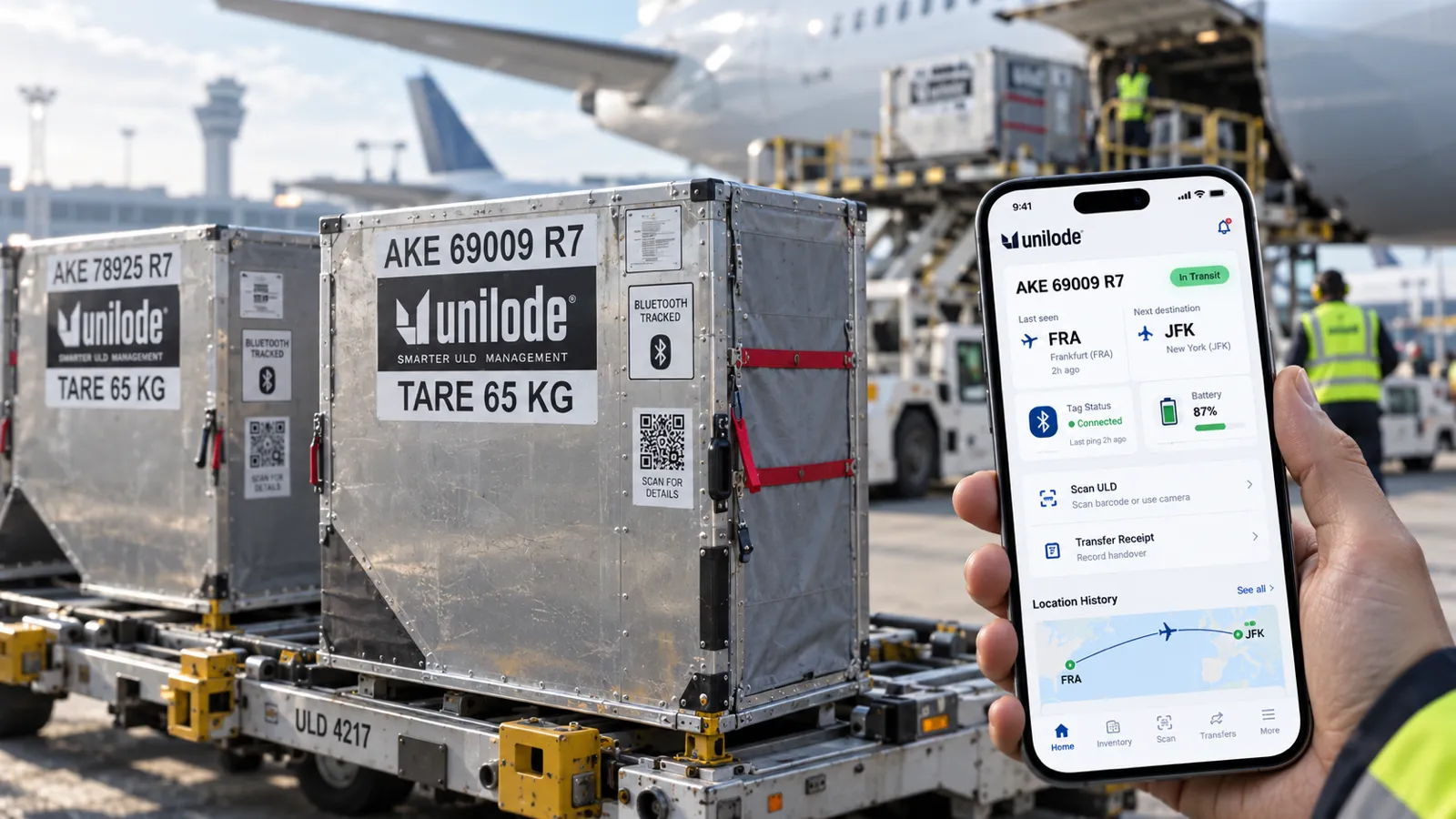
E-ULD Mobile (React Native). The operational field app for tracking ULDs across the network. It:
- pairs physical ULDs with Bluetooth tracking tags, reading the ULD’s identity, checking a tag’s health and pairing eligibility, and pairing and unpairing;
- identifies and scans ULDs by Bluetooth and by camera, with on-device OCR to read ULD markings;
- records sightings;
- produces transfer receipts on demand. It’s shipped to four global app stores, including China: the Apple App Store, Google Play, Huawei AppGallery and Tencent — each with its own permissions, privacy and platform-compliance demands.
Engineering worth naming
- A transition without disruption. Absorbing a business-critical platform from an outgoing vendor, while the business keeps running, is a different discipline from building new — it’s knowledge transfer, continuity and trust as much as code.
- Data as the foundation. An enterprise data warehouse that makes fragmented operational data trustworthy is what turns portals and reports from screens into decisions.
- IoT in the field, not the lab. Bluetooth pairing with physical tracking tags and camera-based OCR scanning, working in real warehouse and airport conditions, is a genuine field-operations problem — not a CRUD app.
- Global, including China. Shipping one mobile app to Apple, Google, Huawei and Tencent means meeting four different sets of store, permission and privacy requirements without forking the product.
- Earned scope. What began as frontend support became full-stack engineering and, increasingly, product ownership — because each step was delivered dependably enough to justify the next.
Results
Through the ongoing partnership, Unilode’s platform has moved from its initial MVP foundation into a continuously improving enterprise product:
- Greater customer transparency — a growing portfolio of reports and insights giving customers clearer visibility into their fleet, inventory, contracts and operational activity.
- Expanded digital capabilities — the portal keeps evolving with new features without compromising the quality of the platform underneath.
- Improved delivery confidence — consistent, quality-focused delivery on business-critical releases, close to Unilode’s own teams.
- Operational efficiency — continual review of existing approaches to improve performance and reduce unnecessary technology cost.
- An end-to-end partnership — from frontend support to frontend and backend engineering, business analysis, solution design, deployment and ongoing support.
Specific performance figures are Unilode’s to publish; what stands is the scope and the trajectory — a business-critical aviation platform taken over mid-flight and grown into a product.
What this means for air-cargo and logistics software
Asset-heavy logistics operators — moving containers, pallets and equipment across a global network — rarely run on software any vendor sells off the shelf, and often inherit systems built by someone who has since left. Unilode shows the alternative: a long-term engineering partner that can take ownership of a business-critical platform, consolidate its data, build the portals and field apps the operation runs on, and keep improving it — through the transition, not around it. If you operate that kind of logistics platform and need an engineering team that can own it with you, talk to Toobler’s engineering team.
Working with Toobler has been a very positive experience. The developers supporting our eULD mobile application have consistently delivered high-quality work, shown strong technical capability, and integrated seamlessly with our internal team. Their professionalism, responsiveness, and ability to understand our requirements have made a clear impact on the progress of our product. We appreciate the partnership and look forward to continuing our collaboration.

Patrick Kok
Director IT Strategy & Transformation, Unilode
Related work and capabilities
- Industry
Aviation & Asset Operations
Airlines, air cargo and ULD operators run on data that is hard to see and harder to trust. Toobler builds, modernizes and integrates the platforms behind it — data platforms, portals and field apps.
- Industry
Logistics & Freight
Freight data moves slower than the freight does. Toobler builds, integrates and modernizes the platforms logistics operators run on, and keeps them running.
Proof, engineered
Case studies from Toobler — real platforms engineered across event technology, construction and digital twins. The work behind the claims.