The software platform behind connected smart lighting
Infinity — the multi-tenant, multi-site cloud platform Toobler built for CosmicNode: it turns thousands of connected LED fixtures and sensors across greenhouses and smart buildings into one remotely managed, monitored and automated system.
- Client
- CosmicNode
- Architecture
- Cloud-native on Kubernetes
- Scope
- Multi-tenant, multi-site
- Deployed across
- Greenhouses + smart buildings
A single greenhouse can hold five thousand LED grow lights; a smart building, thousands more. CosmicNode makes the wireless hardware that connects them — and Toobler built Infinity, the cloud platform that turns all of them into one system a grower or facility manager can see, control and automate from anywhere.
Customer and context
CosmicNode is a wireless-controls and IoT company for smart lighting. Its hardware turns individual LED fixtures — across horticultural greenhouses and commercial buildings — into connected, controllable endpoints on a wireless mesh. CosmicNode builds that hardware. Toobler built the software: Infinity, the enterprise, multi-tenant, multi-site cloud platform that sits above the network and makes the whole estate manageable. Toobler has been CosmicNode’s software engineering partner since 2022, and the platform is still being developed today.
The challenge
CosmicNode’s hardware could make thousands of fixtures wirelessly addressable. The software had to make them operable — at scale, across sites, for non-technical operators:
- Thousands of endpoints, one system. A single greenhouse can hold thousands of fixtures and sensors across zones, and a customer might run several sites in different countries. The platform had to model and manage all of it centrally.
- Real-time control and monitoring. Operators needed to control lighting — zones, dimming, schedules, multi-channel spectrum — and see live state, faults and energy as it happens.
- Multi-tenant, multi-site. Many customers on one platform, each with its own sites, buildings, zones, users and permissions.
- Two very different worlds, one platform. The same system had to serve greenhouse growers and commercial-building managers — different structures, different needs.
The solution
Toobler designed and built Infinity as the cloud and intelligence layer above CosmicNode’s wireless network.
A model of the physical estate. Infinity represents the real world the devices live in:
customer → site → building or greenhouse → floor or section → zone → fixtures and sensors
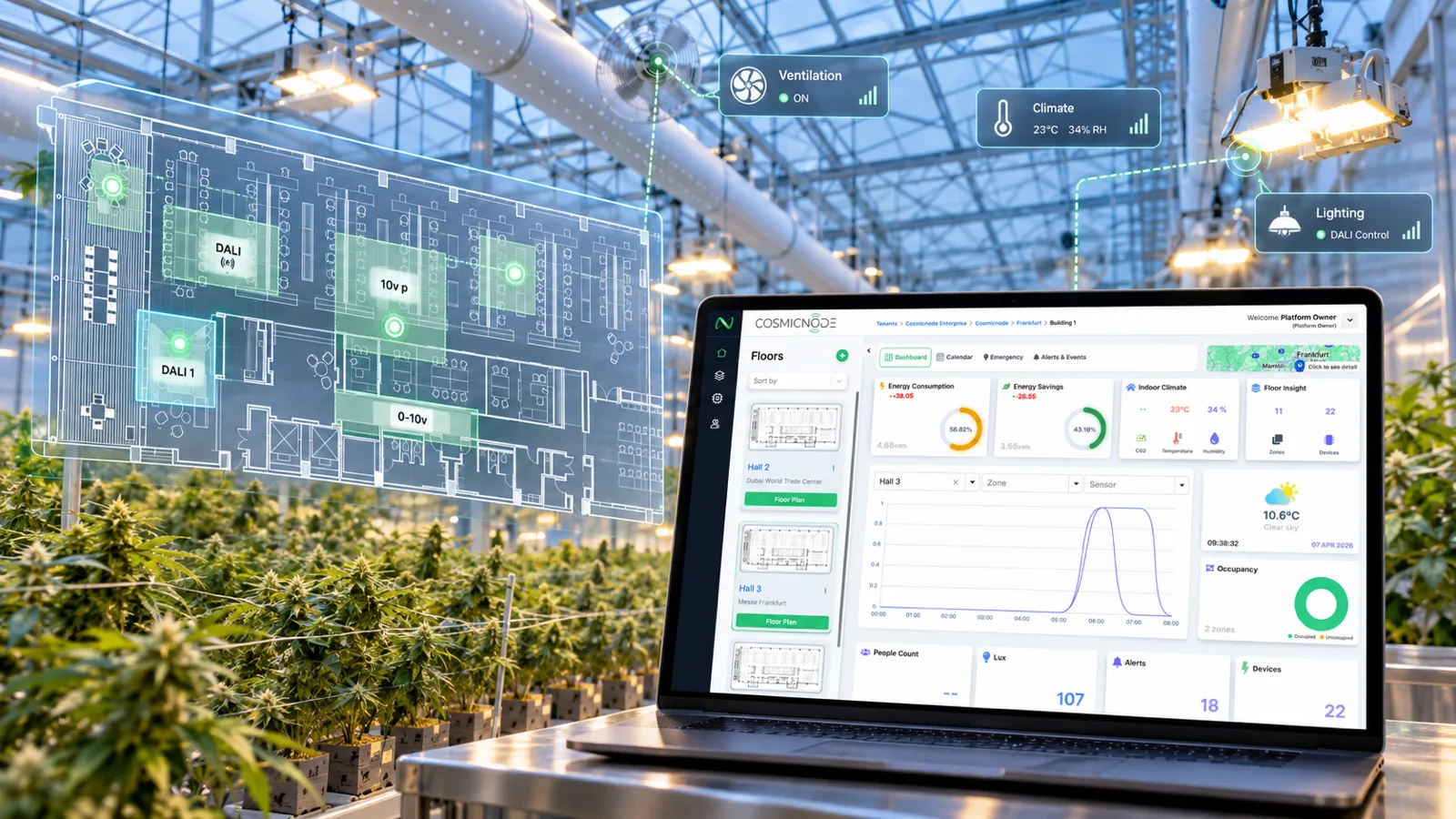
An operator can navigate from a whole portfolio down to a single lighting zone, with floor-plan visualization of where everything is.
Central control and real-time monitoring. From one place, operators control lighting — on/off, dimming, zoning, scheduling and multi-channel spectrum — commission devices, and monitor live state, faults and alerts across the entire deployment.
A real-time data pipeline. Devices publish over MQTT (Mosquitto); Telegraf collects the stream into InfluxDB for time-series storage; Grafana turns it into dashboards; and AWS WebSocket carries live, bidirectional updates. Lambda functions aggregate the time-series and archive it to S3.
Dashboards and analytics beyond lighting. Energy dashboards, occupancy and environmental information, reports and metrics, alerts and fault monitoring — turning a lighting network into operational data for the building or greenhouse.
Integrations. REST APIs and third-party, BMS and climate-computer integrations, so Infinity fits into the systems a building or greenhouse already runs on.
A cloud-native architecture built to scale. Infinity runs on Amazon EKS (Kubernetes) with an Ambassador API gateway routing HTTP, WebSocket and MQTT, Node.js services and MongoDB — containerized and orchestrated to grow with the number of devices, sites and tenants.
Built continuously. From the first sprints through successive releases and a DevOps pipeline (EKS setup; InfluxDB, Grafana and MQTT on Kubernetes; CI/CD), Toobler has developed Infinity from 2022 to today.
A digital twin of the lighting estate
Infinity does something a monitoring dashboard doesn’t: it keeps a live digital model of the physical estate. Every fixture, sensor and zone has a digital identity; its real-time state — on or off, dimming level, energy, occupancy, environmental readings — is represented in the platform; and commands flow back the other way, from the model to the physical device. An operator can move from a customer’s whole portfolio down to a single zone on a floor plan, see what is happening there now, and change it.
That physical-world ⇄ digital-representation loop — sense, understand, act — is the connected-asset foundation a digital twin is built on. Infinity is not a simulation-based twin — it does not model or predict the physics of a space — but it is the live, controllable digital layer over a real estate that a twin needs beneath it, and it is the same direction as Toobler’s digital-twin work.
Engineering worth naming
- The software layer of IoT, not the hardware. CosmicNode makes the wireless nodes; Toobler built the platform that makes thousands of them usable — the harder, software-defined half of the problem.
- A live digital model of the physical estate. Customer / site / building / zone / fixture with floor-plan visualization, live state and control — the connected-asset foundation a digital twin is built on, and the same direction as our digital-twin work.
- Real-time, device to dashboard. MQTT → Telegraf → InfluxDB → Grafana, plus WebSocket — control and telemetry live, end to end.
- One platform, two industries. The same multi-tenant system serves greenhouse horticulture and commercial smart buildings.
Results
- Thousands of fixtures and sensors, managed as one system — controlled, monitored and automated from a single cloud platform.
- Real-time visibility and control across zones, sites and tenants, with energy, occupancy and environmental data.
- A platform that spans greenhouses and smart buildings — multi-tenant, multi-site, and integrated with the systems around it.
- A multi-year software partnership — Toobler building and evolving Infinity as CosmicNode’s software team since 2022.
What this means for IoT software
The value in a connected-device product is rarely the device — it is the software that turns thousands of them into something a person can actually operate: model the estate, control it in real time, make sense of its data, and integrate it with everything around it. Infinity is that layer for connected lighting — the software half of an IoT product, engineered on a cloud-native, real-time foundation. If you make connected hardware and need the platform that turns it into a product, talk to Toobler’s engineering team.
Related work and capabilities
- Capability
Digital Twin Solutions & Engineering Services
Twin initiatives stall at the plumbing, not the modeling. The integration, modeling and operational layer that makes a twin work — on your real data and systems.
Industrial IoT
Industrial assets produce data long before anyone can act on it. Toobler builds the software layer that connects, monitors and controls them at scale.
Proof, engineered
Case studies from Toobler — real platforms engineered across event technology, construction and digital twins. The work behind the claims.