A social events app, built end to end

- Client
- Hapzis
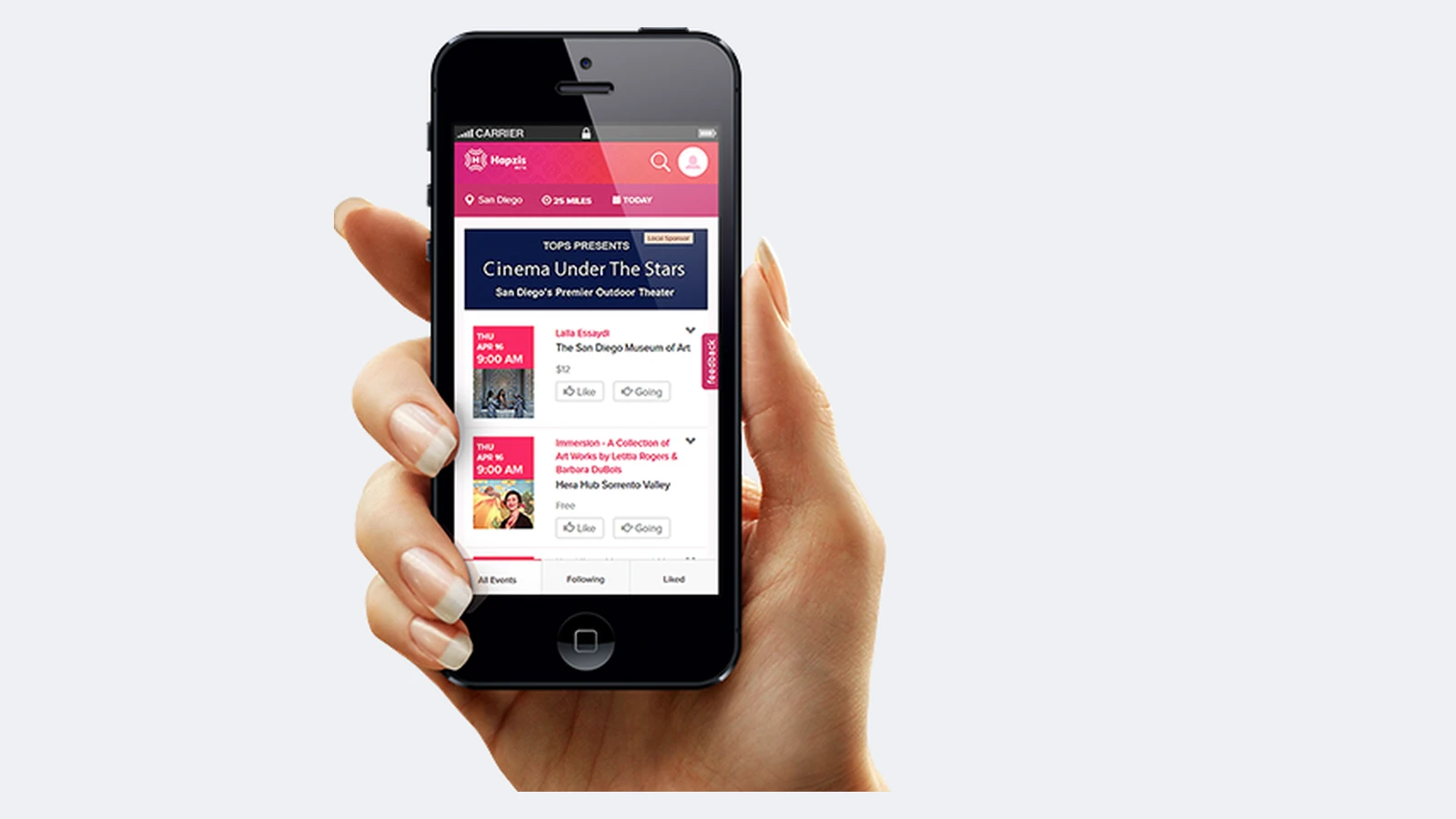
The hard part of an events app isn’t listing events — it’s helping someone find the ones they’d actually go to, near them, and bring their friends along. Hapzis set out to do exactly that: discover, follow, share and talk about local events so nothing gets missed. Toobler built it end to end — search, social, chat, maps and notifications, across the web and mobile.
Customer and context
Hapzis is a consumer social events product: browse what’s happening nearby, follow and share events, see what friends are going to, and message them about it. Toobler was the engineering partner that built the whole product — the backend and datastore, the search engine, the social and chat layers, and the web and mobile experiences.
The challenge
A social events product has to do several hard things at once:
- Finding the right event is a search problem. Lots of events, filtered by category and location — that needs real search, not an endless scroll.
- It’s social at its core. People follow friends, invite them, and want to see what those friends like and are going to — a friend graph, not just a feed.
- People want to talk about it. Real-time messaging — one-to-one and in groups — so plans actually happen.
- It has to reach people. Timely notifications and email digests to pull users back when something relevant is on.
- Every screen. A web experience plus mobile apps, on one backend that keeps them in sync.
The solution
Event discovery on Apache Solr. The core of Hapzis is event search — Toobler built discovery on Apache Solr, so users find events by category and location quickly. It was the single largest engineering area of the project, with related and recommended events surfaced on each event’s detail view.
A social friends layer. Facebook login, Facebook and Yahoo contact invites, add/remove friends, a friends list and a “following” feed that blends events a user follows with what their friends like and are going to — plus like, dislike and “going” actions on every event.
Real-time chat. A full messaging system: one-to-one and group conversations, group creation and invites, online/offline presence, multiple chat windows, and the ability to start a chat straight from an event.
Maps, notifications and digests. Map previews of event locations, push notifications through the mobile apps, and newsletter and daily-log email digests with granular unsubscribe control.
A full-stack backend, on every screen. A PHP backend with MongoDB and Redis, Solr for search, and AWS behind it, serving a responsive web app wrapped as iOS and Android web-view apps — with an admin side and scheduled jobs.
Engineering worth naming
Hapzis is a genuine full-stack consumer build: Solr-powered discovery, a real-time one-to-one and group chat system, a social friends graph wired into Facebook and Yahoo contacts, maps, push and email — delivered across web and mobile on a single backend. Most of the complexity lives in discovery and social, and that is exactly where the engineering went. A strong example of taking a founder’s concept and building the whole product, search engine and chat included.
Even though I create projects for other clients, I could not have completed this project without Toobler. They work autonomously, they have many teams to complete any project (machine learning, phonegap, native ios, php, backbone, etc) and they are tireless in their commitment to quality and client satisfaction.
Stephane Deuvaert
Founder & CEO, Hapzis
Related work and capabilities
- Industry
Event Technology
Connect event platforms, CRM, data and AI workflows without replacing your core stack. Explore Toobler's event intelligence and engineering services.
Proof, engineered
Case studies from Toobler — real platforms engineered across event technology, construction and digital twins. The work behind the claims.
SaaS Product Engineering
SaaS products outgrow the architecture that launched them. Toobler designs, builds, scales and re-platforms software products for SaaS companies, ISVs and funded startups.