A learning platform built as a path designer
A multi-academy LMS with a step-based path designer, facilitator roles, live learning, Turnitin-checked assessment and certification

- Client
- Totem
Most learning platforms are a video library with a progress bar. The one Toobler built inside Totem is a path designer: a course is a sequence of steps an author composes, a facilitator runs live, and a learner moves through — with assessment, certification and the email automation around it. It took four years and a quarter of the platform’s engineering effort.
Customer and context
Totem brings events, webinars, communities and learning together on one platform. This case study is about the learning half: the LMS that professional and association audiences use between events, where the value is not a recording but a structured program someone finishes and is certified for.
Toobler engineered it from 2020 to 2024 as part of the wider Totem engagement — around 1,400 tasks and 26 people, roughly a seventh of all the work recorded on the platform in that period.
The challenge
- A course is not a playlist. Authors needed to compose a path out of different kinds of step — video, a PDF, a download, an embed, a block of text, a quiz — not upload a file and call it a module.
- Someone has to run it. Professional learning has facilitators and course leaders, not just admins and students, and they need their own permissions, their own view, and their own tools.
- Live and self-paced in one product. A program is often a mix: work through steps in your own time, then join a scheduled live session with the rest of the cohort.
- Assessment has to be defensible. A certificate is worth something only if the assessment behind it is, which raises questions a video platform never has to answer.
- It is multi-tenant, at two levels. Many client environments, and within them many academies, each with its own courses, members and branding.
- It has to chase people. Learners stall. A platform that does not notice and prompt them produces low completion and no certificates.
The solution
A path designer, not a course uploader. Authors build a course as a path of steps, each a different type — video blocks, PDF pages with their own controls, downloads, embeds, text steps and quizzes — arranged, made mandatory or optional, and toggled for visibility. A learner’s position is tracked as the last step taken, so returning to a half-finished program resumes rather than restarts.
Facilitators as a first-class role. Course-leader roles are enforced in middleware rather than hidden in the UI, with facilitator lists, facilitator information shown to learners, and a separate view for the people running a cohort rather than taking it.
Live Learning alongside self-paced steps. Scheduled sessions with their own agenda and join flow sit inside the same course as the self-paced material, including external links out to sessions hosted elsewhere — so a blended program is one thing to a learner, not two systems.
Assessment that stands up, including Turnitin. Quizzes are editable in place, and essay assignments run through a Turnitin integration for similarity checking — the difference between a certificate that asserts attendance and one that asserts work. Certificates carry per-academy logos and are generated from the course record.
Automation per step. Email triggers are configured on individual steps, with an automation and triggers view per course, so prompting, reminders and follow-up are part of course design rather than something an administrator remembers to do.
Multi-academy tenancy. Academies sit between the client environment and the course, each with its own membership, branding and course catalog, with bulk member import, invitee management with search, and per-academy certificate branding.
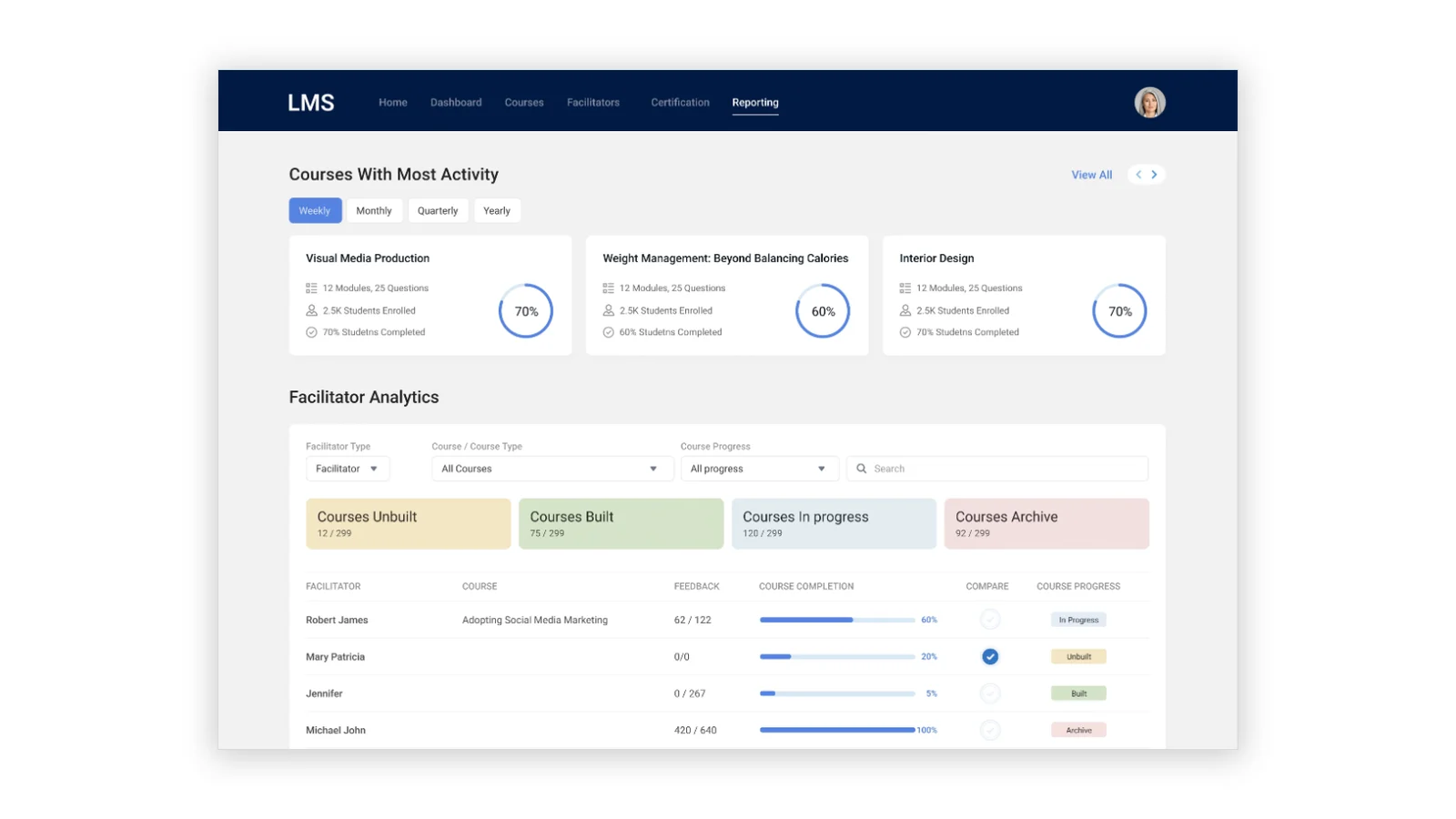
Analytics for both sides. Course analytics and user analytics, progress and last-step reporting, plus lesson and course feedback collected as multi-question steps — so a facilitator can see where a cohort stalls, not only who finished.
Built for an international audience. Arabic translation, including the right-to-left handling that comes with it, alongside configurable secondary email and mobile contact fields.
Results
The LMS shipped and kept shipping for four years, as one product surface among four on a platform that also runs events, webinars and communities — sharing its identity, membership and administration rather than bolting a separate learning tool alongside them.
What it demonstrates is the harder half of learning software. Hosting video is a solved problem; composing a program out of mixed step types, giving facilitators somewhere to stand, making an assessment defensible enough to certify, and automating the chasing that turns enrollments into completions — that is where a learning platform either earns its place in a professional organization or becomes a content folder with a login.
Related work and capabilities
- Case study Event Technology · Live Streaming · Real-time
Engineering Real-Time Audience Engagement for Live Virtual Events
How Toobler engineered low-latency streaming and near-real-time polling, Q&A and chat around OpenTok for Totem's live webinars and virtual events.
Proof, engineered
Case studies from Toobler — real platforms engineered across event technology, construction and digital twins. The work behind the claims.
SaaS Product Engineering
SaaS products outgrow the architecture that launched them. Toobler designs, builds, scales and re-platforms software products for SaaS companies, ISVs and funded startups.