A pet-services marketplace, with a community built in
A two-sided pet-services marketplace with a built-in community — owner and vendor apps, admin console and an event-driven backend
- Client
- PawSanta
Pet owners want to find a groomer they can trust, book a slot, and know when to collect their dog. Pet businesses want bookings, a way to promote themselves, and to get paid. PawSanta set out to serve both — and to give pet owners a community of their own. Toobler designed and built the whole platform: an app for pet owners, a mobile and web app for pet businesses, an admin console, and the event-driven backend that connects them.
Customer and context
PawSanta is a digital platform for pet owners, bringing pet services, products, deals and a pet-owner community into one app. On one side are pet parents and their “Pawkids”; on the other are vendors — grooming salons and other pet-care businesses, some running from outlets, some from home or on the move.
Toobler took PawSanta from UX and UI design through to a working platform, delivered in six milestones across 2020, each one advancing the parent app, the vendor apps, the admin console and the APIs together.
The challenge
- Two sides, four applications. Pet owners, vendors and platform administrators each needed their own experience — on phones for owners and vendors, on the web for vendors and admins — sharing one set of data and one set of rules.
- Pet care has its own data model. A salon that grooms small dogs is not one that handles large ones; some vendors come to your home, some collect your pet. Services, prices and availability depend on species, breed, size, location and holidays.
- Commerce and community in the same product. Bookings, payments, wallets, loyalty and deals had to sit alongside a social network, without either getting in the way of the other.
- A platform built to grow. Notifications, chat, activity tracking and analytics touch every part of the product, and needed a backend that could take on new services without rework.
The solution
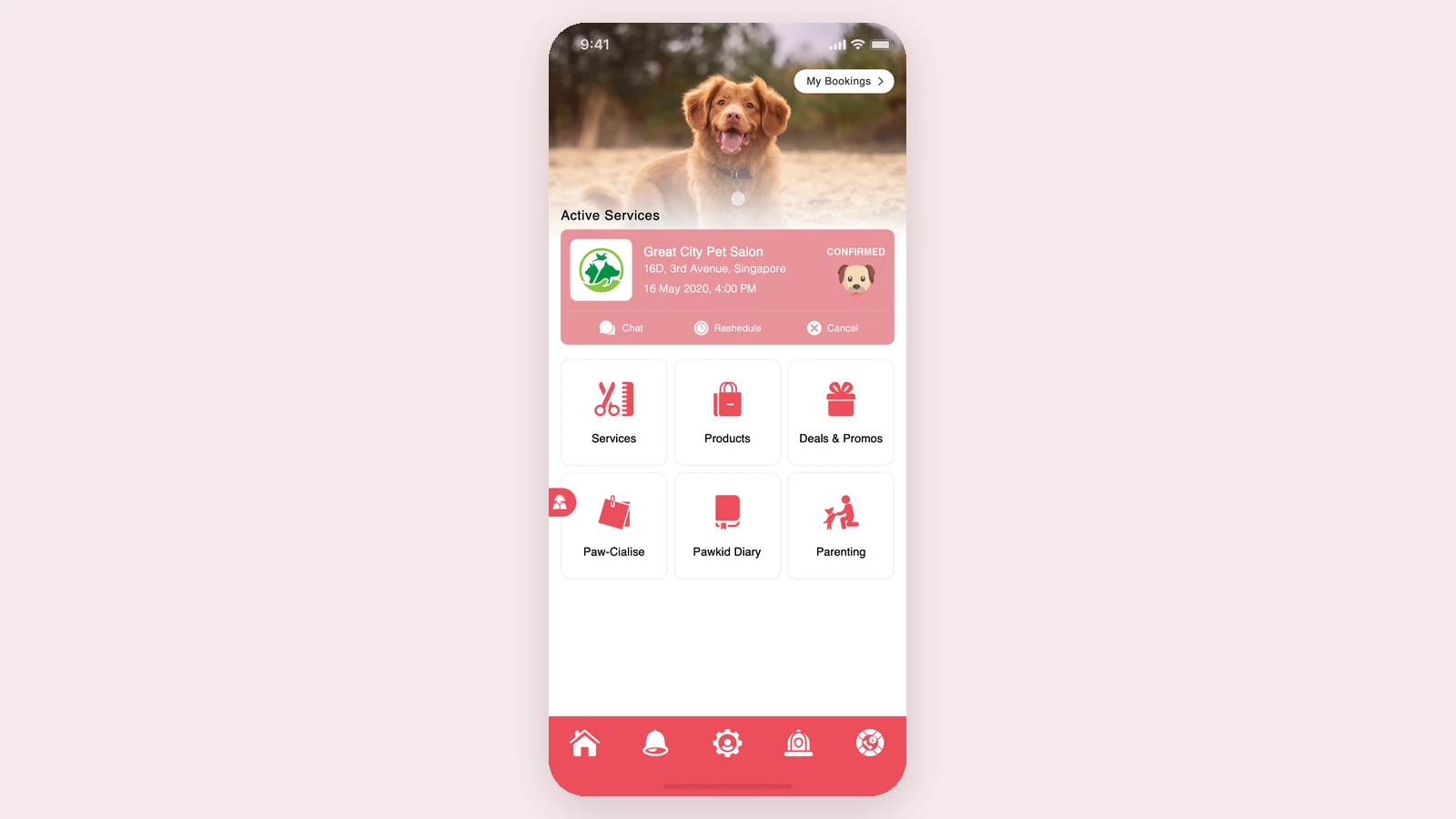
An app for pet parents. Owners sign up with a one-time code by SMS or email, or with Google, Facebook or Apple, and can log in with a fingerprint. Each pet gets a profile with photos and its own QR code for lost-and-found. The Pawkid Diary keeps monitors and a calendar of recurring events. Owners search vendors, rate and report them, book a service, apply a deal, chat with the vendor inside the booking, and keep favorites. A wallet, vouchers and loyalty rewards live under Parenting, with refer-and-earn for inviting other owners and vendors.
Apps for pet businesses. Vendors sign up as either an outlet-run or a home- or mobile-run business, and complete a profile that earns credibility badges from uploaded documents. They manage outlets — adding and cloning them, setting working hours and public holidays — and define exactly which pets they cater for, down to species, breed and size ranges. Services cover grooming packages and à la carte add-ons, home visits, and pet transport priced by zone. Staff get roles and permissions. Orders come in with chat attached, vendors can add manual bookings, rate the pet parent, and send a “ready in 15 minutes” message when a pet is nearly done. Earnings land in the Paw Pocket wallet and can be transferred out; vendors build their own deals — buy-one-get-one, bundles, an item with a free service — and track performance in business reports.
Paw-Cialise, a community inside the product. Owners and vendors share posts with photos and video, comment, like and share, add friends, follow groups with their own walls, and chat one-to-one or in groups in real time. Lost-and-found posts tie back to a pet’s QR code.
An admin console to run the marketplace. Platform administrators manage users, configuration, species and breeds, and platform deals such as introductory offers for new vendors and referral incentives; push marketing overlays into the apps; handle reports and suggestions through a communication module; and follow analytics across the platform.
An event-driven backend. The platform runs as microservices behind an API gateway, talking to each other over gRPC. Activity flows through Kafka into an enrichment service and on to Elasticsearch for tracking and analytics, and a publish-subscribe notification module drives in-app and push messages for every workflow between platform, vendors and owners. Chat runs over Socket.IO. Payments, SMS, push notifications and deep links come through established providers.
Infrastructure as part of the build. Everything runs on Kubernetes on Google Cloud, including Kafka and Elasticsearch, with separate development, staging and production environments, a CI/CD pipeline per service, monitoring, and cost optimization.
A key workflow: booking a groom
- A pet parent searches for a groomer and filters the outlets; each vendor’s listing sets out the species, breeds and sizes it caters for.
- They pick a service, apply a deal, and book; the booking is confirmed and appears in the vendor’s orders.
- Owner and vendor can chat inside the booking, sharing images if needed.
- After check-in, the vendor sends a “ready in 15 minutes” message so the owner knows when to collect.
- The owner rates the vendor, and the vendor can rate the owner in return.
Results
Across six milestones in 2020, Toobler designed and built PawSanta’s two-sided platform: a pet-owner app, mobile and web apps for pet businesses, an admin console, and a microservices backend.
What the project shows is breadth delivered in step: four applications, a social network and a marketplace advancing together milestone by milestone, on an event-driven architecture designed to take on new services as the platform grows.
Related work and capabilities
- Case study E-commerce · Marketplace
A two-sided marketplace, built for sneakers
How Toobler built ShoeperMarket — a dedicated two-sided marketplace for buying and selling shoes: Solr-powered catalog search, offers, a demand-capturing Hunt List with smart matching, and full seller and buyer flows.
- Industry
E-commerce & Marketplaces
How you sell is specific to you, and a template store makes you sell the way it was configured. Toobler builds the stores, marketplaces, catalog search, checkout and integrations commerce businesses run on.
Proof, engineered
Case studies from Toobler — real platforms engineered across event technology, construction and digital twins. The work behind the claims.