Engineering Real-Time Audience Engagement for Live Virtual Events
Low-latency live video with near-real-time polling, Q&A and chat, across 20+ client environments
- Client
- Totem
Introduction
Delivering video to a large remote audience is one problem. Letting that audience interact with a speaker in real time is a harder one. The moment a webinar’s polls, Q&A and chat fall behind the video — or the video falls behind the room — a “live” session stops feeling live: polls close before half the audience has seen the question, answers arrive after the speaker has moved on, and participation quietly drops.
Totem, the digital engagement platform built by Bridge Event Technologies Limited, needed live sessions that behaved like a room, not a broadcast. Toobler engineered the application architecture that made that possible — separating live video from real-time interaction so each could stay responsive as audiences scaled.
Context
Totem unifies events, webinars, learning and communities into one platform, and runs across 20+ client environments, each hosting multiple events. This case study concerns one capability within that platform: the live, interactive event experience — webinars and virtual sessions where speakers and large remote audiences communicate in real time. It focuses on that live-engagement engineering rather than the wider Totem platform.
The challenge
“Real time” is deceptively hard once thousands of people are connected under different conditions. The problem broke into several interlocking engineering challenges:
- Keeping video latency low. Conventional streaming can trail the presenter by tens of seconds — enough to make interaction meaningless.
- Delivering interactions in near real time. Polls, Q&A and chat had to reach every connected attendee promptly, independent of the video buffer.
- Poll simultaneity. A poll is only fair if the whole audience sees it at roughly the same moment; stragglers end up voting on a question the speaker has already left.
- Absorbing bursts. A poll launch or a lively Q&A produces a sudden spike of activity that must not degrade the video everyone is watching.
- Reliability across networks and geographies. Attendees join from different regions, bandwidths and devices, and drop and reconnect mid-session.
- Capturing engagement data without taxing the live experience. Organisers wanted live engagement insight while the event ran — without that measurement competing with delivery.
The central engineering idea
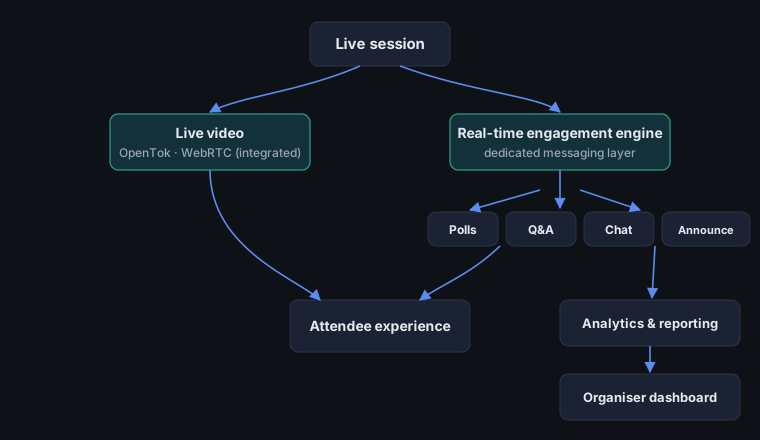
The architecture rests on one decision: live video delivery and real-time audience interaction are complementary but independently scalable services. Video travels one path; polls, Q&A, chat and announcements travel another. Neither is allowed to become the other’s bottleneck.
The solution
Low-latency video via OpenTok. Toobler integrated OpenTok’s WebRTC-based live video for the interactive sessions, giving low-latency delivery that adapts to available bandwidth and holds up across varying network conditions. Toobler did not build the underlying global video-delivery infrastructure — that is OpenTok’s — and the more valuable engineering was everything built around it.
A dedicated real-time engagement engine. Interactive features — live polls, Q&A, one-to-one chat, speaker chat, session notifications and live announcements — run on a separate real-time messaging layer, not on the video stream. Because engagement events are processed independently, attendees receive updates promptly without waiting on video synchronisation, and a surge of chat or votes places no additional load on playback.
Poll synchronisation. Organisers launch a poll during a live session; the question is broadcast to all connected attendees together, results update as votes arrive, and speakers can discuss results while voting is still open. Treating the poll as a broadcast event on the engagement layer — rather than something coupled to each viewer’s video position — is what keeps it fair at scale.
A scalable, fault-isolated event architecture. The platform supports multiple concurrent events and stages, thousands of concurrent attendees, and hundreds of simultaneous interactions per second, with engagement analytics collected continuously. The modular design isolates faults: spikes in polling or chat are contained within the engagement engine and do not reach the streaming path.
Engineering for real-world conditions
Production is not a demo. Attendees connect from different regions and bandwidths, move between sessions, and lose and regain connectivity; event-day traffic concentrates into short, intense windows. The separation of concerns is what makes these conditions survivable: because interaction state lives in the engagement engine rather than the video stream, a participant who drops and reconnects rejoins the session and its live state without disrupting others, and a burst of activity scales on the messaging layer without touching video. Speakers get audience feedback within an acceptable interaction window even as participation climbs.
A key workflow: a live poll
The clearest illustration of the architecture is a single poll:
Organiser launches the poll → the poll is created as an event on the engagement layer → connected attendees receive it in near real time → responses are submitted → responses are aggregated → live results become available to the room while voting is open → the engagement data is stored for reporting.
At no point does this path depend on the video pipeline. That independence is the point: the poll stays responsive whether ten or ten thousand people are watching.
Turning interaction into useful data
Every interaction — votes, questions, chat, attendance — is captured as an engagement event and flows to analytics and reporting, surfaced to organisers through a dashboard. Because this data is part of the wider Totem platform rather than a bolted-on tool, organisers can read live engagement during an event and carry it into post-event reporting, and it becomes part of the session’s analytics rather than an isolated feature.
Results
- Near-real-time audience engagement and highly responsive live polls, with Q&A and chat that keep pace with the speaker.
- Stable streaming during live events, and a consistent experience across devices and networks.
- Reduced dependence on separate third-party engagement tools, and lower operational complexity for organisers.
- A design proven across 20+ client environments, engineered for thousands of concurrent attendees and hundreds of interactions per second.
The improved responsiveness let organisers run genuinely participatory sessions — polls discussed as they happen, questions answered in context — rather than one-way broadcasts.
What this means for event platforms today
Live-event technology is no longer only about transmitting video. Once an audience is expected to participate, a platform has to treat streaming, real-time communication, interaction state, analytics and event-day concurrency as parts of one coordinated experience — and engineer them so that no single part can take down the others. Separating delivery from interaction, and giving each its own room to scale, is what lets a virtual session feel like a live one.
Related work
- Event media & content automation — the engineering behind live and on-demand event media.
- Event Platform Integration & AI Readiness Sprint — a scoped way to plan the integration and real-time capabilities behind an event platform.
Related work and capabilities
- Industry
Event Intelligence, Integration & Product Engineering
Connect event platforms, CRM, data and AI workflows without replacing your core stack. Explore Toobler's event intelligence and engineering services.
- Service
Event Media & Content Automation
Automate event media and content — session capture, clipping, repurposing, captioning and delivery — engineered into your platform with governed, human-reviewed AI.
- Service
Event Platform Integration & AI Readiness Sprint
Assess event platforms, data flows, CRM, manual workflows and AI opportunities. Get a practical roadmap and 90-day implementation plan.