Moving a live deals marketplace, then building what came next
A live deals marketplace migrated with data and URLs intact, then extended with a mobile app and hotel booking
- Client
- WagJag
WagJag is a Canadian daily-deals marketplace: local restaurants and experiences, events, products, travel and gifts, sold as time-limited vouchers on wagjag.com. In 2018 WagJag moved onto the codebase of a sister deals site, and Toobler’s team did the move: a full data and URL migration from WagJag’s previous commerce platform, followed by almost two years of engineering on the merged platform, a new mobile app for iOS and Android, and a hotel booking engine that sells rooms by date instead of by voucher.
Customer and context
WagJag runs deals across Canadian cities. Each deal has options, limits, a timer and a voucher that the customer redeems with the merchant, and the business depends on the full cycle working: merchants paid correctly, customers able to buy, gift and redeem, and the deals team able to launch, extend and report on deals every day.
Toobler’s work ran from April 2018 to February 2020. It started with an architecture review and migration plan, reached a final cutover on wagjag.com in February 2019, and continued with platform features, security and performance work, the mobile app and the hotel booking engine.
The challenge
- Move a live marketplace without losing anything. Customers, purchases, vouchers, merchants and deals had to move from one system’s data model to another’s, with minimal downtime.
- Keep every URL and search ranking. Years of deal pages, category pages and search URLs had to keep working or redirect cleanly, with titles, meta and canonicals matching the live site.
- Match the old site, then go further. The merged platform had to look and behave like WagJag before the deals team could ask for more.
- Money and vouchers have rules. Merchant splits, pay-on-redemption terms, credits, promo codes, gifts, taxes by province and refunds all had to stay correct across card and PayPal payments.
- High-traffic days. Newsletter campaigns and Black Friday bring sudden spikes in purchases, including several customers buying the last units of a deal at once.
The solution
A migration planned around downtime. The team compared two ways to move large tables: a Node.js serverless function that copies a table in batches and calls itself again before it times out, and EC2 instances loading many tables in parallel. Tables and columns in both systems were mapped in a set of documents that fed temporary tables, and the migration ran from those. Customer passwords moved with their hashes, so customers didn’t have to reset them. WagJag’s images and assets came off its previous platform, and the codebase was re-themed page by page (home, deal pages, cart, account, static pages, vouchers and emails) after a feature-by-feature comparison with the live site. Staging migrations ran from November 2018, and the final migration went live on wagjag.com in February 2019.
URLs and SEO carried over. The old sitemap was used to check that every URL still worked. Old search and deal URL formats redirect to the new ones. Page titles, meta descriptions, keywords and canonicals were matched to the live site, Offer, Product and Organization structured data was added, and the sitemap, robots file and 404 and 500 pages were fixed during the post-migration review.
Deals that run on rules. Deals have start and end times, timers that appear only in the final hours, flash-sale timers and a calendar view. The team can target deals to cities, rank them, mark staff picks and sort categories by recent popularity. Voucher expiry can be set to 30, 60 or 90 days from purchase or to a fixed date, redemption windows are checked, and instructions can differ per deal option. Vouchers are generated as PDFs with barcodes and emailed on purchase. Merchants get emails when their deal goes live and when it ends, and deals record their sales agent and creator.
Checkout, credits and gifts. Customers pay by card through Bambora, with saved cards and billing addresses, or with PayPal, and refunds go back through the original payment method. Tax is calculated from the billing province, and shipping applies only to products. Customers can buy for themselves or as a gift, with separate limits, gift addresses and gift emails. They can also use credits, earn referral credit and refer friends to a deal, apply promo codes, and return through abandoned-cart emails.
Merchant and affiliate logic. The platform supports both pay-on-redemption and pay-on-sale terms for merchants, with matching changes in the merchant portal. Affiliate deals send buyers to a partner site, can skip the deal page, and report visits and clicks. A channel report records events across the purchase flow, and the deals team has a revenue sheet, deal summaries, admin filters and previews of draft deals.
Fraud checks and tracking. Sift Science checks purchases on the web, in the app and on hotel bookings. SendGrid and Marketo send transactional and marketing emails, and Pepperjam, the Facebook pixel and Google Analytics e-commerce tracking measure campaigns and sales.
Security and performance under load. The team added XSS filtering, parameterized queries against SQL injection and CSRF protection on forms, fixed the findings of a penetration test, moved credentials out of the repository, and put the site behind Cloudflare and AWS WAF. Purchases are protected against race conditions when several customers buy the same stock at once. Reports and scheduled jobs run on read replicas, slow queries were rewritten, the database was resized, assets moved to S3, and a load test ran on staging. Sentry, New Relic and CloudWatch monitoring covered newsletter sends and Black Friday, and releases moved to a weekly deployment process across local, staging and production environments.
A mobile app for iOS and Android. The React Native app covers the full buying flow: deals by category and city, search with suggestions, deal pages with timers and options, cart, card payment, purchases and vouchers (view, download and redeem), favorites, Facebook login and push notifications through Firebase. The team built and documented the API behind it, with fraud checks and campaign tracking matching the website. The app went to TestFlight in December 2018, was released in September 2019 and launched in March 2020, including the 64-bit Android build.
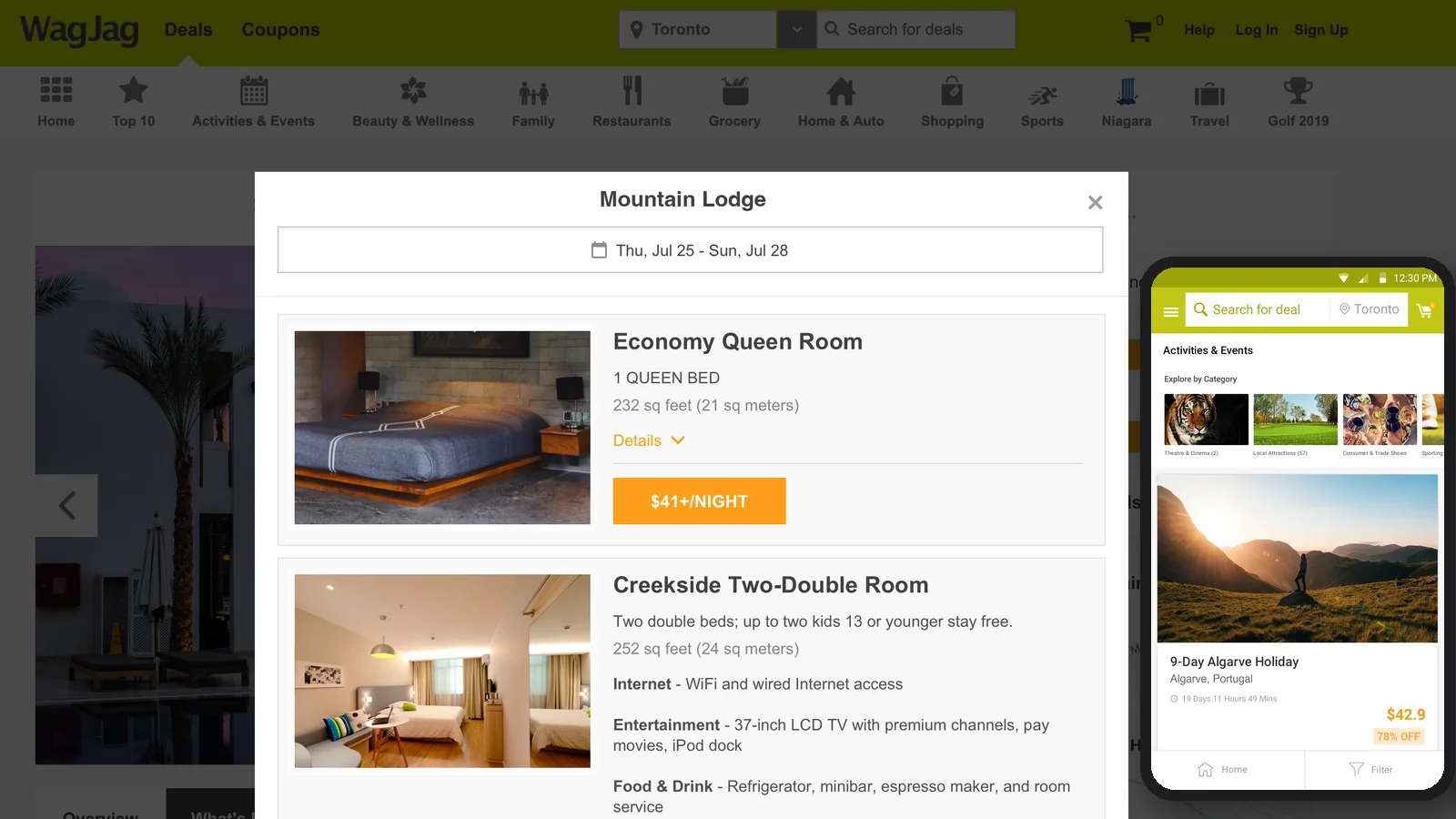
Hotel deals booked by date. For hotel deals, customers book specific nights instead of buying a voucher. Hotels send WagJag a CSV of dates, prices and rooms about three months ahead, and the deals team uploads it. The deal page then shows a Book button: the customer picks a room type, chooses dates on an availability calendar and checks out with taxes and additional fees. A separate Node.js API (Sequelize, JWT authentication and access control) manages hotels, galleries, room types, availability, bookings, payments and booking vouchers. Customers see their bookings in their account, confirmation emails go to both the customer and the hotel, and the admin handles hotels, availability uploads, calendar edits, booking resends and scheduled booking reports. The hotel API and its database were set up in production in November 2019.
Search moved to Elastic. Search moved from Sphinx to Elastic App Search, with indexes updated whenever a deal is saved, a full reindex every 24 hours, and search across deals on the site and deals and customers in the admin.
A key workflow: a hotel deal from CSV to booking
- A hotel sends WagJag a CSV of room types, dates, prices and availability for the next three months.
- The deals team uploads it in the admin and checks the availability calendar.
- A customer opens the deal, chooses a room type and picks dates from the calendar.
- They check out with taxes and fees calculated, and Sift checks the payment.
- The booking appears in their account, and confirmation emails go to the customer and the hotel.
Engineering worth naming
- Migration designed for minimal downtime. Serverless and parallel EC2 approaches were tested before committing, and the migration ran from documented table and column mappings.
- URL and SEO parity. Old URLs were preserved or redirected, and metadata was matched to the live site.
- Commerce rules in one place. Voucher expiry, limits, gifts, credits, promo codes, taxes and merchant payment terms work across web, app and hotel bookings.
- Built for spikes. Race-condition handling, read replicas, WAF and monitoring for campaign days.
- A second product on the same platform. Hotel booking added date-based inventory alongside voucher deals.
Results
Toobler migrated WagJag’s marketplace onto a new codebase with its data and URLs intact, went live on wagjag.com in February 2019, and then extended the platform with deal, voucher, payment, gifting and affiliate features, security and performance work, a React Native app for iOS and Android, a hotel booking engine and Elastic search.
For any marketplace moving to a new platform, WagJag shows what to protect: customer accounts, money and vouchers, and the URLs that search engines already know.
Related work and capabilities
- Industry
E-commerce & Marketplaces
How you sell is specific to you, and a template store makes you sell the way it was configured. Toobler builds the stores, marketplaces, catalog search, checkout and integrations commerce businesses run on.
- Case study E-commerce · Marketplace · Cloud
Furniture from the stores near you, in one checkout
How Toobler built Couch Compare, a US furniture marketplace with ZIP-based search, one checkout across local stores and per-store fulfillment.
Proof, engineered
Case studies from Toobler — real platforms engineered across event technology, construction and digital twins. The work behind the claims.