Every post on a WordPress site, audited in one place
A SaaS that audits, monitors, scores and fixes website content for SEO, with competitive NLP scoring, a WordPress plugin, teams and subscription billing
- Client
- PostGuide
A content site with a few hundred posts hides a lot of problems: broken links, copied paragraphs, posts competing for the same keyword, pages search engines can’t crawl, images without alt text. Finding them usually means a pile of separate tools and a spreadsheet, and fixing them means going back into the CMS one post at a time. PostGuide puts the finding and the fixing in one place. Toobler built PostGuide from a proof of concept to a subscription SaaS: the web app, the services that crawl, check and score every post, and the WordPress plugin that writes fixes back to the site.
Customer and context
PostGuide is a SaaS platform for checking and improving the SEO quality of a website’s content. The core product is a standalone web app: customers register a site, PostGuide brings in its posts and pages, and every one of them is audited, monitored and scored. For WordPress sites, an optional PostGuide plugin connects the site to the app with a token and keeps the two in sync both ways, so a fix made in PostGuide lands in WordPress without copying and pasting.
Toobler worked with PostGuide from April 2022 to January 2024, in twelve milestones. It started with wireframes and a proof of concept, then built accounts, the plugin and site connection, the post table and its checks, real-time site monitoring and team access, and later the dashboard, the content editor, subscriptions and scoring. By the end, the platform ran as more than eight independently deployable services in JavaScript, Python and PHP.
The challenge
- One view of a whole site. Every post and page, with its keyword, author, links, status and problems, had to live in a single table that stays fast and usable as sites grow.
- Checks that need the wider web. Plagiarism and search ranking can’t be judged from the site alone. They need searches and comparisons against other pages, run in the background.
- Heavy analysis without a slow app. Scoring a post means fetching the top-ranking pages for its keyword and running language analysis on each of them. That work is slow and costly, and the app had to stay responsive while it happened.
- Search checks that keep running. Search engines rate-limit automated lookups, so the checks that depend on them needed a fallback rather than failing outright.
- Two-way with WordPress. Customers wanted to fix things, not just find them, so changes made in PostGuide had to be written safely back to WordPress.
- A product to sell. Teams, roles, plans, billing and limits by plan had to be built in, not bolted on.
The solution
A platform built from services. A React web app talks to a Node.js core API, which owns sites, posts, projects, teams, roles, invitations and subscriptions, and stores them in PostgreSQL. Anything slow is handed off: the API publishes jobs over MQTT to a set of Python services, which share work through Redis queues. When a job finishes, a dedicated Socket.IO hub pushes the result to the right customer’s browser, routed by site and project. Posts are indexed in Elasticsearch for full-text search. Every service ships in its own Docker container and runs on Kubernetes, with a CI/CD pipeline per service.
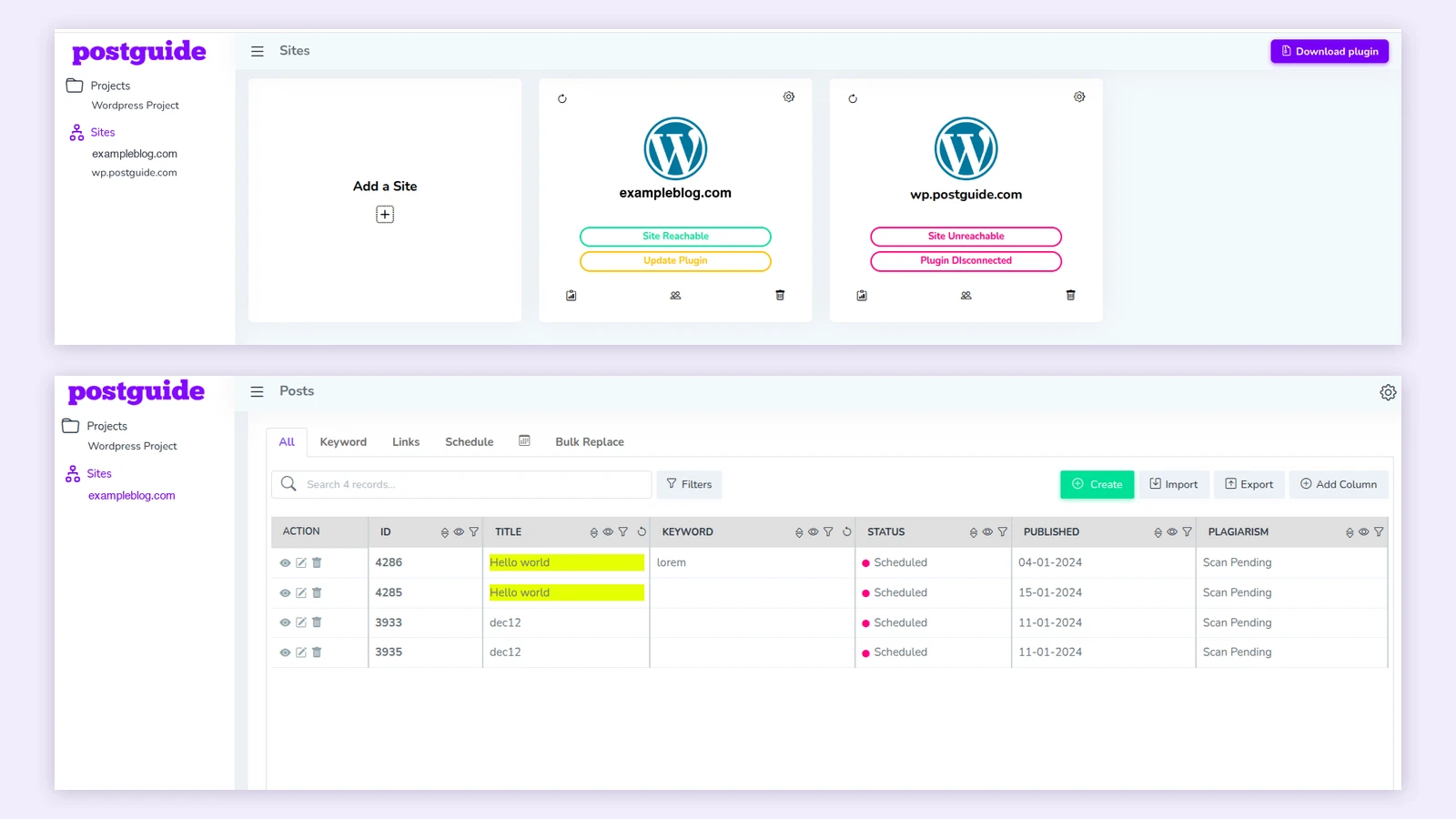
Connecting a site. Customers register a site in the web app. On WordPress, they install the PostGuide plugin with the token the app gives them, and the plugin sends posts and pages to PostGuide and keeps them in sync. The app reads the target keyword set in Yoast or Rank Math, along with title, URL, author, category, tags, word count, status and dates. Sites can be refreshed, disconnected and reconnected, and the app tracks which plugin version each site runs.
A post table built for content work. Every post sits in one sortable, searchable grid, with filters on every column, columns that can be added, hidden, resized and rearranged, a frozen header, and CSV export and import. Each post has a detail view showing its headings, paragraphs, images and links. Columns cover alt text, H1 tags, response time and affiliate links, and tracker columns let customers follow their own data. An editorial calendar schedules content, and projects group sites and posts for a team.
Checks on every post, in the background. Separate services parse each post’s structure (headings, paragraphs, images and links), map inbound and outbound links, flag broken ones, and index the content for search. PostGuide also flags:
- plagiarism, by splitting each post into short passages, searching for them on the web, and comparing the pages it finds, with an email alert when a post scores high;
- crawlability, using the site’s robots.txt and each page’s HTTP status;
- duplicate posts and duplicate keywords, and posts whose URL slug doesn’t match their target keyword.
Scoring against the competition, not keyword counts. The PostGuide Score rates a post from 0 to 100. A scoring service fetches the top-ranking pages for the post’s keyword with a headless browser and breaks each one into its elements: headings, paragraphs, images, links, tables and lists. It runs Google Cloud Natural Language entity analysis on every element, weights each page by its ranking position, and benchmarks structure such as word count and the number of headings, images and links. The result is a score plus entity-level recommendations: which topics the post is missing, and where. Scores also work for projects, content planned in PostGuide before it exists on a site.
Ranking and search checks that degrade gracefully. A keyword tracker records where each published post ranks for its target keyword, by country, on a schedule, with history kept in PostgreSQL and Google BigQuery for trend analysis. Search lookups for ranking and plagiarism run in parallel headless browsers, with a managed scraping service as an automatic fallback when lookups are rate-limited.
Live site monitoring. PostGuide checks every site every five minutes. Each monitoring worker handles up to 50 sites, and more workers start as the customer base grows. Status changes reach the app in real time, with notifications. A site dashboard shows response times, publishing activity, post counts by status, word counts, images and alt text, link totals, problems found and posts per author. Response times first went into InfluxDB and were later moved into PostgreSQL with hourly, daily and monthly rollups.
Fixing things from the app. Customers can edit titles, authors, categories, tags, keywords, status and dates in the table and have the changes written to WordPress, with undo for the last change in each column. A bulk change tool finds and replaces text across posts, titles and links. A rich-text content editor writes drafts back through the plugin, and the calendar schedules them.
Teams, plans and billing. Accounts use Auth0, with two-factor authentication and login history. Site owners invite team members and give them roles and site-level access. Subscriptions run on Paddle, with plans, invoices, plan changes, coupons and referral codes, and limits by plan on sites, posts, checks, tracker columns, projects and editors. A super-admin area gives the PostGuide team a view of customers, sign-ups, sessions and revenue. APIs are protected by token validation, role checks, and XSS and CSRF safeguards, and are documented with Swagger.
A key workflow: auditing a newly connected site
- A customer adds their site in PostGuide and installs the PostGuide plugin with the token it gives them.
- Their posts and pages appear in the post table, each with its target keyword from Yoast or Rank Math, author, status and word count.
- Background jobs start: each post’s structure is parsed, links are mapped and checked, passages are checked for plagiarism, content is indexed for search, and five-minute site monitoring begins.
- The customer filters the table to the posts with problems, fixes titles and keywords inline, and uses the bulk change tool to update an old link across every post.
- The changes are written back to WordPress through the plugin, and the dashboard and PostGuide Score track the site over time.
A key workflow: scoring a post against the competition
- A customer writes or imports a post targeting a keyword.
- The core API publishes a scoring job over MQTT.
- The scoring service fetches the top-ranking pages for that keyword and breaks each into its elements.
- Entity analysis runs on every element, and pages that rank higher carry more weight.
- The result returns to the API, and the PostGuide Score and its recommendations appear in the customer’s browser in real time.
Engineering worth naming
- A plugin and an app that stay in sync. Token-based site connection, a webhook for incoming posts and safe write-back keep WordPress and PostGuide consistent.
- Heavy work kept off the request path. Parsing, link checks, plagiarism, indexing and scoring run as jobs dispatched over MQTT and Redis queues, so the post table stays fast while the work happens.
- Scoring by meaning, not keyword density. Entity analysis across the top-ranking pages, weighted by position, catches topic gaps that counting keywords misses.
- Checks that degrade gracefully. Parallel browsers with a managed fallback keep ranking and plagiarism checks running when lookups are limited.
- Real-time status at scale. Monitoring workers that scale in batches of 50 sites, plus websockets, show customers when a site goes down without a page refresh.
- Built to be sold. Roles, invitations, Paddle subscriptions, limits by plan and a super-admin view were part of the product from the start.
Results
Over twelve milestones, Toobler took PostGuide from a proof of concept to a subscription SaaS: a web app that audits, monitors and scores every post, NLP-based competitive scoring, a WordPress plugin that writes fixes back to the site, and the accounts, teams and billing that make it a product, running as containerized services on Kubernetes.
For any SaaS built on top of another platform, PostGuide shows the shape of the work: a reliable connection to that platform, heavy processing kept in the background, external checks that fail over instead of failing, and the commercial plumbing built in from the start.
Related work and capabilities
- Case study SaaS Product Engineering · Mobile
From website builder to all-in-one SaaS platform
How Toobler engineered GoSite's all-in-one SaaS platform for local service businesses — a no-code website builder, unified CRM/booking/payments/reviews/messaging, native mobile, on a serverless AWS stack — over six years.
Proof, engineered
Case studies from Toobler — real platforms engineered across event technology, construction and digital twins. The work behind the claims.
SaaS Product Engineering
SaaS products outgrow the architecture that launched them. Toobler designs, builds, scales and re-platforms software products for SaaS companies, ISVs and funded startups.