For commercial & QS teams
Forecast construction cost, not just report it
Cost reporting tells you what already happened. Commercial, project and operations leaders need the variance before it reaches the numbers. Toobler engineers construction cost-intelligence platforms that forecast spend and reconcile it against value (CVR) — built on your project data, a structured model and macro-economic signals, not sold as off-the-shelf estimating software.
The Problem
Why Construction Cost Control Still Lags the Work
Commercial and project teams are managing risk on cost data that arrives too late and reflects too little of what actually moves it.
-
Budget vs actual, reported in arrears
Most construction cost management software surfaces variance only after the reporting cycle closes — once the number is fixed and the crew has moved on.
-
CVR reconciliation still runs manually
Cost Value Reconciliation is often stitched together in spreadsheets project by project, leaving commercial teams to reconcile cost against value by hand every month.
-
Forecasts ignore the macro-economic drivers
Interest rates, and material and fuel prices move project cost long before a variance report does — yet most construction project cost management software tracks history, not the external signals that shift it.
Approach
How Toobler Engineers Construction Cost Forecasting
Toobler builds the cost-intelligence layer directly on your project data — a structured cost model, automated CVR and forecasting tuned to the conditions that actually move construction cost.
- 01
Structured cost model
We model contract values, variations, categories and monthly expenditure against your chart of accounts and project types, so cost data has one consistent structure to report and forecast from.
- 02
Automated cost/value reconciliation
CVR runs against live project and financial data rather than a rebuilt spreadsheet, so commercial teams see cost against value continuously, not at month-end.
- 03
ML expense forecasting on macro-economic signals
Time-series forecasting models trained on macro-economic indicators — interest rates, and material and fuel prices — project likely cost movement ahead of the reporting cycle, surfaced directly in the project manager's view.
Delivery Record
Built and Proven on a Live Construction Operations Platform
- 01 — The brief
A construction and contracting group needed cost visibility that moved ahead of the reporting cycle — monthly actuals reconciled against prediction, and expenditure forecast against the market conditions that actually move it, not just internal history.
- 02 — What we engineered
Toobler engineered monthly project cost prediction and actuals tracking, a Cost Value Reconciliation service by project type, and a machine-learning forecasting pipeline — preprocessing, model training, retraining and an API — built on macro-economic features including interbank rates and material and fuel prices, delivered alongside the operations and workforce platform surrounding it.
- 03 — What it changed
The outcome is a cost-intelligence capability engineered into the client's own operations platform — not a license to a generic estimating tool — giving commercial and project leaders a forecast view ahead of the standard cost report.
Why Custom
Custom-Built Cost Intelligence, Not Off-the-Shelf Software
Toobler engineers construction estimating and cost-forecasting capability into the systems you already run, rather than selling a fixed construction management software platform.
-
Built on your project data
Your chart of accounts, contract structures and project types define the model — not a vendor's generic template.
-
Integrated with the systems you run
Cost intelligence connects to your existing project management, finance and field systems, extending what you have rather than replacing it.
-
Engineered, supported and evolved
Toobler's product engineering and managed operations teams build, support and extend the platform as your portfolio, contracts and markets change.
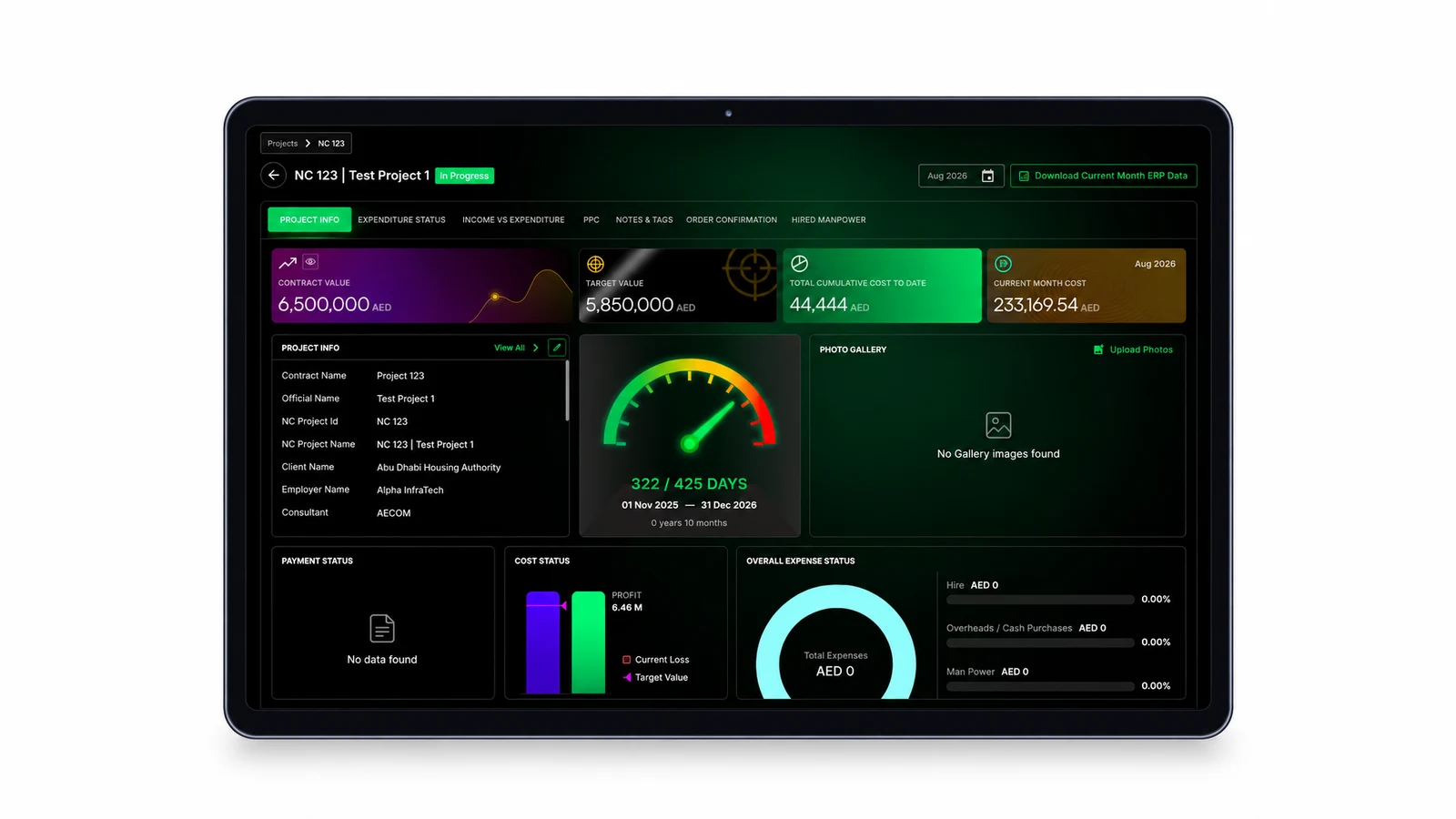
Proof, not promises
NaelCost intelligence, engineered for a construction group
A construction cost-management and AI expense-forecasting platform, engineered on the group's own project data
How Toobler engineered a construction cost-intelligence platform for Nael — structured cost management, CVR and machine-learning expense forecasting from macro-economic signals.
Discuss the Cost-Forecasting Platform Your Projects Need
Talk to Toobler about engineering a construction cost-intelligence platform — structured cost modeling, automated CVR and forecasting tuned to macro-economic conditions — built on your project data and existing systems.