A kitchen cabinet store that prices every cabinet to size
A made-to-measure kitchen cabinet store with formula-based pricing, custom sizes and kitchen-style configuration
Buying kitchen cabinets usually means a showroom visit, a salesperson and a quote that takes days. A kitchen cabinet retailer wanted customers to do it themselves online: choose a kitchen style, pick the cabinets, set the sizes and finishes, and see the price straight away. Toobler built the store and the admin behind it, with pricing that recalculates from every measurement and material the customer chooses.
Customer and context
The client sells made-to-measure kitchen cabinets and runs showrooms and an in-house design service. Its products aren’t fixed items with fixed prices. A base cabinet can be built to different widths, heights and depths, in different materials, with different doors, hinges, drawers and finishes, and each combination costs something different.
Toobler built the platform over about six months in 2013, working in sprints that started with the admin and catalog, moved on to the shopping cart and customer accounts, and then added the configuration features that made custom cabinets possible to order online. Every sprint ran with written test cases, defect tracking and regression testing on test and staging servers.
The challenge
- Prices had to come from the product’s dimensions. A cabinet’s price depends on its size and materials, so the store couldn’t rely on a price list. It needed pricing rules that work for any size a customer enters.
- Not every cabinet is a box. Corner cabinets are shaped differently from standard ones and need more measurements to describe them and to price them.
- Lots of choices, one clear path. Style, color, door profile, edge profile, finish and packaging all had to be selectable without overwhelming a customer who just wants a kitchen.
- The catalog had to be run by the business. Staff needed to add products, components and styles themselves, and change materials and prices without a developer.
The solution
A catalog built from components. In the admin, staff manage categories and subcategories, and the parts a cabinet is made from: cabinet types, doors, hinges, drawers, accessories and materials, with materials priced per square meter. Products are assembled from these components, with images, video and an option to allow custom sizes.
Formula-based pricing. Each cabinet type carries a formula based on width, height and depth, and the store calculates each product’s price from it. Change a dimension or a material and the price updates. Corner cabinets use seven measurements (height, left and right width, left and right depth, and left and right back) and their own pricing formula.
Custom sizes on the product itself. Where a product allows it, customers enter their own dimensions, and can add up to ten custom sizes of the same product in one order. They can also customize the door, hinges and size from the product page.
Kitchen style as the starting point. Customers begin by choosing a kitchen style. Each style has its own colors, image slider and estimated lead time, and products and door colors are mapped to it, so a customer only sees options that belong together.
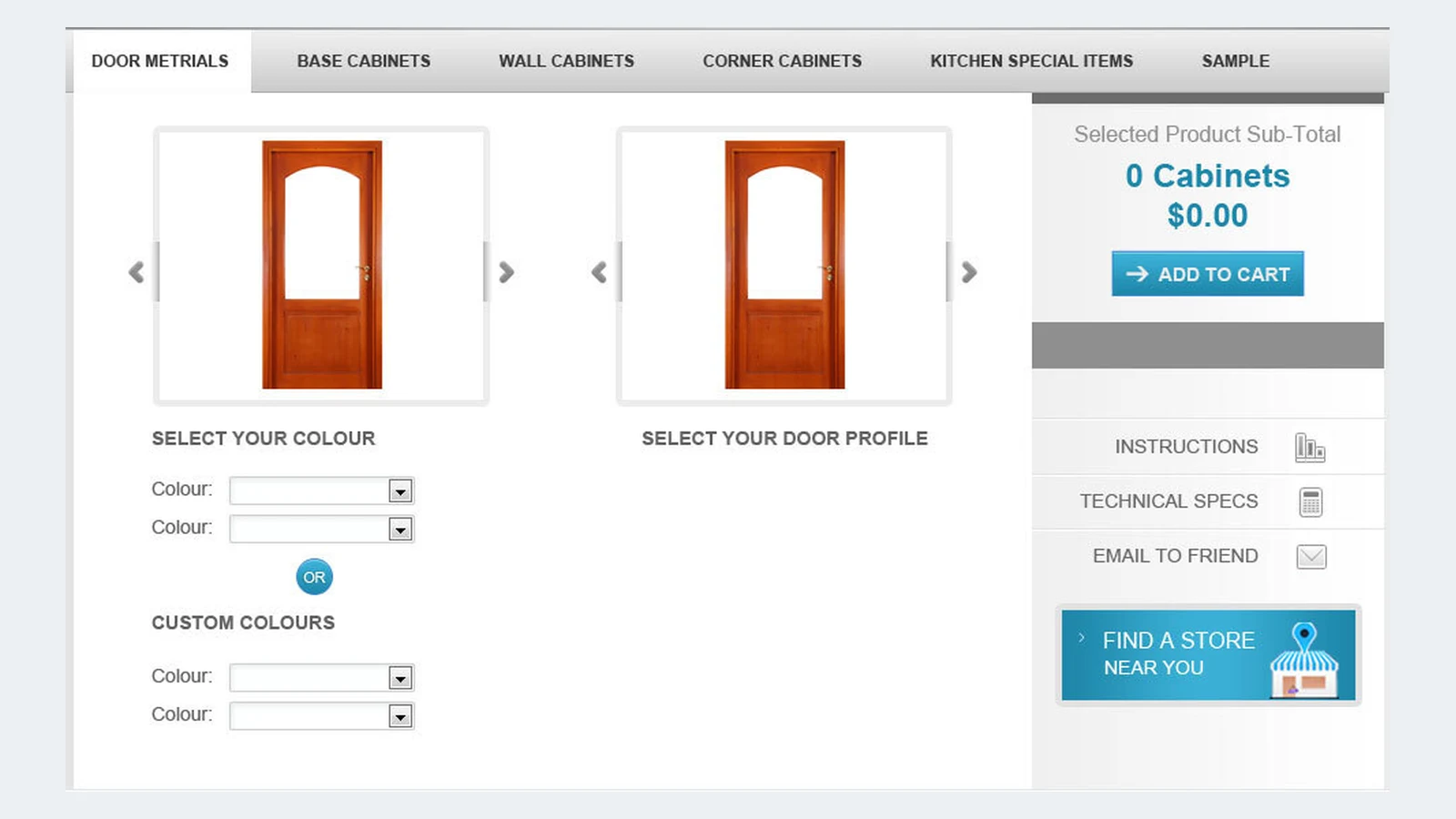
A door profile that sets the look once. In the door profile tab, the customer sets a default color, finish, edge profile and packaging for their cabinets. The image changes as they change the color, and they can enter a custom color or a Dulux paint code.
A cart that understands lead times. Guests and signed-in customers can add products, adjust quantities and see the price recalculate. The cart is kept after logout, enforces a minimum order value set by the business, and shows an estimated delivery time based on the longest lead time among the chosen styles.
Accounts, search and discovery. Customers can register, manage their account and multiple shipping addresses, keep a wishlist and see their order history. Site search covers product, category and cabinet names; product images zoom to show sides and corners; and product pages have search-friendly URLs, related products and customer testimonials.
A key workflow: ordering a custom cabinet
- The customer chooses a kitchen style, which sets the colors and lead time available.
- In the door profile tab, they set the color, finish, edge profile and packaging for their cabinets.
- They open a cabinet, enter custom width, height and depth, and adjust the door and hinges.
- The store calculates the price from the cabinet’s formula and the chosen materials.
- They add it to the cart, add more sizes or cabinets, and see the total and estimated delivery time update.
Engineering worth naming
- Pricing as rules, not a price list. Formulas per cabinet type, materials priced by area, and separate component pricing let the store price any size a customer enters.
- A data model for awkward shapes. Corner cabinets needed their own measurements and formula, handled in the same catalog and cart as standard cabinets.
- Configuration organized around the customer’s first decision. Hanging colors, doors and lead times off the kitchen style keeps a large option set manageable.
- Testing built into every sprint. Test cases were written, reviewed and run for each module, with defects tracked and regression-tested before release to staging.
Results
In six months of sprints, Toobler built the core of a made-to-measure cabinet store on Python and Django: a component-based catalog with an admin the business runs itself, formula-based pricing for standard and corner cabinets, custom sizes, kitchen-style configuration, and a cart and customer accounts that carry those choices through to checkout.
The pattern applies to any business that sells products built to order: when every item is configured, the price has to come from rules the business controls, and the store has to guide customers through the choices without losing them.
Related work and capabilities
- Case study E-commerce · Marketplace · Web
Boat Rental Marketplace: Building a Scalable Rental Platform
How Toobler designed and built HeartOcean's boat-rental marketplace: owner listings, slot-based booking, deposits and refunds, and an admin portal.
- Industry
E-commerce & Marketplaces
How you sell is specific to you, and a template store makes you sell the way it was configured. Toobler builds the stores, marketplaces, catalog search, checkout and integrations commerce businesses run on.
Proof, engineered
Case studies from Toobler — real platforms engineered across event technology, construction and digital twins. The work behind the claims.