Rewarding kindness, and turning it into donations
A social platform where rewards for kindness become charity donations, built across iOS, Android and web on Firebase
- Client
- KindStar
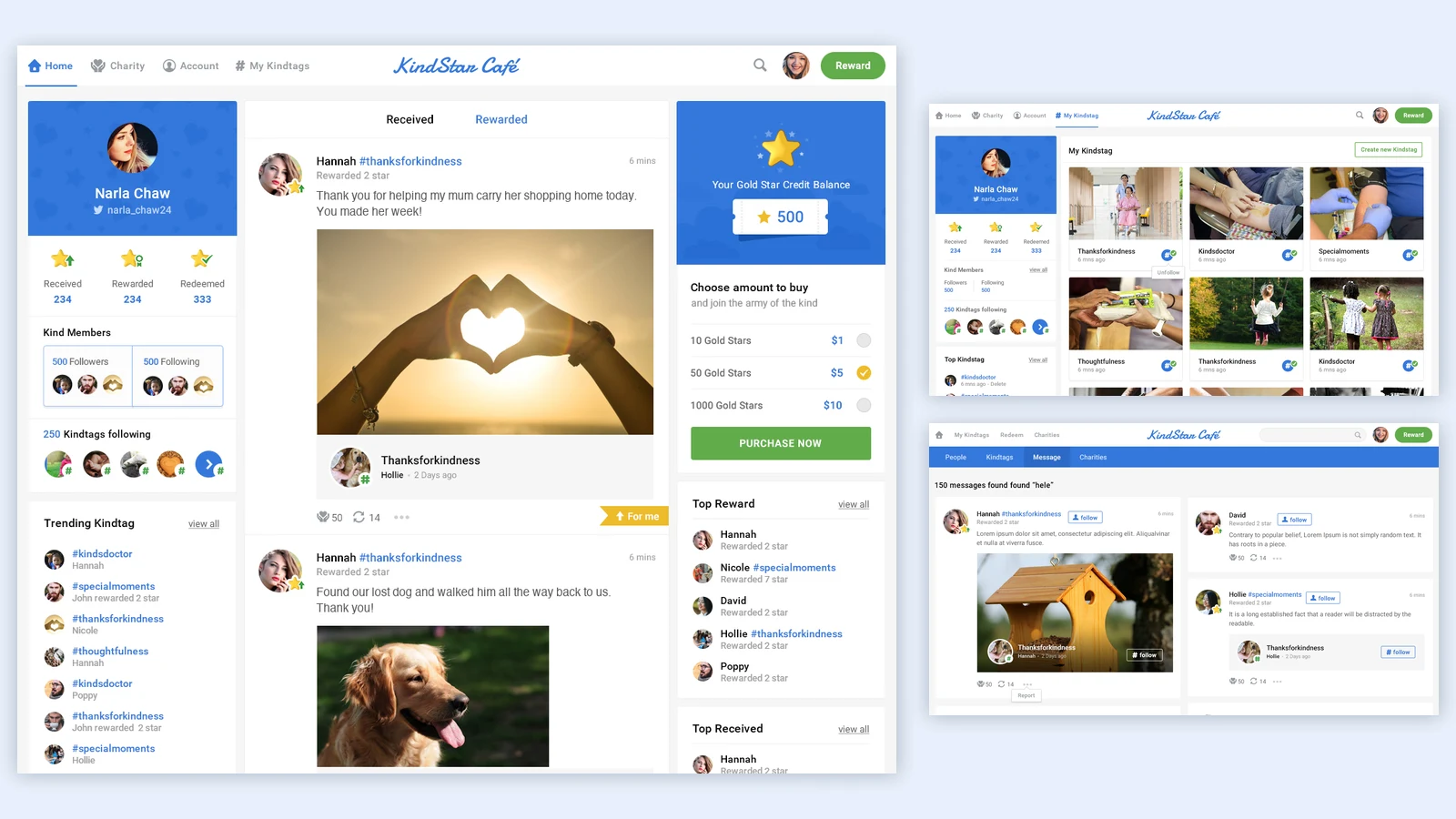
Most social apps reward attention. KindStar set out to reward kindness, and to turn it into something a charity can spend. Its members buy Gold Stars, give them to people for kind acts along with a short message, and the stars people receive are donated to a charity of their choice. Toobler built KindStar from the first mobile app in 2017 to a production platform in 2020: the iOS and Android app, the web app and the Firebase backend behind both.
Customer and context
KindStar, launched as KindStar Café, is a social platform for recognizing kindness. A member who sees someone do something kind can reward them with Gold Stars and a “kind message”, wherever that person is: on Twitter, Facebook or Instagram, in the member’s phone contacts, or at an email address or phone number. In 2017 that list also included Google+, which was one of the first networks the app could sign in with and post to. People who aren’t members yet get an invitation link, and the stars they receive end up as donations to the charity they select.
Toobler worked on KindStar for three years. The first mobile app came in 2017, followed by a website, a move to a new database, a release in 2018, a completely new user experience designed by the client, a pilot release in May 2019, and a production platform with live payments in 2020. The work ended with a handover of knowledge to KindStar’s own team.
The challenge
- A currency that has to balance. Stars are bought with real money, given away and donated. Every purchase, reward and donation has to be recorded once and only once, even when a member taps twice or two actions happen at the same moment.
- Recipients who aren’t on the platform. The person who did something kind usually isn’t a KindStar member. The app had to find them on the network they use, or reach them by email or text, and bring them in.
- Public by default, safe by design. Rewards are posted publicly, so messages had to be checked before they appeared, and members needed ways to report abuse and keep some rewards private.
- From an app to a social network. Over three years, KindStar grew from rewarding and donating into following, feeds, trending campaigns, stories and chat, while the product stayed live.
The solution
Gold Stars, from purchase to donation. Members buy stars through in-app purchase on iOS and Android and through Stripe on the web, with saved cards, top-ups and a single step to buy and reward or donate at once. Every action is logged by type (bought, received, rewarded, donated), and purchases, rewards and donations are locked while they run, so a repeated tap or a simultaneous action can’t spend the same stars twice. Node.js scripts process donations for members and charities and notify members when their stars have been donated. Later work added several currencies with exchange-rate conversion, VAT handling and donation receipts.
Rewarding anyone, wherever they are. The reward screen searches for recipients across social networks, mentions them on Twitter, or takes a contact from the phone or a typed-in email address or phone number, validating numbers before anything is sent. People who aren’t members receive an invitation by email or text with a deep link that brings them straight into the app. Before a reward is posted, a cloud function checks the message for profanity, and members can keep rewards private.
A social network built around kindness. KindStar grew into a full social platform:
- profiles, following, likes, comments, mentions and hashtags, with notifications on the web, on phones and through web push;
- “recycling” kindness by passing on a reward someone else received;
- Kindtags, hashtag-style campaigns that members create and reward through;
- a reward stream, a donation stream, trending stories and leaderboards of top givers, receivers and donors, updated on a schedule;
- photo and video stories, sharing to Twitter and Facebook, pinned messages, “Say thank you”, trusted networks, direct chat, and report abuse;
- search across members, Kindtags, messages and charities, powered by Elasticsearch.
One Firebase backend for web and mobile. The mobile app is built with Ionic and Cordova, the web app with Angular, and both run on Firebase: authentication, cloud messaging, dynamic links, analytics, crash reporting and performance monitoring, with Cloud Functions in Node.js handling triggers and scheduled jobs. In 2017–18 Toobler moved the whole product from Firebase’s original Realtime Database to Firestore, keeping its statistics in the Realtime Database.
Charities and administration. An admin console manages which charities appear, with their details and status, and charities and schools can sign up from the website.
Ready for production. Before going live with real payments, the platform was hardened: Firestore security rules and tests, authenticated APIs, OWASP ZAP security testing, stress testing, fixes for Cloud Functions cold starts, and automated tests with Katalon Studio. Live Stripe payments went in during the move to production, followed by a handover to KindStar’s team.
A key workflow: rewarding a kind act
- A member sees someone help a stranger and opens the reward screen.
- They find the person on Twitter, or enter their phone number if they aren’t on social media.
- They choose how many Gold Stars to give and write a short kind message.
- A cloud function checks the message, the stars move from one balance to the other under a lock, and the reward appears in the public stream unless it’s marked private.
- The recipient gets a notification or an invitation link; the stars they receive are later donated to their chosen charity.
Engineering worth naming
- Money-like transactions on Firebase. Locking around purchases, rewards and donations keeps balances right without a traditional transactional database.
- Reaching people off the platform. Social search, contacts, email and SMS invitations with deep links turned every reward into a way in for new members.
- A database migration with the product live. Moving web and mobile from the Realtime Database to Firestore, while keeping statistics where they performed best.
- Hardened before real money. Security rules, API authentication, penetration testing and stress testing came before live payments.
Results
Over three years, Toobler took KindStar from a first mobile app to a production platform with live payments: an iOS and Android app and a web app on one Firebase backend, a Gold Star economy that turns rewards into charity donations, and a social network built around recognizing kindness.
For any product where people move money-like value between each other, KindStar shows what the work involves: balances that can’t drift, a way to reach people who haven’t joined yet, and security in place before the payments go live.
Related work and capabilities
- Case study SaaS Product Engineering · Mobile · Social
Get-togethers organized, whether or not your friends have the app
How Toobler built SeshMe: an iPhone app for organizing get-togethers, with SMS invites anyone can answer, contact matching and group chat.
Proof, engineered
Case studies from Toobler — real platforms engineered across event technology, construction and digital twins. The work behind the claims.
SaaS Product Engineering
SaaS products outgrow the architecture that launched them. Toobler designs, builds, scales and re-platforms software products for SaaS companies, ISVs and funded startups.