A drop-in gym pass marketplace, taken over and grown
A live drop-in gym pass marketplace taken over and grown: marketplace payments, MINDBODY booking, map search and a corporate wellness offer

- Client
- GymLion
Not everyone wants a gym membership. Travelers, people trying a new class and people who train in more than one place want a day or a week, not a year. GymLion built a marketplace for exactly that: drop-in passes to gyms and fitness studios, searched on a map and bought online. Toobler took over the live product and developed it for fifteen months, adding marketplace payments, a MINDBODY integration and a corporate wellness offer.
Customer and context
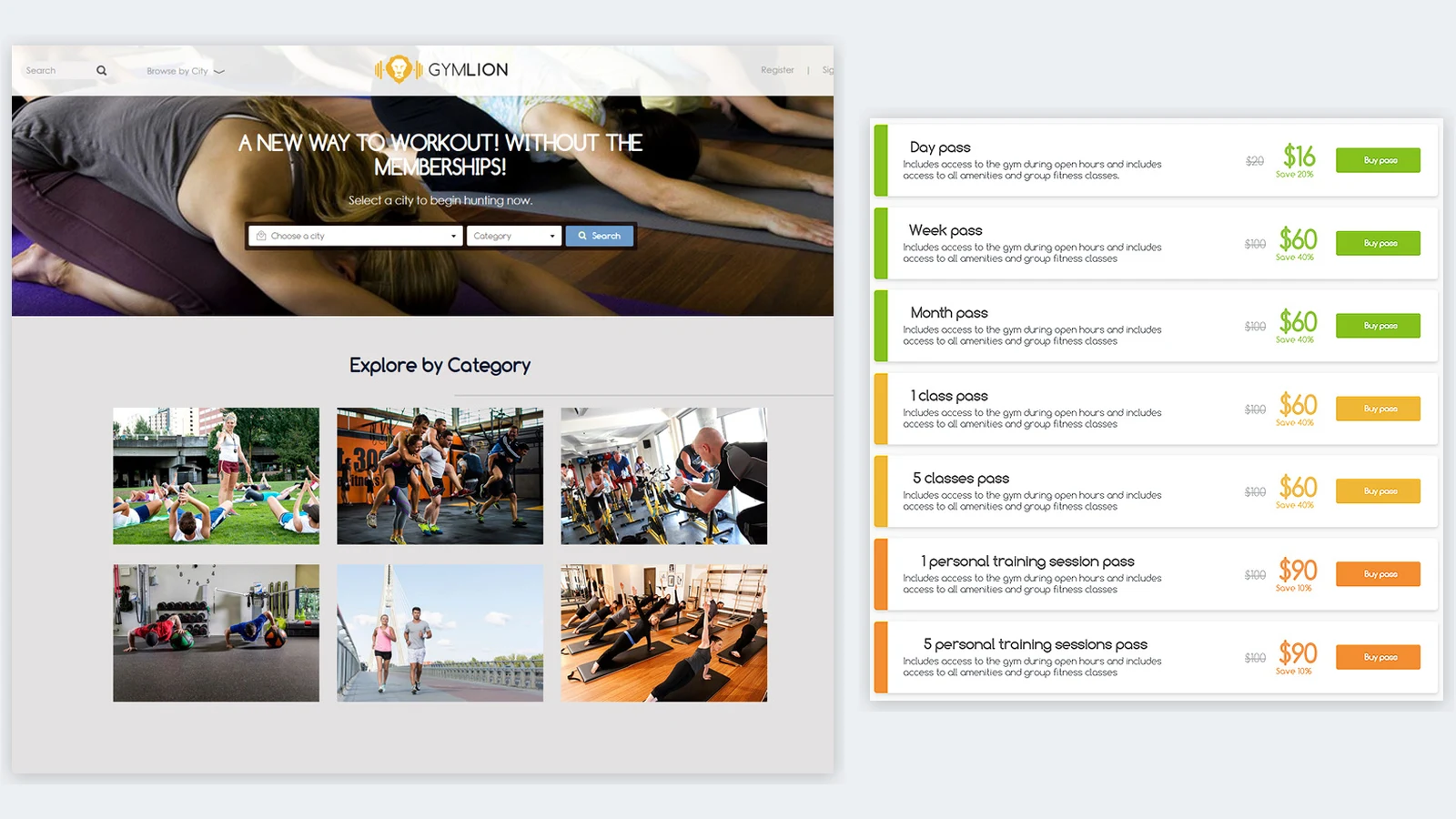
GymLion is a US marketplace for drop-in gym and fitness-studio passes. Visitors search by city, compare gyms and studios, and buy a day, week or class pass that arrives by email. Gyms and studios list themselves, set up their passes and get paid through the platform.
When Toobler joined in January 2014, GymLion was already live on Node.js and MongoDB. The work started with studying the existing code and documentation and fixing issues on the live server, then moved into continuous development with one dedicated developer working directly with GymLion’s team, through to April 2015.
The challenge
- Two kinds of customer, one checkout. Every pass sale involves a buyer and a gym. The money has to reach the right gym, with the platform’s share handled correctly, and each gym needs a way to set up how it gets paid.
- Studios already had booking systems. Many fitness studios run their classes in MINDBODY. Asking them to maintain a second schedule on GymLion wasn’t realistic, so their classes had to come from the system they already used.
- Search had to answer “where” and “how much”. People choose a drop-in gym by location, class type, amenities and price, so the search had to make all four easy at once.
- The business model was still moving. Over the engagement, GymLion added free passes, promo codes, ratings and, later, a corporate wellness offer. Each change had to land on a live site without breaking purchases.
The solution
Marketplace payments with Braintree and PayPal. Toobler implemented Braintree Marketplace, with a sub-merchant account for each gym. Gyms add their bank details, which are stored with Braintree rather than on GymLion, and can see their own transactions. PayPal payments are split between the gym, as primary receiver, and the platform. The card form was encrypted, with clear error codes and validation, and the checkout handles gyms whose bank details are still pending.
MINDBODY schedules and booking. For studios on MINDBODY, GymLion shows their live class schedules, in time order and filtered by studio location, and lets visitors book a class through a custom payment method in MINDBODY. GymLion passes appear at MINDBODY checkout, and double bookings are blocked.
Search built around the map. Results show next to a map that stays fixed while the list scrolls, with a pin and info window for each gym, and gym addresses are geocoded when a gym is added or edited. Visitors refine by class, category, amenities and pass type, and sort by price or distance, with each gym’s cheapest pass shown in the results. The search page works on tablets and phones.
Tools for gyms and studios. Gyms add their locations and passes, and can edit their listing in place on the page itself: title, description, opening times, contact details and tags. Their admin area shows activity, a table of their gyms and their transactions, and a notification when a location or pass is still missing.
Promotions, ratings and growth. GymLion can run promo codes as a percentage or a dollar amount, with a promo balance at checkout, offer free passes and track how often they’re claimed, and let visitors rate gyms with paw prints, with replies from the gym. Visitors can sign in with Facebook or Twitter and share gyms, and welcome and purchase emails go out through Mandrill, with newsletter sign-ups synced to MailChimp.
A corporate wellness offer. In late 2014, GymLion started selling to employers. Toobler added company promo codes that charge the employer’s card instead of GymLion’s, employer autocomplete and corporate-email checks at registration, a wellness homepage for signed-out visitors, and a discount option for passes.
Search visibility and measurement. A sitemap regenerated on a schedule, schema.org markup, unique titles and meta descriptions, and caching headers made gym pages easier to index. Analytics covered Google Analytics goals and events, Optimizely tests, Mixpanel funnels and several customer-support and monitoring tools.
A key workflow: buying a drop-in pass
- A visitor searches for gyms in their city and narrows the results by class type and amenities on the map.
- They sort by price, open a gym and choose a pass. If they aren’t signed in, they sign in or register and go straight back to checkout.
- They pay by card or PayPal, and can apply a promo code.
- The payment is split between the gym and GymLion, and the gym can see the transaction in its admin area.
- The pass arrives by email, and the gym gets a notification of the purchase.
Engineering worth naming
- Taking over a live product. The first job was learning code someone else wrote while keeping a site that took payments running, then building on it.
- Two-sided payments. Sub-merchant accounts per gym and split PayPal payments put the money in the right place without GymLion holding gyms’ bank details.
- Meeting studios where they are. The MINDBODY integration brought existing class schedules and bookings onto GymLion instead of asking studios to keep two systems.
- Changing the business on a live site. Free passes, promo codes, ratings and a corporate offer were added over fifteen months without stopping sales.
Results
Over fifteen months, Toobler took GymLion from the live marketplace it inherited to one with marketplace payments for every gym, MINDBODY schedules and bookings, map-based search with price and distance sorting, self-service tools for gyms, and a corporate wellness offer for employers.
For any marketplace that has outgrown its first build, the lesson is the same: the work is in learning what exists, keeping sales running, and adding the features the business needs next.
Related work and capabilities
- Case study E-commerce · Marketplace · Mobile
A pet-services marketplace, with a community built in
How Toobler designed and built PawSanta: apps for pet owners and pet businesses, an admin console, and an event-driven microservices backend.
- Industry
E-commerce & Marketplaces
How you sell is specific to you, and a template store makes you sell the way it was configured. Toobler builds the stores, marketplaces, catalog search, checkout and integrations commerce businesses run on.
Proof, engineered
Case studies from Toobler — real platforms engineered across event technology, construction and digital twins. The work behind the claims.