A week of meals, built around the person eating them
An iPhone app that turns a user's details into calorie and macro targets and a weekly meal plan, with a food API and Django admin
- Client
- FoodCoach
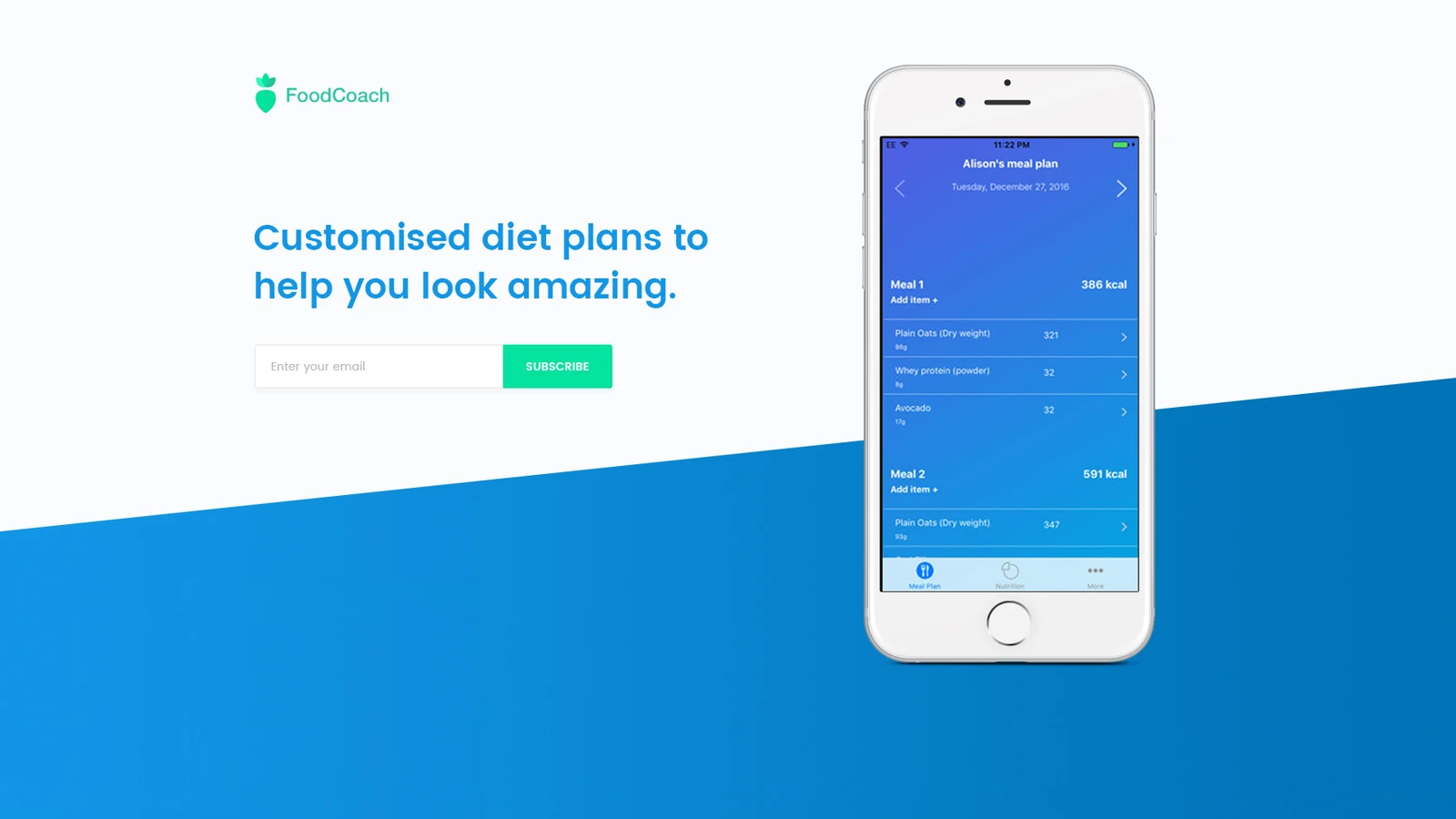
Most diet advice is generic: eat less, move more. FoodCoach wanted to give people something specific, a week of meals built around their own body, goals and tastes. Toobler built MealPlan, FoodCoach’s iPhone app that turns a few answers into a personal weekly meal plan, along with the food database and API behind it and the admin tools FoodCoach’s team used to manage the food data and publish nutrition content.
Customer and context
FoodCoach is a nutrition-coaching business. Its MealPlan app asks users about themselves, works out how many calories and how much protein, fat and carbohydrate they need, and builds a weekly plan from foods they actually like. FoodCoach’s founder wrote detailed specifications and reviewed the builds closely, down to the data model and the wording on each screen.
Toobler built the food API and admin first, in March 2016, then the iPhone app, refined through several rounds of the founder’s feedback during 2016. Later work through 2017 extended the admin with tools for FoodCoach’s website and blog.
The challenge
- A plan that fits the person. Calorie and macro targets depend on gender, age, height, weight, activity and goals, and the plan has to respect the foods each user likes and dislikes.
- Getting started without a signal. A new user who opens the app with no connection still needs to set up and see a plan.
- A data model that matches how people eat. A week of meals isn’t seven meals; it’s seven days, each with several meals, and the app’s storage had to reflect that.
- Food data the team could manage. The food database needed relationships between foods, such as what is usually eaten together, and a way for non-developers to keep it current.
- Quality that holds up to a detailed client. The founder tested the screens closely, so layout, units, keyboards and wording all had to be right.
The solution
Onboarding in four steps. After a short set of introduction screens, users enter their gender, age, height and weight, activity level and goals. Height and weight work in centimeters or inches and convert cleanly back and forth, and every value can be revisited later from settings.
Calories, macros and a weekly plan. From those details, the app calculates the user’s daily calories and macronutrients and shows them on their own tab, with an option to email them. MealPlan then builds a weekly plan from the food database, filtered by the foods the user likes and dislikes, with serving sizes they can adjust. The plan is stored as a week of seven days, each holding that day’s meals, as FoodCoach specified.
An app that works from the first launch. If there’s no internet connection the first time the app opens, it loads its foods from a file bundled with the app, so setup can carry on; when a connection is available, it downloads the latest food data. Plans and profile data are stored on the phone in a Realm database.
Built to be easy to change. Fonts, sizes and colors live in one shared configuration file; every user-facing string is ready for translation; layout constraints are clean across screen sizes; and unit tests in Xcode check the app’s calculations against FoodCoach’s own test data. The notification permission prompt was moved from first launch to a moment FoodCoach chose.
A food API and admin. Behind the app sits an authenticated API for managing and searching the food database: adding, editing and removing foods with their descriptions, categories, images and status, and searching by name and description. FoodCoach’s team works with it through an admin interface.
A Django admin for food data and content. Later admin work in Django added management of FoodCoach’s core foods, filters for the relationships between foods (what a food is always eaten with, and often eaten with), and a tool for the blog: the team picks foods and chooses which nutrition values to show (calories, fats, saturated fat, carbohydrates, protein, salt), and the admin generates a nutrition table with totals ready to publish. It also added a sitemap and a contact form for the website.
A key workflow: from first launch to a meal plan
- A new user opens MealPlan on a train with no signal; the app loads its foods from the copy bundled with it.
- They enter their details in four steps, switching their height from centimeters to inches along the way.
- MealPlan calculates their calories and macros and shows them on their own tab.
- They mark a few foods they dislike, and the app builds their week: seven days, each with its meals and serving sizes.
- Back online, the app picks up the latest food data from FoodCoach’s API.
Engineering worth naming
- Personalization from first principles. Calorie and macro targets calculated from each user’s details, then turned into a plan of real foods.
- Offline-first onboarding. A bundled food file means the first experience doesn’t depend on a connection.
- A data model that mirrors real life. Weeks of days of meals, stored on the device with Realm.
- Food data as content. The same database that feeds the app generates nutrition tables for FoodCoach’s blog.
Results
Toobler built FoodCoach’s MealPlan: an iPhone app that turns a user’s details into calorie and macro targets and a weekly meal plan of foods they like, a food API and admin behind it, and Django tools that let FoodCoach’s team manage food data and publish nutrition content.
For any consumer app built on a body of expert data, MealPlan shows the shape of the work: careful onboarding, a data model that matches how people actually live, and admin tools that let the experts keep the data, and the content, current.
Related work and capabilities
- Case study E-commerce · Marketplace · Integrations
A drop-in gym pass marketplace, taken over and grown
How Toobler took over GymLion's drop-in gym pass marketplace: Braintree and PayPal marketplace payments, MINDBODY booking and map search.
Proof, engineered
Case studies from Toobler — real platforms engineered across event technology, construction and digital twins. The work behind the claims.
SaaS Product Engineering
SaaS products outgrow the architecture that launched them. Toobler designs, builds, scales and re-platforms software products for SaaS companies, ISVs and funded startups.