Get-togethers organized, whether or not your friends have the app
An iPhone app for organizing get-togethers, with SMS invites anyone can answer, contact matching and a group chat for every gathering
- Client
- SeshMe
Planning a night out usually starts in a group text and falls apart there: someone doesn’t have the right app, someone misses the time change, and nobody knows who’s actually coming. SeshMe set out to fix that with an iPhone app built around the gathering itself. Toobler built the app, the API behind it and the web page that lets anyone respond to an invite, whether or not they have SeshMe.
Customer and context
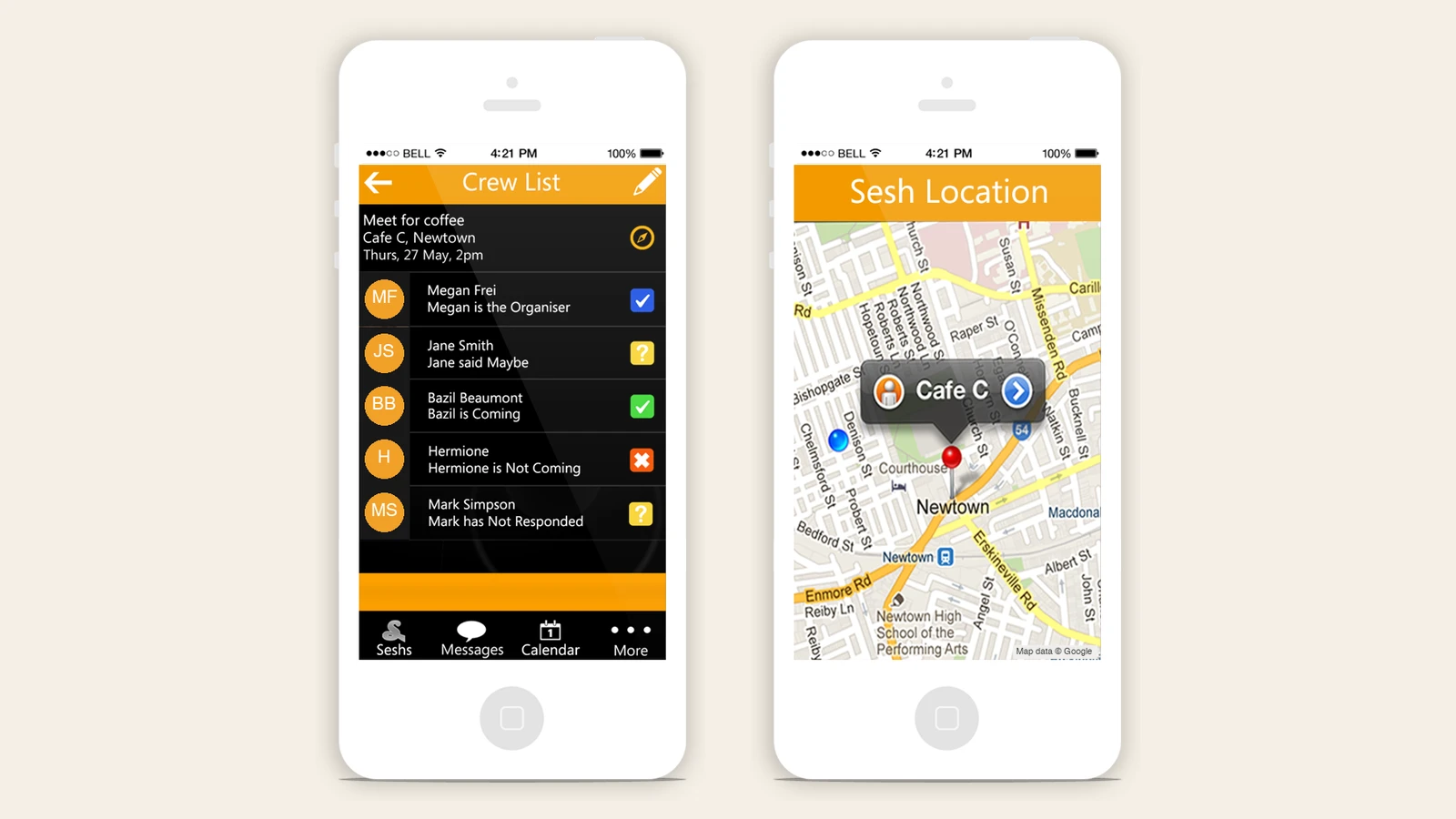
SeshMe is a mobile app for organizing get-togethers. A “Sesh” is a gathering with a time and a place, and the people invited are its “Crew”. The organizer creates a Sesh, invites the Crew from their phone contacts, and everyone talks in a group chat attached to that Sesh, with a calendar of upcoming Seshes and a map of where each one is.
SeshMe brought its own designs. Toobler built the product behind them from June 2012 to February 2013: the native iPhone app, the REST API server, and the web invite page. The work ran in short release cycles, from the first screens and an MVP through rounds of feedback from SeshMe’s own testing to version 1.4.
The challenge
- Not everyone has the app. An invitation that only reaches other SeshMe users isn’t much use for a real group of friends. People without the app had to be able to see the invite and reply.
- The phone book is the social network. Users shouldn’t have to find their friends again inside a new app. The app had to work from the contacts already on the phone, and know which of them already use SeshMe.
- Times have to be right for everyone. A Sesh time, a chat message and a web invite all have to show the right time to each person, in their own time zone.
- Chat has to feel like messaging. The group chat is where plans actually get made, so it had to behave like the messaging people already use: notifications, unread counts and familiar timestamps.
The solution
Invites that work without the app. When an organizer adds someone who doesn’t have SeshMe, the app opens an SMS invite. The link goes to a web invite page where the person enters their mobile number and replies that they’re coming, not coming or maybe, with an optional message. Their reply appears in the Sesh chat as a message saying whether they’re coming, along with anything they wrote. Every invited Crew member shares one Sesh link, and invites expire when the Sesh ends or the organizer cancels it.
Contacts as the starting point. The app reads the phone’s contacts, stores them locally and identifies which contacts already use SeshMe. Organizers build their Crew from that list, sync it when contacts change, and can add people to an existing Sesh at any time, by SMS if they aren’t on SeshMe yet.
Sign-up with a phone number. New users register with their mobile number and verify it by SMS through Twilio, which ties each account to the phone number friends already have in their contacts.
A group chat for every Sesh. Each Sesh has its own conversation, with push notifications through Apple’s notification service, unread counts on the app icon, contact photos beside each message and search across messages. Timestamps follow the iPhone’s own Messages app: the time for today, the weekday for this week, and a short date for anything older.
Times that are right everywhere. The API server stores every time in GMT, and the app and web invite page show it in each viewer’s own time zone, so the same Sesh is shown at the right local time to everyone in it.
Version 1.4. The 1.4 release added open and closed Seshes, let organizers delete Seshes they created, introduced a redesigned four-tab layout and chat screen, and handled the new contacts and calendar permissions in iOS 6. The backend moved to HTTPS on Amazon RDS and Elastic Beanstalk, and Flurry analytics tracked the actions that matter: creating a Sesh, inviting by app or SMS, responding, messaging, and opening the calendar or map.
A key workflow: inviting a friend who doesn’t have SeshMe
- The organizer creates a Sesh with a time and a place.
- They pick their Crew from their contacts; the app shows who already uses SeshMe.
- For a friend without the app, SeshMe opens an SMS with the Sesh link.
- The friend opens the link, enters their mobile number and replies “coming”, with a short message.
- The reply appears in the Sesh chat for everyone, and the invite expires once the Sesh is over.
Engineering worth naming
- Reaching people outside the app. SMS invites and a web reply page bring non-users into the conversation, and their replies land in the same chat as everyone else’s.
- Identity from the phone number. SMS verification plus contact matching means people find their friends without searching or adding them again.
- Time zones done properly. Storing times in GMT and converting for each viewer keeps the app, the chat and the web invite consistent.
- Built from feedback. Short cycles from MVP to version 1.4 turned SeshMe’s own testing into fixes and features release by release.
Results
Over eight months, Toobler took SeshMe from its designs to version 1.4: an iPhone app with Seshes, Crew lists, a calendar, a map and group chat; an API server on Amazon Web Services; and a web invite page that lets anyone reply to an invitation, app or not.
For any social app, the lesson holds: the people you most need to reach are the ones who haven’t installed it yet, so the product has to work for them too.
Related work and capabilities
- Case study SaaS Product Engineering · Mobile · Real-time
A private meetup app, built end to end
How Toobler built Scenes — a native iOS private-meetup app on a real-time Node.js backend, with a server-enforced scene lifecycle and moderation from day one.
Proof, engineered
Case studies from Toobler — real platforms engineered across event technology, construction and digital twins. The work behind the claims.
SaaS Product Engineering
SaaS products outgrow the architecture that launched them. Toobler designs, builds, scales and re-platforms software products for SaaS companies, ISVs and funded startups.