Casting calls, applications and the first conversation, in one place
A live casting platform for casting directors and talent: React Native, web and admin apps on an AWS media pipeline
- Client
- Castroo
Casting still runs on word of mouth, social media posts and inboxes full of photos. Casting directors post a role, sort through hundreds of messages, and lose track of who sent what; actors and other professionals hunt for calls across a dozen places. Castroo brings both sides into one platform. Toobler built Castroo end to end: a React Native app for iOS and Android, a web app, an admin app, and the API and media pipeline behind them.
Customer and context
Castroo is a casting platform for casting directors and production houses. Creators set up their production houses and projects, publish casting calls with the roles they need, and receive applications from professionals whose profiles match. Professionals build a profile with their photos, videos and previous work, apply to the roles that fit them, and talk to creators directly in the app.
Toobler started in September 2022 with the design and the first API, then built the API, the web app and the mobile app in parallel milestones through to the iOS and Android store builds, with testing continuing into 2024. Castroo is live across all three apps.
The challenge
- Two kinds of user, one platform. Creators and professionals need very different tools, on the phone and on the web, sharing the same profiles, projects and messages.
- Media-heavy by nature. Every profile and every application is built on photos and videos, so uploads had to be fast, consistent and cheap to serve.
- Finding the right person. A casting call might ask for a specific age, height, gender or skill; creators needed to find and filter matching talent quickly, not scroll through everyone.
- Conversations that stay on track. Casting happens in messages, so chat had to connect to the project and role it’s about, and let either side block unwanted contact.
- Trust on both sides. New creators needed vetting before they could reach talent, and professionals needed confidence that calls were genuine.
The solution
Profiles built for casting. Professionals sign up with Facebook, Instagram, Apple or a one-time code sent to their phone, choose their role and specialties, and build a profile with physical attributes, skills, interests and a short tagline. Their Castroo gallery holds profile photos and videos, a self-introduction video and media from past applications, and they can import photos and videos straight from Instagram and link previous work on Facebook, Instagram or YouTube.
Casting calls and projects for creators. Creators set up production houses and projects, then publish casting calls with one or more roles. Each role can specify attributes such as gender, age and height, whether photos or a video are required, and whether a self-introduction video is needed. Calls can be saved as drafts, edited, shared to Instagram and Facebook, and shown as expired when they close. Creators can invite collaborators to work on a project with them.
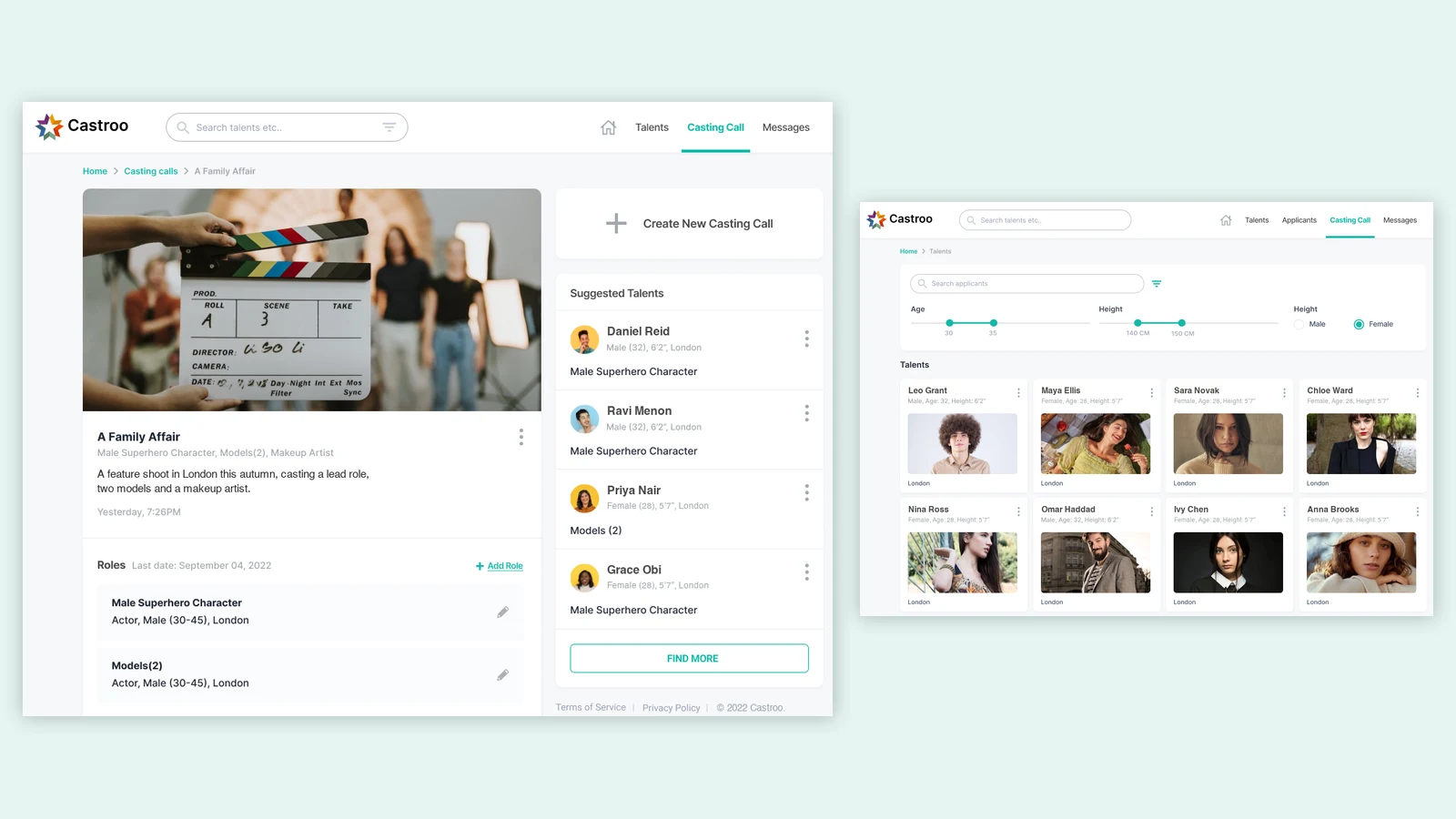
Applicants and talent search. Applications arrive grouped by role, with tabs for recent, saved and selected applicants, read and unread markers, and filters for age, gender, height and role. Creators shortlist and select applicants, see suggested talent for a role, keep favorite talent for future projects, and search all professionals with filters powered by Elasticsearch.
Applying from the phone. Professionals see featured and closing-soon casting calls on their home screen, save roles, and apply with photos, videos, a self-introduction video and links to previous work. The app warns them if their profile is incomplete or a required video is missing, checks the role’s requirements, and shows the status of each application. They can update an application after sending it.
Messaging tied to the role. Creators start conversations from the applicant list, suggested talent or a search, with the project and role attached, and professionals can accept or decline the invitation. An Apply button inside the chat takes them straight to the role. Threads show unread counts and the latest first, and either side can block the other.
Notifications. Applications, shortlists and selections, new messages, invitations and account approvals all appear as in-app notifications and push notifications through Firebase, with real-time updates over sockets.
A media pipeline on AWS. Photos and videos upload directly to Amazon S3 using signed URLs. AWS Lambda functions then create compressed thumbnails and convert videos with ffmpeg, within limits on length and size, and update each item’s status when processing finishes. Deleting media removes it from both the profile and storage.
Admin and trust. In the admin app, the Castroo team manages roles and permissions, approves or rejects new creator accounts (creators see a banner until they’re verified), and chooses featured projects. Professionals can also choose a Pro membership.
Under the hood. The API is built in Express.js with Swagger documentation and unit tests, on MongoDB, with Redis for sessions, Elasticsearch on AWS for search and scheduled jobs that keep profiles and search in sync. Socket.IO powers chat, Twilio sends one-time codes, and changes go through a staging environment before release.
A key workflow: from a casting call to a conversation
- A casting director creates a project under their production house and publishes a casting call for two roles, each with its age, height and video requirements.
- Professionals whose profiles match see the call on their home screen, marked as closing soon.
- A professional applies from the app with photos and a self-introduction video recorded on their phone; the video is converted and thumbnailed automatically.
- The casting director filters applicants by role and height, shortlists three, and starts a chat with one of them, with the role attached.
- The professional gets a push notification, accepts the chat, and confirms the details there.
Engineering worth naming
- Media handled outside the API. Direct S3 uploads and Lambda processing keep heavy photo and video work away from the app servers.
- Search built for casting. Elasticsearch filters on the attributes casting directors actually use.
- Conversations with context. Chat linked to a project and role, with invitations and blocking, keeps casting conversations focused and safe.
- Three apps, one API. The React Native app, the web app and the admin app all run on the same documented API, built milestone by milestone in parallel.
Results
Toobler took Castroo from design to a live casting platform: a React Native app for iOS and Android, a web app for casting directors and professionals, an admin app for the Castroo team, and an AWS-backed API and media pipeline that handles the photos and videos casting depends on.
For any two-sided platform built around media and matching, Castroo shows the essentials: fast, consistent media handling, search on the attributes that matter, and conversations that stay connected to the work they’re about.
Related work and capabilities
- Case study Video · Serverless
A platform for creating and sharing video
How Toobler built vidiCrew — a collaborative video-production and media platform on a serverless AWS pipeline (MediaConvert to HLS to CloudFront), with searchable galleries and web plus native iOS and Android apps.
- Case study Video · Multi-tenant
Personalized prospect videos, straight from HubSpot
How Toobler built a HubSpot-native personalized-video platform — templates merged with CRM contact data to auto-generate a personalized video and email GIF for every prospect, on a multi-tenant SaaS.
Proof, engineered
Case studies from Toobler — real platforms engineered across event technology, construction and digital twins. The work behind the claims.