A Reference Architecture for Integrating Enterprise Event Systems

Cuckoo Anna
On this page
What a reference architecture for event platform integration actually needs to solve
An event platform integration architecture is the set of data flows, identity rules and sync patterns that connect registration, CRM, ticketing, lead retrieval, engagement tools and reporting into one consistent operational picture. Without it, commercial and operations teams work from contradictory attendee, exhibitor and sponsor data spread across disconnected systems.
Most event technology stacks grow by addition: a registration platform, a separate ticketing tool, a lead-retrieval app for exhibitors, a marketing CRM, an engagement or app-analytics layer, and a reporting tool bolted on afterwards. Each was integrated on its own timeline, usually through a point-to-point webhook or a manual CSV export. The result is not a platform — it is a pile of bilateral connections with no shared identity, no shared schema and no single place to see what actually happened at an event.
This is the fragmentation problem Toobler’s Connect stage exists to solve: reliable operational information flows before anything is layered on top for reporting, intelligence or automation. Below is a working reference architecture, a canonical data model and the sync-pattern trade-offs that decide whether the integration holds up under real event-day load.
Reference architecture: five layers, one identity spine
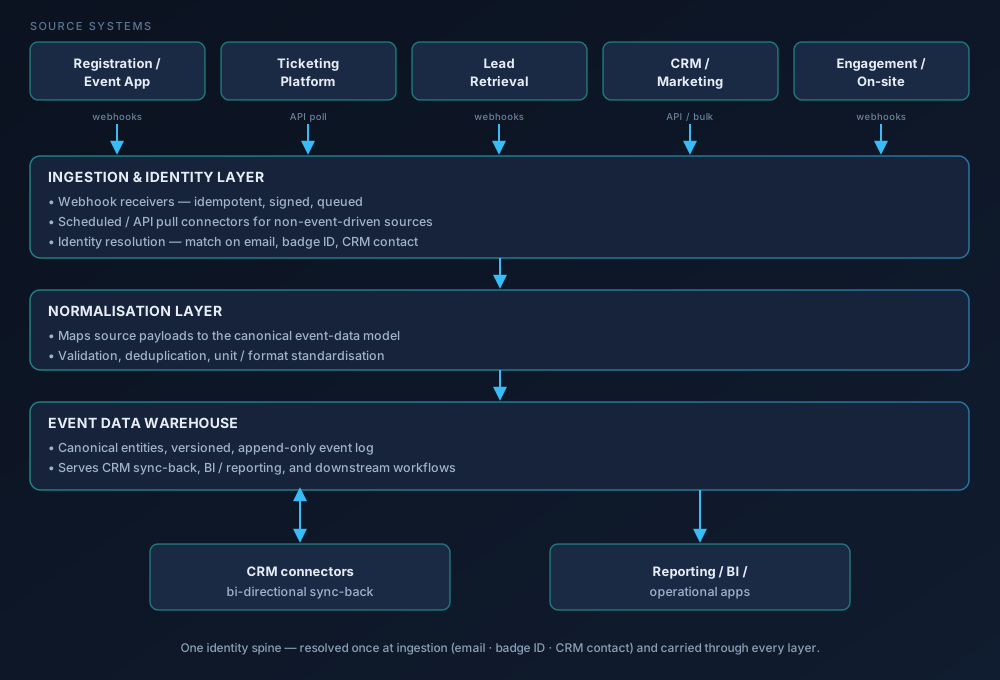
The identity spine — the rule set that decides two records refer to the same attendee, exhibitor or session — sits at the ingestion layer, not buried inside each connector. This is the single most common architectural failure in event stacks: identity logic gets duplicated (and drifts) inside every point-to-point integration instead of being owned once.
A canonical event-data model
Normalisation only works if every source maps to the same entities. A minimum viable canonical model for enterprise event data typically needs:
- Person — a unique identity record (attendee, exhibitor contact, speaker, sponsor rep) keyed on a resolved identity, not a source-system ID.
- Organisation — company or exhibitor entity, linked to CRM account records.
- Event / Session — the container entity, with start/end, location, and capacity attributes.
- Registration / Order — the commercial record: ticket type, price, channel, status.
- Engagement — discrete interaction events: session check-in, booth scan, content download, app interaction, lead capture.
- Relationship edges — person-to-organisation, person-to-session, lead-to-exhibitor — modelled explicitly rather than inferred at report time.
Every source system record is transformed into one or more of these entities during normalisation, with the original source ID retained as a foreign key. This keeps the model auditable: any canonical record can be traced back to the exact source payload that produced it.
Sync patterns: choosing webhooks, polling or batch
Not every source should be integrated the same way. The comparison below is what actually drives the decision:
| Pattern | Best for | Trade-off |
|---|---|---|
| Webhooks (push) | Time-sensitive events: check-ins, lead scans, registration confirmations | Requires idempotency handling and retry logic; a missed or duplicated webhook can silently corrupt state if not deduplicated |
| Scheduled API polling | Sources without reliable webhooks, or where near real-time isn’t required | Adds latency; risk of rate-limiting on high-volume event days |
| Bulk/batch sync | CRM master data, historical backfills, nightly reconciliation | Simplest to build, but stale between runs — unsuitable for on-site engagement data |
| Bi-directional CRM connectors | Writing enriched event data back into CRM records (lead scores, attendance status) | Needs conflict resolution rules — which system owns a field when both sides can write |
In practice, a resilient event data architecture mixes all four: webhooks for on-site engagement and check-in, polling for platforms with weak event notifications, batch sync for CRM master data, and bi-directional connectors for pushing qualified leads and attendance back into commercial systems.
Observability and error handling: the part most integrations skip
Event integrations fail hardest exactly when they matter most — during live registration surges or on-site peaks. A production-grade design needs:
- Dead-letter queues for webhooks that fail normalisation, with visibility into why (schema mismatch, missing identity match, malformed payload).
- Idempotency keys on every ingested event so retries and duplicate webhook deliveries don’t create duplicate engagement records.
- Reconciliation jobs that compare source-system counts (registrations, scans, orders) against warehouse counts on a defined cadence, flagging drift.
- Connector health dashboards showing last-successful-sync time per source, not just uptime — a connector can be “up” and still silently stop receiving webhooks.
- Backfill tooling so a connector outage during a live event can be replayed from source-system history rather than leaving a permanent gap in the canonical record.
Without this layer, integration failures surface weeks later as unexplained gaps in exhibitor lead counts or CRM records that never got attendance status — by which point the source data may no longer be recoverable.
Where this fits in a broader integration programme
This architecture is deliberately scoped to the Connect stage: identity, data flows and a canonical model that later work — reporting, operational context, or governed automation — depends on. Getting this layer right is what determines whether downstream reporting is trustworthy and whether any future automation has clean, well-identified data to act on.
If your event stack has grown into a set of point-to-point connections rather than a designed architecture, the next step is to map your event integration architecture against the model above — identifying where identity resolution is missing, where sync patterns are mismatched to the data, and where observability gaps are hiding failures before they reach reporting or CRM.
How this relates to the data model
This guide takes the architecture and systems view — the data flows, identity resolution and sync patterns that connect event platforms reliably. Its companion, event data model normalisation, covers the canonical data model itself: how attendees, sessions, sponsors and exhibitors are normalised into one schema across systems. Read them together — architecture for how data moves, the data model for what it means.
Written by
Cuckoo Anna
VP – Projects & Delivery
Cuckoo Anna leads technology delivery at Toobler, with a strategic focus on building and scaling its event technology practice — the systems behind registration, attendee engagement, sponsors, exhibitors, meetings, lead capture, reporting and integrations. She works with event businesses and event-tech platforms to connect that ecosystem, combining product engineering, AI, data and integrations to improve workflows, unlock event intelligence and extend the value of the platforms already in place.
Keep reading
- Case study
Building and Evolving an Enterprise Event Platform
See how Toobler engineered enterprise event technology across registration, sponsors, exhibitors, meetings, mobile, reporting and integrations.
- Service
Event Data & CRM Integration Services
Connect event platforms with Salesforce, HubSpot, Marketo, BI and custom systems using reliable APIs, webhooks, mapping and monitored data flows.
- Service
Event Platform Integration & AI Readiness Sprint
Assess event platforms, data flows, CRM, manual workflows and AI opportunities. Get a practical roadmap and 90-day implementation plan.